Department of Health Services Research, CAPHRI Care and Public Health Research Institute, Maastricht University, Maastricht, The Netherlands.
Cedars-Sinai Medical Center, Los Angeles, CA, USA.
Osteoporos Int. 2022 Jan;33(1):13-26. doi: 10.1007/s00198-021-06151-7. Epub 2021 Sep 24.
Two scoping reviews were conducted to review recommendations and guidelines for communication regarding general health risk, and to investigate communication strategies regarding risk of fracture. Healthcare professionals are invited to apply these recommendations to optimize a patient-centered approach to reducing risk of fracture.
To conduct a scoping review of the medical literature regarding recommendations and tools for effective communication between healthcare professionals and patients regarding general health risk and risk of fracture.
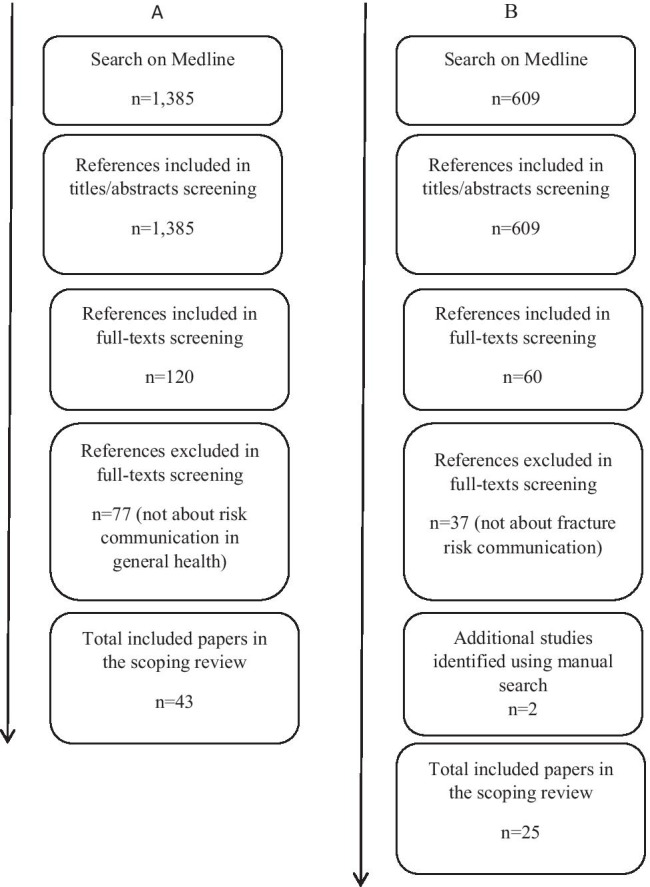
The scoping review was divided into two parts to search for (1) studies presenting recommendations and guidelines for communication regarding general health risk; (2) studies investigating communication regarding risk of fracture for individuals at risk for fractures. Medline was searched in April 2020 to identify relevant studies.
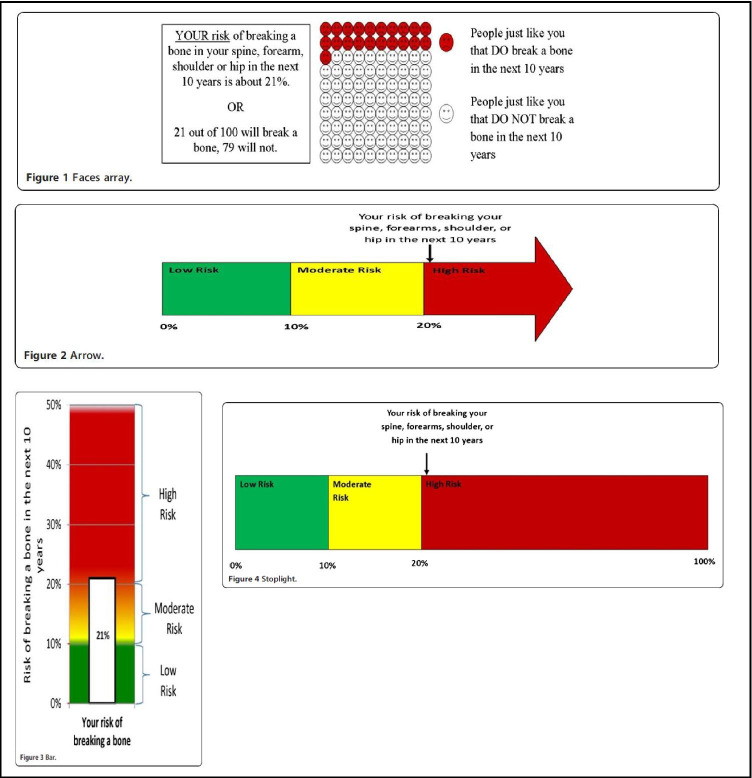
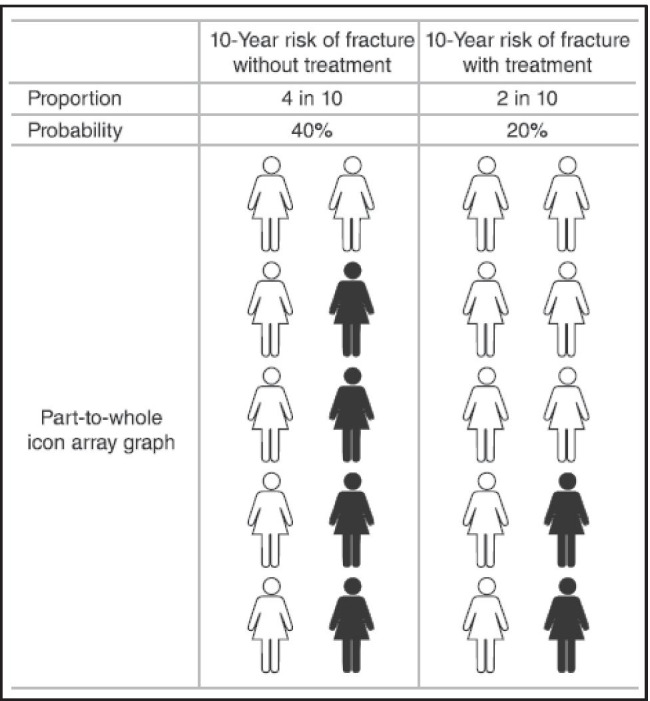
The scoping review included 43 studies on communication with regard to general health risk and 25 studies about communication regarding risk of fracture. Recommendations for effective communication with regard to risk are presented. Communication of numeric data on risk should be adapted to the literacy and numeracy levels of the individual patient. Patient understanding of numerical data can be enhanced with appropriate use of visual aids (e.g., pie charts, icon arrays, bar charts, pictograms). The FRAX® tool is the most recommended and most used tool for assessing risk of fracture. Communication sent as individualized letters to patients following DXA scans has been studied, although patient understanding of their risk of fracture is often reported as low using this technique. Use of visual aids may improve patient understanding.
Healthcare professionals are encouraged to apply recommendations presented in this scoping review in their clinical practice. Patient understanding of risk of fracture should be confirmed by making sure that patients feel free to ask questions and express their concerns. This will contribute to an optimal patient-centered approach. Developing online tools to convert the probability of fracture into patient-friendly visual presentations could facilitate communication between healthcare professionals and patients about risk of fracture.
进行了两次范围综述,以审查关于一般健康风险沟通的建议和指南,并调查关于骨折风险的沟通策略。邀请医疗保健专业人员应用这些建议,以优化以患者为中心的降低骨折风险方法。
对医学文献进行范围综述,以审查有关医疗保健专业人员与患者就一般健康风险和骨折风险进行有效沟通的建议和工具。
该范围综述分为两部分,以搜索(1)研究提出有关一般健康风险沟通的建议和指南;(2)研究调查针对骨折风险患者的沟通。 2020 年 4 月在 Medline 上搜索了相关研究。
该范围综述包括 43 项关于一般健康风险沟通的研究和 25 项关于骨折风险沟通的研究。提出了有关有效沟通风险的建议。应根据个体患者的读写和计算水平调整风险的数值数据沟通。适当使用视觉辅助工具(例如饼图,图标数组,条形图,象形图)可以增强患者对数值数据的理解。 FRAX®工具是评估骨折风险最推荐和最常用的工具。已经研究了根据 DXA 扫描向患者发送个性化信件的沟通方法,尽管使用这种技术报告的患者对其骨折风险的理解通常较低。使用视觉辅助工具可能会提高患者的理解。
鼓励医疗保健专业人员将本范围综述中提出的建议应用于临床实践。应通过确保患者感到可以自由提问和表达关注来确认患者对骨折风险的理解。这将有助于以患者为中心的最佳方法。开发将骨折概率转换为患者友好的视觉演示的在线工具,可以促进医疗保健专业人员与患者之间关于骨折风险的沟通。