Division of Cancer Care and Epidemiology, Queen's University Cancer Research Institute, Kingston, ON, Canada; Departments of Oncology, Queen's University, Kingston, ON, Canada.
Department of Medical Oncology, Tata Memorial Centre, Mumbai, India.
Lancet Oncol. 2021 Oct;22(10):1367-1377. doi: 10.1016/S1470-2045(21)00463-0. Epub 2021 Sep 21.
The WHO Essential Medicines List (EML) identifies priority medicines that are most important to public health. Over time, the EML has included an increasing number of cancer medicines. We aimed to investigate whether the cancer medicines in the EML are aligned with the priority medicines of frontline oncologists worldwide, and the extent to which these medicines are accessible in routine clinical practice.
This international, cross-sectional survey was developed by investigators from a range of clinical practice settings across low-income to high-income countries, including members of the WHO Essential Medicines Cancer Working Group. A 28-question electronic survey was developed and disseminated to a global network of oncologists in 89 countries and regions by use of a hierarchical snowball method; each primary contact distributed the survey through their national and regional oncology associations or personal networks. The survey was open from Oct 15 to Dec 7, 2020. Fully qualified physicians who prescribe systemic anticancer therapy to adults were eligible to participate in the survey. The primary question asked respondents to select the ten cancer medicines that would provide the greatest public health benefit to their country; subsequent questions explored availability and cost of cancer medicines. Descriptive statistics were used to compare access to medicines between low-income and lower-middle-income countries, upper-middle-income countries, and high-income countries.
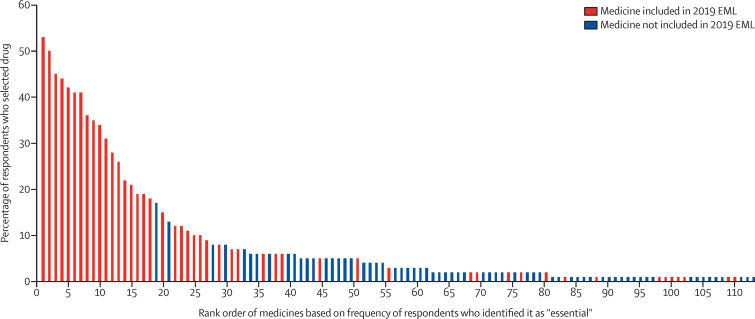
87 country-level contacts and two regional networks were invited to participate in the survey; 46 (52%) accepted the invitation and distributed the survey. 1697 respondents opened the survey link; 423 were excluded as they did not answer the primary study question and 326 were excluded because of ineligibility. 948 eligible oncologists from 82 countries completed the survey (165 [17%] in low-income and lower-middle-income countries, 165 [17%] in upper-middle-income countries, and 618 [65%] in high-income countries). The most commonly selected medicines were doxorubicin (by 499 [53%] of 948 respondents), cisplatin (by 470 [50%]), paclitaxel (by 423 [45%]), pembrolizumab (by 414 [44%]), trastuzumab (by 402 [42%]), carboplatin (by 390 [41%]), and 5-fluorouracil (by 386 [41%]). Of the 20 most frequently selected high-priority cancer medicines, 19 (95%) are currently on the WHO EML; 12 (60%) were cytotoxic agents and 13 (65%) were granted US Food and Drug Administration regulatory approval before 2000. The proportion of respondents indicating universal availability of each top 20 medication was 9-54% in low-income and lower-middle-income countries, 13-90% in upper-middle-income countries, and 68-94% in high-income countries. The risk of catastrophic expenditure (spending >40% of total consumption net of spending on food) was more common in low-income and lower-middle-income countries, with 13-68% of respondents indicating a substantial risk of catastrophic expenditures for each of the top 20 medications in lower-middle-income countries versus 2-41% of respondents in upper-middle-income countries and 0-9% in high-income countries.
These data demonstrate major barriers in access to core cancer medicines worldwide. These findings challenge the feasibility of adding additional expensive cancer medicines to the EML. There is an urgent need for global and country-level policy action to ensure patients with cancer globally have access to high priority medicines.
None.
世界卫生组织基本药物清单(EML)确定了对公众健康最重要的优先药物。随着时间的推移,EML 中纳入了越来越多的癌症药物。我们旨在研究 EML 中的癌症药物是否与全球一线肿瘤学家的优先药物一致,以及这些药物在常规临床实践中的可及性。
本国际横断面调查由来自低收入到高收入国家的一系列临床实践环境的调查员开发,包括世界卫生组织基本药物癌症工作组的成员。开发了一个包含 28 个问题的电子调查,并通过分层雪球法分发给 89 个国家和地区的全球肿瘤学家网络;每个主要联系人通过其所在国家和地区的肿瘤协会或个人网络分发调查。调查于 2020 年 10 月 15 日至 12 月 7 日开放。有资格为成人开具全身性抗癌治疗药物的完全合格的医生有资格参加调查。主要问题是让受访者选择对其国家最有益的十种癌症药物;随后的问题探讨了癌症药物的可及性和成本。使用描述性统计数据比较了低收入和中下收入国家、中上收入国家和高收入国家之间的药物获取情况。
邀请了 87 个国家层面的联系人以及两个区域网络参与调查;46 个(52%)接受了邀请并分发了调查。1697 名受访者打开了调查链接;423 人因未回答主要研究问题而被排除在外,326 人因不合格而被排除在外。来自 82 个国家的 948 名合格肿瘤学家完成了调查(低收入和中下收入国家 165 名[17%],中上收入国家 165 名[17%],高收入国家 618 名[65%])。最常选择的药物是多柔比星(948 名受访者中有 499 名[53%])、顺铂(470 名[50%])、紫杉醇(423 名[45%])、派姆单抗(414 名[44%])、曲妥珠单抗(402 名[42%])、卡铂(390 名[41%])和 5-氟尿嘧啶(386 名[41%])。在 20 种最常选择的高优先级癌症药物中,有 19 种(95%)目前在世界卫生组织 EML 中;其中 12 种(60%)是细胞毒性药物,13 种(65%)在 2000 年前获得了美国食品和药物管理局的监管批准。表示每种前 20 种药物普遍可获得的受访者比例在低收入和中下收入国家为 9-54%,在中上收入国家为 13-90%,在高收入国家为 68-94%。灾难性支出(支出超过食品支出后总消费的 40%)的风险在低收入和中下收入国家更为常见,20 种中下收入国家药物中,有 13-68%的受访者表示存在重大灾难性支出风险,而中上收入国家为 2-41%,高收入国家为 0-9%。
这些数据表明全球范围内获得核心癌症药物存在重大障碍。这些发现对将更多昂贵的癌症药物添加到 EML 中提出了挑战。全球范围内迫切需要采取全球和国家层面的政策行动,以确保全球癌症患者能够获得高优先级药物。
无。