
[具体研究对象]中气味结合蛋白的转录组学特征及其与不同宿主释放挥发物的关联
Transcriptomic Characterization of Odorant Binding Proteins in and Their Association with Different Host Emitted Volatiles.
作者信息
Zhao Ning, Mao Xiangzhong, Liu Naiyong, Liu Ling, Zhang Zhixiao, Ze Sangzi, Yang Bin
机构信息
Key Laboratory of Forest Disaster Warning and Control of Yunnan Province, Southwest Forestry University, Kunming 650224, China.
Yunnan Academy of Forestry and Grassland, Kunming 650224, China.
出版信息
Insects. 2021 Sep 3;12(9):787. doi: 10.3390/insects12090787.
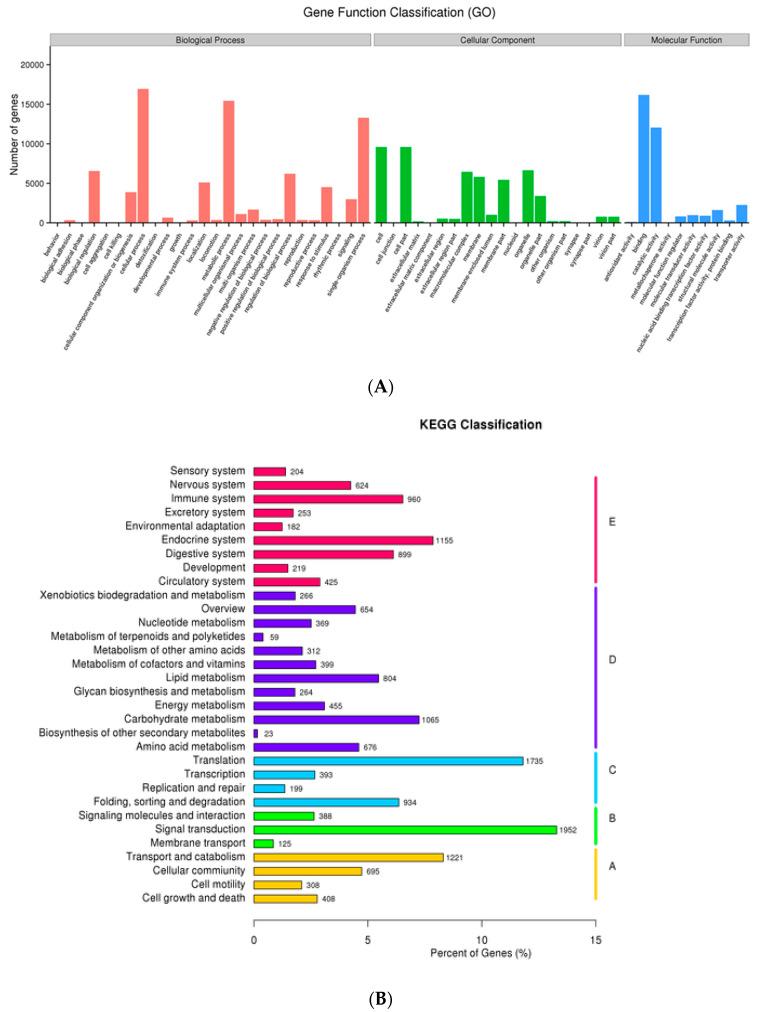
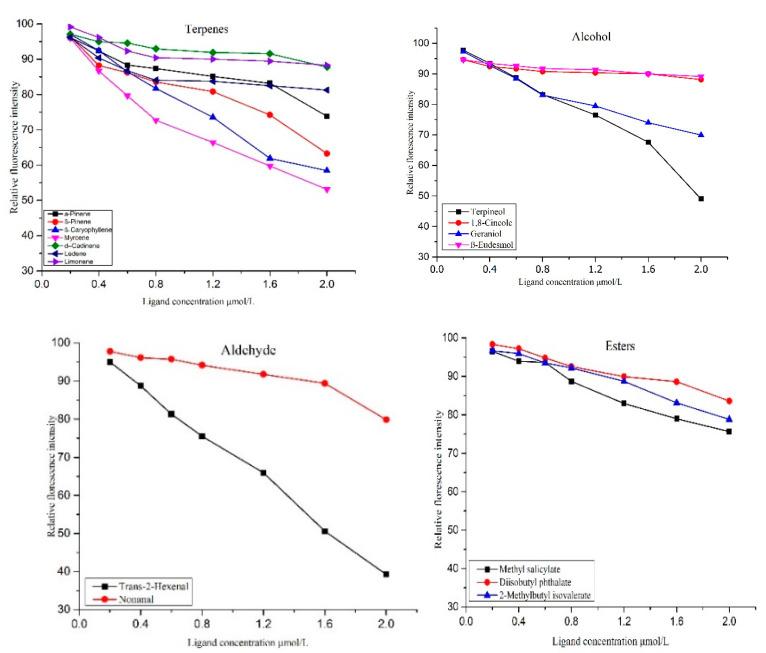
This study characterized the transcriptome of and explored odorant binding proteins (OBPs) and their interaction with host-specific compounds. A total of 36 samples from six different organs including antennae, head, thorax, abdomen, wings, and legs (12 groups with 3 replicates per group) from both male and female insects were collected for RNA extraction. Transcriptomic analysis revealed a total of 89,897 transcripts as unigenes, with an average length of 1036 bp. Between male and female groups, 31,095 transcripts were identified as differentially expressed genes (DEGs). The KEGG pathway analysis revealed 26 DEGs associated with cutin, suberine, and wax biosynthesis and 70, 48, and 62 were linked to glycerophospholipid metabolism, choline metabolism in cancer, and chemokine signaling pathways, respectively. A total of 31 OBP genes were identified. Among them, the relative expression of 11 OBP genes (OBP6, 10, 12, 14, 17, 20, 22, 26, 28, 30, and 31) was confirmed by quantitative RT-PCR in different tissues. Seven OBP genes including CcreOBP6 and CcreOBP10 revealed antennae-specific expression. Further, we selected two OBPs (CcreOBP6 and CcreOBP10) for functional analysis to evaluate their binding affinity with 20 host odorant compounds. The CcreOBP6 and CcreOBP10 exhibited strong binding affinities with terpineol and trans-2-hexenal revealing their potential as an attractant or repellent for controlling .
本研究对[昆虫名称]的转录组进行了表征,并探索了气味结合蛋白(OBPs)及其与宿主特异性化合物的相互作用。从雄性和雌性昆虫的触角、头部、胸部、腹部、翅膀和腿部这六个不同器官共收集了36个样本(12组,每组3个重复)用于RNA提取。转录组分析显示共有89,897个转录本作为单基因,平均长度为1036 bp。在雄性和雌性组之间,鉴定出31,095个转录本为差异表达基因(DEGs)。KEGG通路分析显示有26个DEGs与角质、木栓质和蜡生物合成相关,分别有70、48和62个与甘油磷脂代谢、癌症中的胆碱代谢以及趋化因子信号通路相关。共鉴定出31个OBP基因。其中,11个OBP基因(OBP6、10、12、14、17、20、22、26、28、30和31)的相对表达通过定量RT-PCR在不同组织中得到证实。包括CcreOBP6和CcreOBP10在内的7个OBP基因显示出触角特异性表达。此外,我们选择了两个OBPs(CcreOBP6和CcreOBP10)进行功能分析,以评估它们与20种宿主气味化合物的结合亲和力。CcreOBP6和CcreOBP10对松油醇和反式-2-己烯醛表现出很强的结合亲和力,揭示了它们作为控制[昆虫名称]的引诱剂或驱避剂的潜力。




 Zotero 插件