Venthur Herbert, Zhou Jing-Jiang
Laboratorio de Química Ecológica, Departamento de Ciencias Químicas y Recursos Naturales, Universidad de La Frontera, Temuco, Chile.
Center of Excellence in Biotechnology Research Applied to the Environment (CIBAMA), Universidad de La Frontera, Temuco, Chile.
Front Physiol. 2018 Aug 24;9:1163. doi: 10.3389/fphys.2018.01163. eCollection 2018.
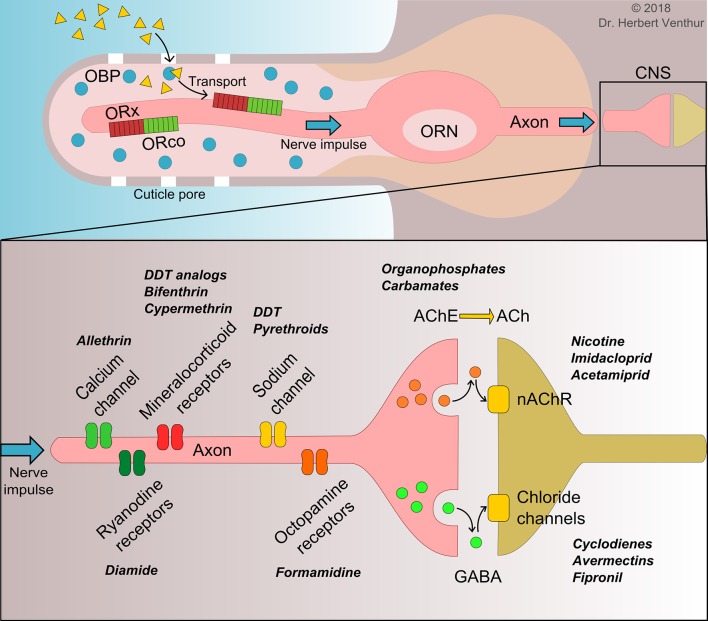
Recently, two alternative targets in insect periphery nerve system have been explored for environmentally-friendly approaches in insect pest management, namely odorant-binding proteins (OBPs) and odorant receptors (ORs). Located in insect antennae, OBPs are thought to be involved in the transport of odorants to ORs for the specific signal transduction of behaviorally active odorants. There is rich information on OBP binding affinity and molecular docking to bioactive compounds as well as ample 3D crystal structures due to feasible production of recombinant proteins. Although these provide excellent opportunities for them to be considered as pest control targets and a tool to design pest control agents, the debates on their binding specificity represent an obstacle. On the other hand, ORs have recently been functionally characterized with increasing evidence for their specificity, sensitivity and functional roles in pest behaviors. However, a major barrier to use ORs for semiochemical discovery is the lack of 3D crystal structures. Thus, OBPs and ORs have not been analyzed comparatively together so far for their feasibility as pest control targets. Here, we summarize the state of OBPs and ORs research in terms of its application in insect pest management. We discuss the suitability of both proteins as pest control targets and their selection toward the discovery of new potent semiochemicals. We argue that both proteins represent promising targets for pest control and can be used to identify new super-ligands likely present in nature and with reduced risk of resistance development than insect pesticides currently used in agriculture. We discuss that with the massive identification of OBPs through RNA-seq and improved binding affinity measurements, these proteins could be reconsidered as suitable targets for semiochemical discovery.
最近,人们在昆虫外周神经系统中探索了两个替代靶标,用于害虫管理的环保方法,即气味结合蛋白(OBP)和气味受体(OR)。OBP位于昆虫触角中,被认为参与将气味剂运输到OR,以实现行为活性气味剂的特定信号转导。由于重组蛋白的可行生产,关于OBP与生物活性化合物的结合亲和力和分子对接有丰富的信息,以及充足的三维晶体结构。尽管这些为它们被视为害虫控制靶标和设计害虫控制剂的工具提供了绝佳机会,但关于它们结合特异性的争论仍是一个障碍。另一方面,OR最近已被进行功能表征,越来越多的证据表明它们在害虫行为中的特异性、敏感性和功能作用。然而,将OR用于信息素发现的一个主要障碍是缺乏三维晶体结构。因此,到目前为止,尚未对OBP和OR作为害虫控制靶标的可行性进行比较分析。在这里,我们总结了OBP和OR在害虫管理应用方面的研究现状。我们讨论了这两种蛋白质作为害虫控制靶标的适用性以及它们在发现新的有效信息素方面的选择。我们认为这两种蛋白质都是有前景的害虫控制靶标,可用于识别自然界中可能存在的新的超级配体,且与目前农业中使用的杀虫剂相比,抗性发展风险更低。我们讨论了通过RNA测序大量鉴定OBP以及改进结合亲和力测量后,这些蛋白质可被重新视为信息素发现的合适靶标。