Caselli Alice, Petacchi Ruggero
BioLabs, Institute of Life Science, Scuola Superiore Sant'Anna, Piazza Martiri Della Libertà 33, 56127 Pisa, Italy.
Insects. 2021 Sep 8;12(9):802. doi: 10.3390/insects12090802.
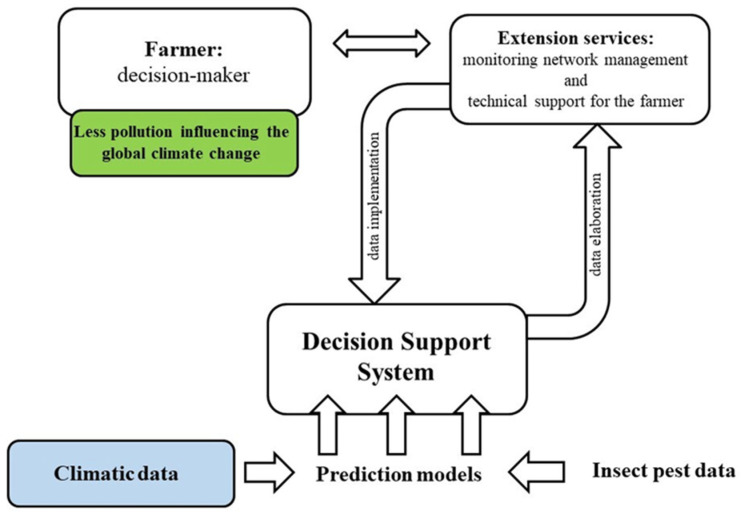
Evidence of the impact of climate change on natural and agroecosystems is nowadays established worldwide, especially in the Mediterranean Basin, an area known to be very susceptible to heatwaves and drought. is one of the main income sources for the Mediterranean agroeconomy, and it is considered a sensitive indicator of the climate change degree because of the tight relationship between its biology and temperature trend. Despite the economic importance of the olive, few studies are nowadays available concerning the consequences that global heating may have on its major pests. Among the climatic parameters, temperature is the key one influencing the relation between the olive tree and its most threatening parasites, including and Therefore, several prediction models are based on this climatic parameter (e.g., cumulative degree day models). Even if the use of models could be a promising tool to improve pest control strategies and to safeguard the Mediterranean olive patrimony, they are not currently available for most pests, and they have to be used considering their limits. This work stresses the lack of knowledge about the biology and the ethology of olive pests under a climate change scenario, inviting the scientific community to focus on the topic.
如今,气候变化对自然和农业生态系统影响的证据在全球范围内都已得到证实,尤其是在地中海盆地,该地区已知极易受到热浪和干旱的影响。橄榄是地中海农业经济的主要收入来源之一,由于其生物学特性与温度趋势之间的紧密关系,它被视为气候变化程度的一个敏感指标。尽管橄榄具有经济重要性,但目前关于全球变暖可能对其主要害虫产生的后果的研究却很少。在气候参数中,温度是影响橄榄树与其最具威胁性的寄生虫(包括[此处原文缺失具体寄生虫名称]和[此处原文缺失具体寄生虫名称])之间关系的关键因素。因此,一些预测模型基于这一气候参数(例如,累积度日模型)。即使模型的使用可能是改进害虫控制策略和保护地中海橄榄遗产的一个有前景的工具,但目前大多数橄榄害虫的模型尚未可用,并且在使用时必须考虑其局限性。这项工作强调了在气候变化情景下对橄榄害虫的生物学和行为学缺乏了解,呼吁科学界关注这一主题。