Denton Jai A, Koludarov Ivan, Thompson Michele, Bryk Jarosław, Velasque Mariana
Genomics & Regulatory Systems Unit, Okinawa Institute of Science & Technology, 1919-1 Tancha, Kunigami-gun 904-0495, Japan.
Institute of Vector-Borne Disease, Monash University, Clayton, VIC 3800, Australia.
Insects. 2021 Sep 18;12(9):842. doi: 10.3390/insects12090842.
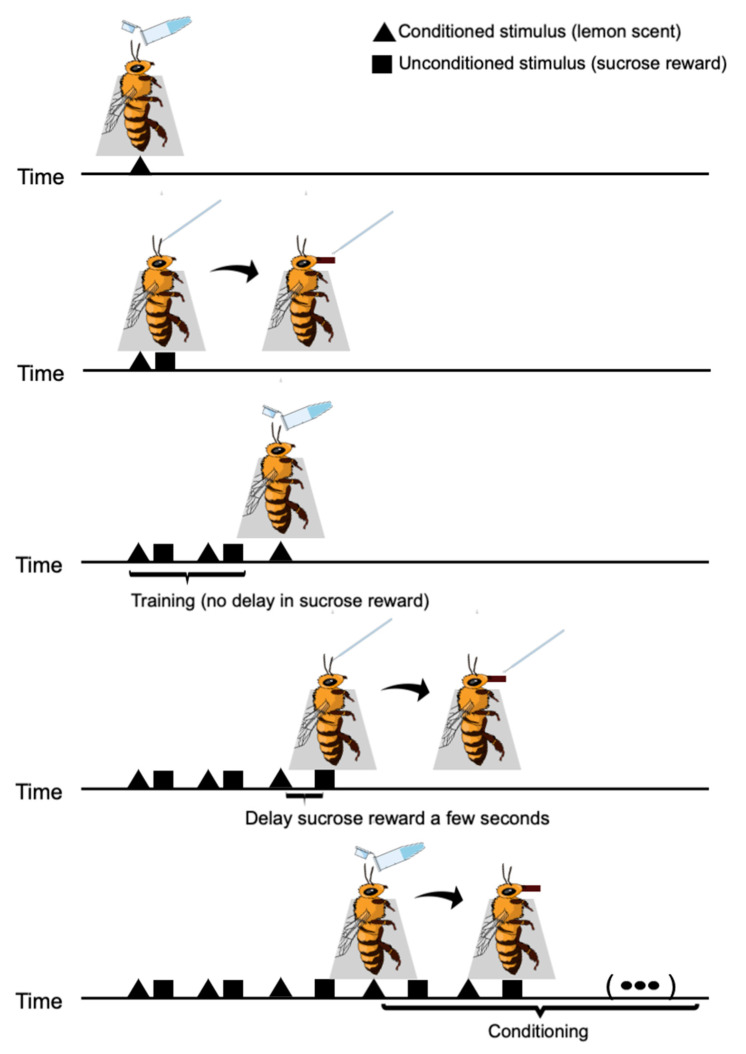
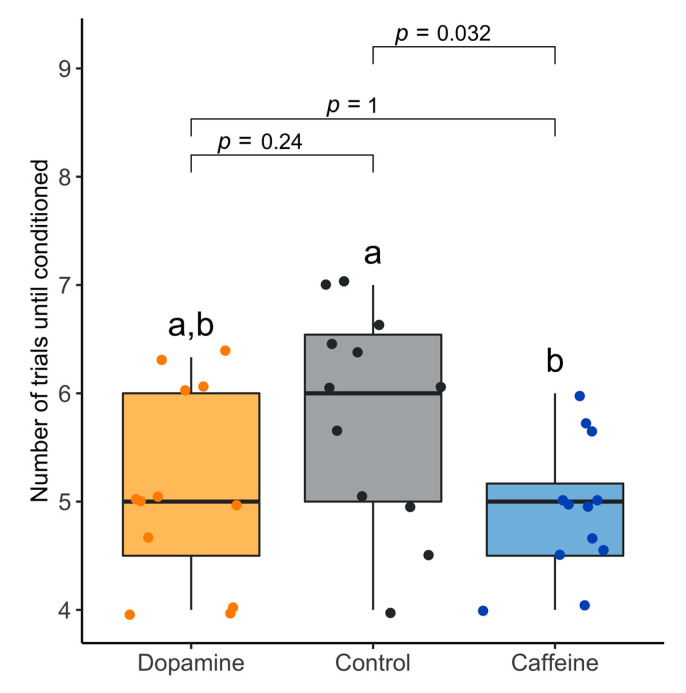
(honeybees) are a well-established model for the study of learning and cognition. A robust conditioning protocol, the olfactory conditioning of the proboscis extension response (PER), provides a powerful but straightforward method to examine the impact of varying stimuli on learning performance. Herein, we provide a protocol that leverages PER for classroom-based community or student engagement. Specifically, we detail how a class of high school students, as part of the Ryukyu Girls Outreach Program, examined the effects of caffeine and dopamine on learning performance in honeybees. Using a modified version of the PER conditioning protocol, they demonstrated that caffeine, but not dopamine, significantly reduced the number of trials required for a successful conditioning response. In addition to providing an engaging and educational scientific activity, it could be employed, with careful oversight, to garner considerable reliable data examining the effects of varying stimuli on honeybee learning.
蜜蜂是学习与认知研究中一个成熟的模型。一种成熟的条件反射实验方案,即喙伸反应(PER)的嗅觉条件反射,为研究不同刺激对学习表现的影响提供了一种强大而直接的方法。在此,我们提供一种利用PER进行基于课堂的社区或学生参与活动的方案。具体而言,我们详细介绍了作为琉球女孩外展计划一部分的一群高中生,是如何研究咖啡因和多巴胺对蜜蜂学习表现的影响的。他们使用PER条件反射实验方案的一个修改版本,证明了咖啡因而非多巴胺能显著减少成功条件反射反应所需的试验次数。除了提供一项引人入胜且具有教育意义的科学活动外,在谨慎监督下,它还可用于收集大量可靠数据,以研究不同刺激对蜜蜂学习的影响。