Plotkin Daniel L, Roberts Michael D, Haun Cody T, Schoenfeld Brad J
Health Sciences Department, CUNY Lehman College, Bronx, NY 10468, USA.
School of Kinesiology, Auburn University, Auburn, AL 36849, USA.
Sports (Basel). 2021 Sep 10;9(9):127. doi: 10.3390/sports9090127.
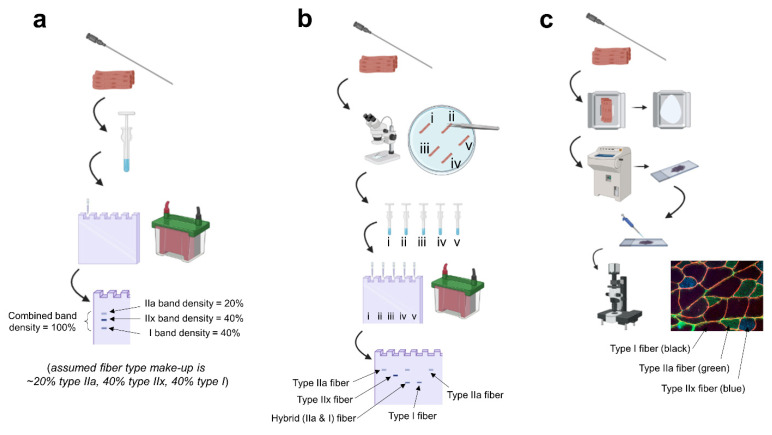
Human muscle fibers are generally classified by myosin heavy chain (MHC) isoforms characterized by slow to fast contractile speeds. Type I, or slow-twitch fibers, are seen in high abundance in elite endurance athletes, such as long-distance runners and cyclists. Alternatively, fast-twitch IIa and IIx fibers are abundant in elite power athletes, such as weightlifters and sprinters. While cross-sectional comparisons have shown marked differences between athletes, longitudinal data have not clearly converged on patterns in fiber type shifts over time, particularly between slow and fast fibers. However, not all fiber type identification techniques are created equal and, thus, may limit interpretation. Hybrid fibers, which express more than one MHC type (I/IIa, IIa/IIx, I/IIa/IIx), may make up a significant proportion of fibers. The measurement of the distribution of fibers would necessitate the ability to identify hybrid fibers, which is best done through single fiber analysis. Current evidence using the most appropriate techniques suggests a clear ability of fibers to shift between hybrid and pure fibers as well as between slow and fast fiber types. The context and extent to which this occurs, along with the limitations of current evidence, are discussed herein.
人类肌肉纤维通常根据肌球蛋白重链(MHC)亚型进行分类,其特征是收缩速度从慢到快。I型,即慢肌纤维,在优秀的耐力运动员中大量存在,如长跑运动员和自行车运动员。或者,快肌IIa和IIx纤维在优秀的力量型运动员中大量存在,如举重运动员和短跑运动员。虽然横断面比较显示了运动员之间的显著差异,但纵向数据尚未明确得出纤维类型随时间变化的模式,尤其是慢肌纤维和快肌纤维之间的变化模式。然而,并非所有纤维类型识别技术都是一样的,因此可能会限制解释。表达一种以上MHC类型(I/IIa、IIa/IIx、I/IIa/IIx)的混合纤维可能占纤维的很大比例。测量纤维的分布需要能够识别混合纤维,而这最好通过单纤维分析来完成。目前使用最合适技术的证据表明,纤维具有在混合纤维和纯纤维之间以及慢肌纤维和快肌纤维类型之间转换的明显能力。本文讨论了这种情况发生的背景和程度,以及当前证据的局限性。