Department of Hematology and Immunohematology, School of Biomedical and Laboratory Sciences, College of Medicine and Health Sciences, University of Gondar, P.O. Box 196, Gondar, Ethiopia.
Laboratory Technologist at University of Gondar Comprehensive Specialized Hospital, Gondar, Ethiopia.
BMC Infect Dis. 2021 Sep 26;21(1):1005. doi: 10.1186/s12879-021-06691-7.
Visceral leshimaniasis is a parasitic disease characterized by systemic infection of phagocytic cells and an intense inflammatory response. The progression of the disease or treatment may have an effect on hematological parameters of these patients'. Thus, the current study sought to compare the hematological profiles of visceral leishmaniasis patients before and after treatment with anti-leishmaniasis drugs.
An institutional-based retrospective cohort study was conducted among visceral leishmaniasis patients admitted to the University of Gondar comprehensive specialized referral hospital leishmaniasis research and treatment centre between September 2013 and August 2018. Hematological profiles were extracted from the laboratory registration book before and after treatment. Data were entered to Epi-info and exported to SPSS for analysis. Descriptive statistics were summarized using frequency and percentage to present with the table. The mean, standard deviation, median, and interquartile range were used to present the data. Furthermore, using the paired t-test and the Wilcoxon Signed rank test, the mean difference for normally and non-normally distributed data was compared. Spearman and Pearson correlation analysis were used to describe the relationship between hematological parameters and various variables. A P value of 0.05 was considered statistically significant.
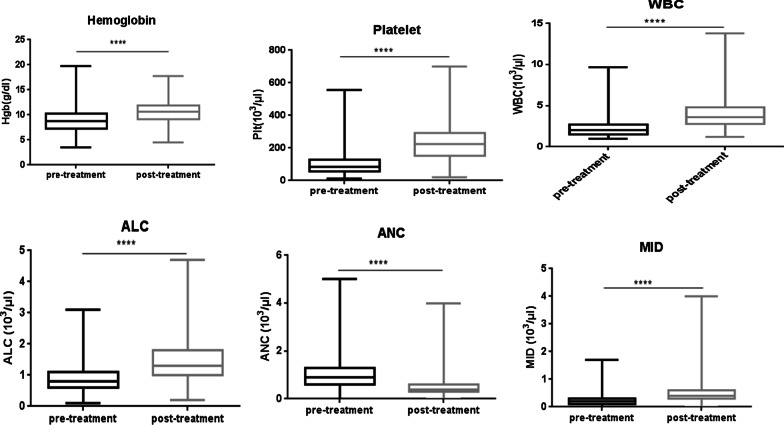
With the exception of the absolute neutrophil count, all post-treatment hematological parameters show a significant increase when compared to pre-treatment levels. Prior to treatment, the prevalence of anemia, leukopenia, and thrombocytopenia was 85.5, 83.4, and 75.8%, respectively, whereas it was 58.3, 38.2, and 19.2% following treatment. Furthermore, parasite load was found to have a statistically significant negative correlation with hematological profiles, specifically with white blood cell and red blood cell parameters.
According to our findings, patients with visceral leishmaniasis had improved hematological profiles after treatment. The effect of treatment on parasite proliferation and concentration within visceral organs, in which the parasite load could directly affect the patient's hematological profiles, may be associated with the change in hematological profiles.
内脏利什曼病是一种寄生虫病,其特征为吞噬细胞的全身感染和强烈的炎症反应。疾病的进展或治疗可能会影响这些患者的血液学参数。因此,本研究旨在比较内脏利什曼病患者在接受抗利什曼病药物治疗前后的血液学特征。
这是一项于 2013 年 9 月至 2018 年 8 月在贡德尔大学综合专门转诊医院利什曼病研究和治疗中心进行的基于机构的回顾性队列研究。在治疗前后从实验室登记册中提取血液学特征。数据输入 Epi-info 并导出到 SPSS 进行分析。使用频率和百分比以表格形式总结描述性统计数据。使用均值、标准差、中位数和四分位距来表示数据。此外,使用配对 t 检验和 Wilcoxon 符号秩检验比较正态和非正态分布数据的均值差异。使用 Spearman 和 Pearson 相关分析描述血液学参数与各种变量之间的关系。P 值为 0.05 被认为具有统计学意义。
除绝对中性粒细胞计数外,所有治疗后的血液学参数与治疗前相比均显著增加。治疗前,贫血、白细胞减少和血小板减少的患病率分别为 85.5%、83.4%和 75.8%,而治疗后分别为 58.3%、38.2%和 19.2%。此外,寄生虫负荷与血液学特征,特别是白细胞和红细胞参数具有统计学显著负相关。
根据我们的发现,内脏利什曼病患者在治疗后血液学特征得到改善。治疗对寄生虫增殖和内脏器官内浓度的影响,其中寄生虫负荷可能直接影响患者的血液学特征,可能与血液学特征的变化有关。