Infectious Diseases Institute, Makerere University, College of Health Sciences, P.O BOX 22418, Kampala, Uganda.
Clinical School, University of Cambridge, Cambridge, UK.
BMC Med Ethics. 2021 Sep 26;22(1):132. doi: 10.1186/s12910-021-00692-6.
Over the past two decades, Uganda has experienced a significant increase in clinical research driven by both academia and industry. This has been combined with a broader spectrum of research proposals, with respect to methodologies and types of intervention that need evaluation by Research Ethics Committees (RECs) with associated increased requirement for expertise. We assessed the competencies of REC members regarding review of research protocols with complex and emerging research study designs. The aim was to guide development of a training curriculum to improve the quality of scientific and ethical review.
This was a cross-sectional study design, with quantitative data collection methods. Research Ethics Committee members completed a structured pre-coded questionnaire on current competence with complex and emerging study design. REC members were asked to outline a list of additional topics for which they needed training. Data from coded questions were entered into Epidata Version 3.1 and then exported to STATA Version14.1 for analysis. Descriptive analysis was performed and findings are presented using percentages and frequencies.
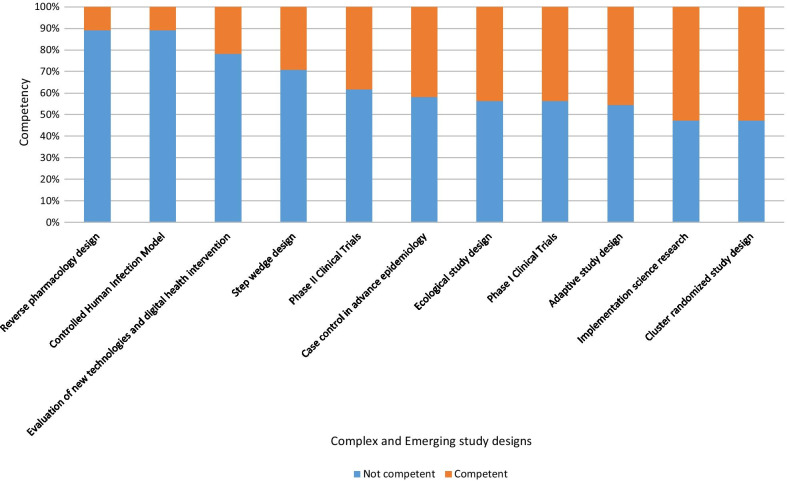
We enrolled 55 REC members from 6 RECs who have a total of 97 members. The majority of whom were males (56.4%, n = 31/55). The level of competence for review of selected study design was lowest for Controlled Human Infection Model (10.9%, n = 6) and reverse pharmacology design (10.9%, n = 6), and highest for cluster randomized study design (52.7%, n = 29) and implementation science research (52.7%, n = 29).
Competence for review of research protocols with complex and emerging study design was low among participating REC members. We recommend prioritising training of REC members on complex and emerging study designs to enhance quality of research protocol review.
在过去的二十年中,乌干达的临床研究显著增加,这是学术界和工业界共同推动的结果。随着研究提案的范围不断扩大,涉及的方法和干预类型也越来越多,需要研究伦理委员会(REC)进行评估,这也相应增加了对专业知识的需求。我们评估了 REC 成员在审查具有复杂和新兴研究设计的研究方案方面的能力。目的是指导培训课程的开发,以提高科学和伦理审查的质量。
这是一项横断面研究设计,采用定量数据收集方法。研究伦理委员会成员完成了一份关于审查具有复杂和新兴研究设计的当前能力的结构化预编码问卷。REC 成员被要求列出他们需要培训的其他主题。编码问题的数据输入到 EpiData 版本 3.1 中,然后导出到 STATA 版本 14.1 进行分析。进行描述性分析,并使用百分比和频率呈现研究结果。
我们从 6 个 REC 中招募了 55 名 REC 成员,他们共有 97 名成员。其中大多数是男性(56.4%,n=31/55)。审查选定研究设计的能力最低的是受控人体感染模型(10.9%,n=6)和反向药理学设计(10.9%,n=6),最高的是整群随机研究设计(52.7%,n=29)和实施科学研究(52.7%,n=29)。
参与的 REC 成员在审查具有复杂和新兴研究设计的研究方案方面的能力较低。我们建议优先培训 REC 成员有关复杂和新兴研究设计的知识,以提高研究方案审查的质量。