Sotelo C, Alvarado-Mallart R M
Proc Natl Acad Sci U S A. 1986 Feb;83(4):1135-9. doi: 10.1073/pnas.83.4.1135.
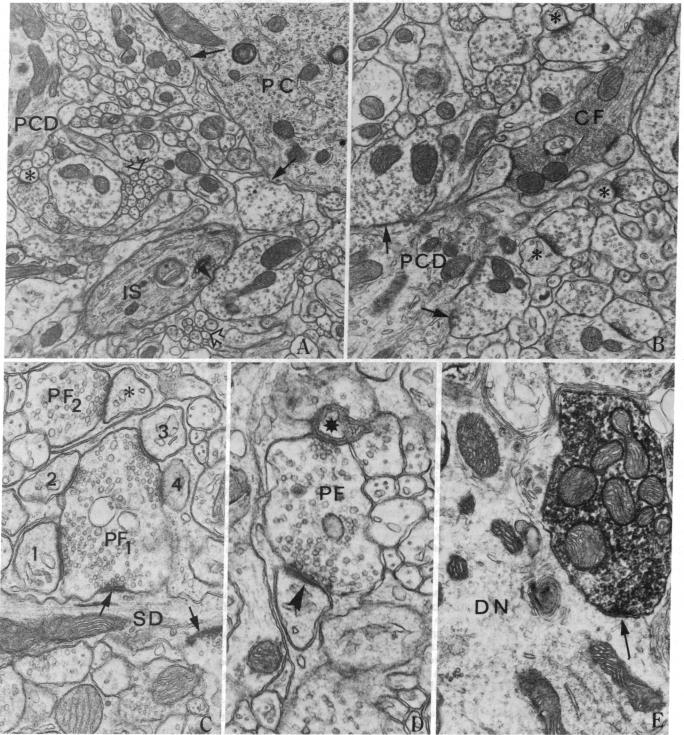
Cell suspensions from cerebellar primordia of 12-day mouse embryos were grafted into the cerebellum of 4-month-old Purkinje cell degeneration (pcd) mutant mice and examined 2-3 months later. In contrast to those of nontreated mutants, all of the grafted cerebella exhibited Purkinje cells that had migrated into the molecular layer, where they were clustered over its superficial two-thirds. These Purkinje cells develop flattened dendritic trees perpendicular to bundles of parallel fibers. Ultrastructural examination of their synaptic inputs and outputs disclosed that (i) as in normal cerebella, climbing fibers and axons from basket and stellate cells synapse on thick dendrites, whereas parallel fibers almost exclusively contact the distal spiny branchlets, and (ii) a substantial number of Purkinje cell axons reach their appropriate targets in the deep cerebellar nuclei, where they establish synaptic connections on large and small neurons. These results indicate that embryonic Purkinje cells grafted into the cerebellum of adult mice with heredodegenerative ataxia integrate themselves very specifically into the cerebellar circuitry of the recipient mouse, where they can replace the missing Purkinje cells. They also provide a morphological basis favoring the notion of functional restorative capabilities of neural grafts in systems in which neurons are connected in an almost point-to-point manner.
将12日龄小鼠胚胎小脑原基的细胞悬液移植到4月龄浦肯野细胞变性(pcd)突变小鼠的小脑中,并在2 - 3个月后进行检查。与未处理的突变体相比,所有移植的小脑均显示有浦肯野细胞迁移到分子层,它们聚集在分子层表面的三分之二区域。这些浦肯野细胞发育出垂直于平行纤维束的扁平树突。对其突触输入和输出的超微结构检查发现:(i)与正常小脑一样,攀缘纤维以及来自篮状细胞和星状细胞的轴突与粗树突形成突触,而平行纤维几乎只与远端有棘小分支接触;(ii)大量浦肯野细胞轴突到达小脑深部核团的合适靶点,并在大小神经元上建立突触连接。这些结果表明,移植到患有遗传性共济失调成年小鼠小脑中的胚胎浦肯野细胞能非常特异性地整合到受体小鼠的小脑回路中,在那里它们可以替代缺失的浦肯野细胞。它们还为支持神经移植在神经元以几乎点对点方式连接的系统中具有功能恢复能力这一观点提供了形态学依据。