Leviev Cardiothoracic and Vascular Center, Sheba Medical Center, Ramat Gan, Israel; Sackler Faculty of Medicine, Tel Aviv University, Tel Aviv, Israel.
Leviev Cardiothoracic and Vascular Center, Sheba Medical Center, Ramat Gan, Israel; Sackler Faculty of Medicine, Tel Aviv University, Tel Aviv, Israel.
J Heart Lung Transplant. 2022 Feb;41(2):148-157. doi: 10.1016/j.healun.2021.08.010. Epub 2021 Aug 28.
The repeated waves of the COVID-19 pandemic have highlighted the necessity to optimize vaccine responses in immunocompromised populations. We investigated the safety and immunogenicity of a third, booster, dose of the Pfizer BNT162b2 vaccine in heart transplant (HT) patients.
The cohort comprised 96 adult HT patients who received a third homologous dose of the BNT162b2 vaccine 168 days after the second dose. The vaccine-induced antibody responses of both receptor-binding domain (RBD) IgG and neutralizing antibodies were assessed in all patients, with a positive antibody response being defined as the presence of either IgG anti-RBD or neutralizing antibodies. For a subset of patients, T cell response was also studied.
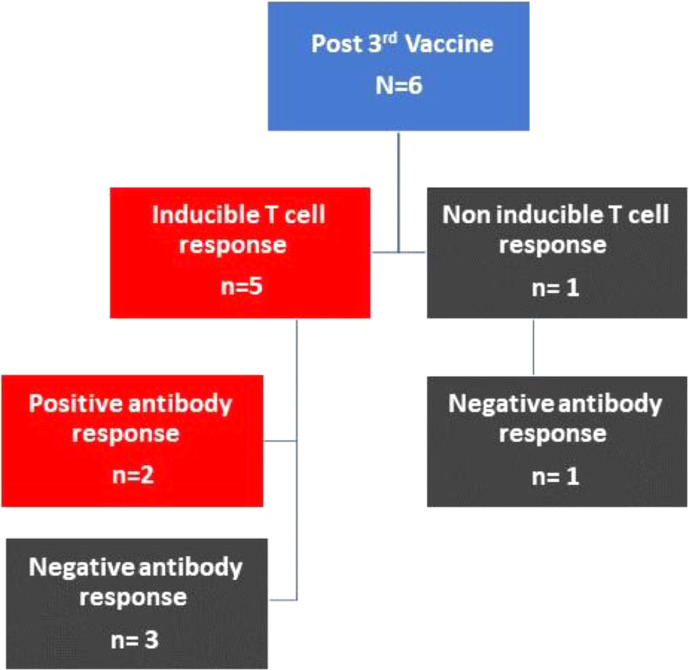
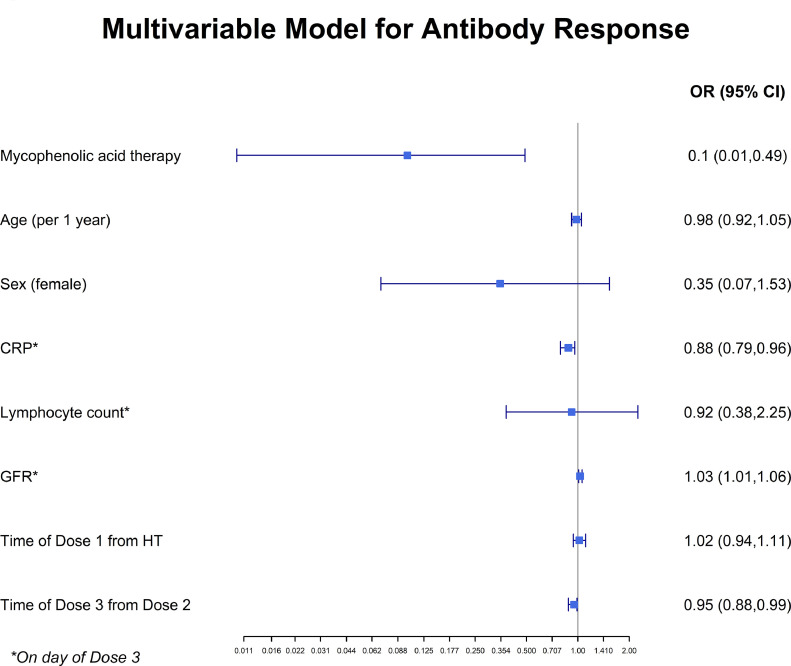
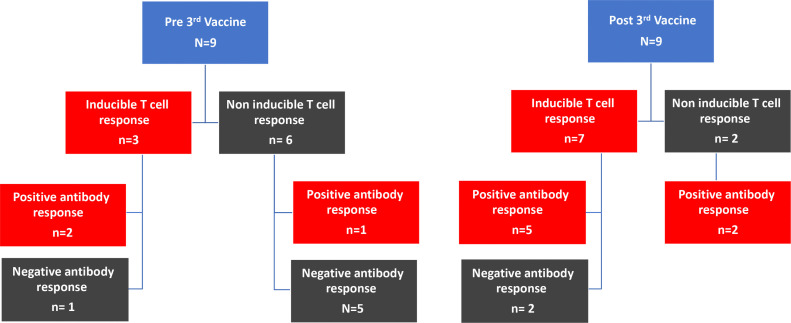
The third dose was associated with a low rate of adverse events, mostly mild pain at the injection site. No serious adverse events were recorded, and there were no episodes of rejection. At 18 days following the third dose of the vaccine, the positive antibody response increased from 23% to 67%, with a corresponding increase in neutralizing capacity. The third dose elicited SARS-CoV-2 neutralization titers >9-fold and IgG anti-RBD antibodies >3-fold of the range achieved after the two primary doses. Mycophenolate use, lower eGFR and higher C-reactive protein were independently associated with a reduced likelihood of generating an immune response. Importantly, a specific T-cell response following the third dose was evident in the majority of transplant recipients.
An homologous third booster dose of the BNT162b2 vaccine gave overall consistent tolerability and a good safety profile, while eliciting humoral and cellular immune responses.
COVID-19 疫情的反复凸显了优化免疫功能低下人群疫苗反应的必要性。我们研究了第三剂(加强针)辉瑞 BNT162b2 疫苗在心脏移植(HT)患者中的安全性和免疫原性。
该队列包括 96 名接受第二剂后 168 天接受第三剂同源 BNT162b2 疫苗的成年 HT 患者。所有患者均评估了受体结合域(RBD)IgG 和中和抗体的疫苗诱导抗体反应,抗体阳性反应定义为存在 IgG 抗 RBD 或中和抗体。对于部分患者,还研究了 T 细胞反应。
第三剂与不良反应发生率低相关,大多数为注射部位轻度疼痛。未记录到严重不良事件,也没有排斥反应。在接种第三剂疫苗后 18 天,抗体阳性反应从 23%增加到 67%,中和能力相应增加。第三剂疫苗诱导的 SARS-CoV-2 中和滴度比两剂基础剂量后达到的范围高 9 倍,IgG 抗 RBD 抗体高 3 倍。环孢素使用、较低的 eGFR 和较高的 C 反应蛋白与产生免疫反应的可能性降低独立相关。重要的是,大多数移植受者在第三剂后出现了特异性 T 细胞反应。
同源第三剂 BNT162b2 疫苗加强针总体耐受性一致,安全性良好,同时引起体液和细胞免疫反应。