Wang Weihao, Duan Xiaoye, Huang Zhengxiang, Pan Qi, Chen Chen, Guo Lixin
Department of Endocrinology, Beijing Hospital, National Center of Gerontology, Institute of Geriatric Medicine, Chinese Academy of Medical Sciences, Beijing, China.
School of Biomedical Sciences, University of Queensland, Brisbane, QLD, Australia.
Front Mol Neurosci. 2021 Sep 9;14:742294. doi: 10.3389/fnmol.2021.742294. eCollection 2021.
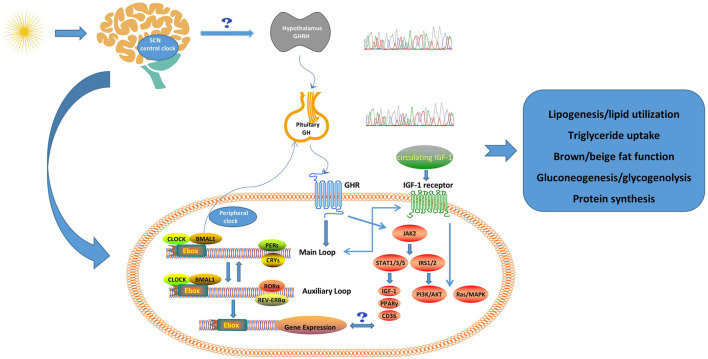
Organisms have developed common behavioral and physiological adaptations to the influence of the day/night cycle. The CLOCK system forms an internal circadian rhythm in the suprachiasmatic nucleus (SCN) during light/dark input. The SCN may synchronize the growth hormone (GH) secretion rhythm with the dimming cycle through somatostatin neurons, and the change of the clock system may be related to the pulsatile release of GH. The GH-insulin-like growth factor 1 (IGF-1) axis and clock system may interact further on the metabolism through regulatory pathways in peripheral organs. We have summarized the current clinical and animal evidence on the interaction of clock systems with the GH-IGF-1 axis and discussed their effects on metabolism.
生物体已经针对昼夜循环的影响形成了常见的行为和生理适应性。在光/暗输入期间,生物钟系统在视交叉上核(SCN)中形成内部昼夜节律。SCN可能通过生长抑素神经元使生长激素(GH)分泌节律与暗周期同步,并且生物钟系统的变化可能与GH的脉冲式释放有关。GH-胰岛素样生长因子1(IGF-1)轴和生物钟系统可能通过外周器官中的调节途径在代谢方面进一步相互作用。我们总结了目前关于生物钟系统与GH-IGF-1轴相互作用的临床和动物证据,并讨论了它们对代谢的影响。