Islam Shahrin, Boström Kristina I, Di Carlo Dino, Simmons Craig A, Tintut Yin, Yao Yucheng, Hsu Jeffrey J
Division of Cardiology, Department of Medicine, David Geffen School of Medicine at UCLA, Los Angeles, CA, United States.
UCLA Molecular Biology Institute, Los Angeles, CA, United States.
Front Physiol. 2021 Sep 9;12:734215. doi: 10.3389/fphys.2021.734215. eCollection 2021.
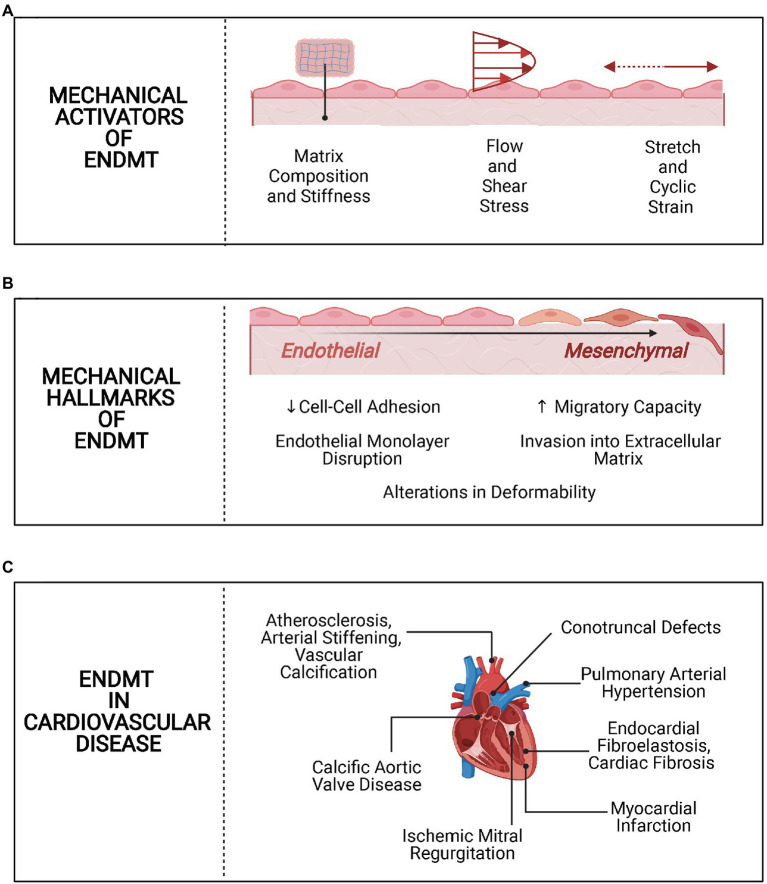
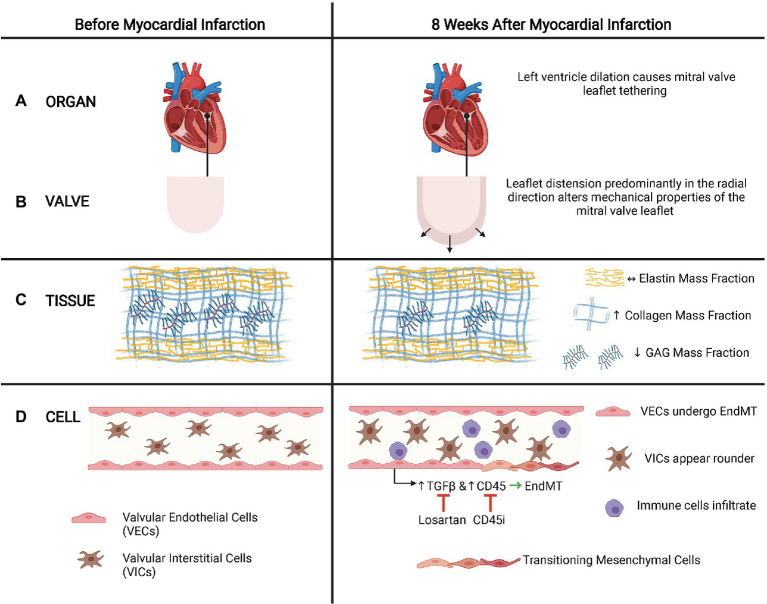
Endothelial cells (ECs) lining the cardiovascular system are subjected to a highly dynamic microenvironment resulting from pulsatile pressure and circulating blood flow. Endothelial cells are remarkably sensitive to these forces, which are transduced to activate signaling pathways to maintain endothelial homeostasis and respond to changes in the environment. Aberrations in these biomechanical stresses, however, can trigger changes in endothelial cell phenotype and function. One process involved in this cellular plasticity is endothelial-to-mesenchymal transition (EndMT). As a result of EndMT, ECs lose cell-cell adhesion, alter their cytoskeletal organization, and gain increased migratory and invasive capabilities. EndMT has long been known to occur during cardiovascular development, but there is now a growing body of evidence also implicating it in many cardiovascular diseases (CVD), often associated with alterations in the cellular mechanical environment. In this review, we highlight the emerging role of shear stress, cyclic strain, matrix stiffness, and composition associated with EndMT in CVD. We first provide an overview of EndMT and context for how ECs sense, transduce, and respond to certain mechanical stimuli. We then describe the biomechanical features of EndMT and the role of mechanically driven EndMT in CVD. Finally, we indicate areas of open investigation to further elucidate the complexity of EndMT in the cardiovascular system. Understanding the mechanistic underpinnings of the mechanobiology of EndMT in CVD can provide insight into new opportunities for identification of novel diagnostic markers and therapeutic interventions.
心血管系统内衬的内皮细胞(ECs)处于由脉动压力和循环血流产生的高度动态微环境中。内皮细胞对这些力非常敏感,这些力被转导以激活信号通路,从而维持内皮稳态并对环境变化做出反应。然而,这些生物力学应力的异常会引发内皮细胞表型和功能的变化。这种细胞可塑性所涉及的一个过程是内皮-间充质转化(EndMT)。由于EndMT,内皮细胞失去细胞间粘附,改变其细胞骨架组织,并获得增强的迁移和侵袭能力。长期以来已知EndMT在心血管发育过程中发生,但现在越来越多的证据也表明它与许多心血管疾病(CVD)有关,这些疾病通常与细胞力学环境的改变有关。在本综述中,我们强调了与EndMT相关的剪切应力、循环应变、基质硬度和组成在CVD中的新作用。我们首先概述EndMT以及内皮细胞如何感知、转导和响应某些机械刺激的背景。然后我们描述EndMT的生物力学特征以及机械驱动的EndMT在CVD中的作用。最后,我们指出有待进一步研究的领域,以进一步阐明EndMT在心血管系统中的复杂性。了解CVD中EndMT机械生物学的机制基础可以为识别新型诊断标志物和治疗干预措施提供新的机会。