Elwood Peter C, Morgan Gareth, Delon Christine, Protty Majd, Galante Julieta, Pickering Janet, Watkins John, Weightman Alison, Morris Delyth
Division of Population Medicine, Cardiff University, Cardiff CF14 4XN, UK.
Freelance statistician, London, UK.
Ecancermedicalscience. 2021 Jul 2;15:1258. doi: 10.3332/ecancer.2021.1258. eCollection 2021.
Despite the accumulation of research papers on aspirin and cancer, there is doubt as to whether or not aspirin is an acceptable and effective adjunct treatment of cancer. The results of several randomised trials are awaited, and these should give clear evidence on three common cancers: colon, breast and prostate. The biological effects of aspirin appear likely however to be of relevance to cancer generally, and to metastatic spread, rather than just to one or a few cancers, and there is already a lot of evidence, mainly from observational studies, on the association between aspirin and survival in a wide range of cancers.
In order to test the hypothesis that aspirin taking is associated with an increase in the survival of patients with cancer, we conducted a series of systematic literature searches to identify clinical studies of patients with cancer, some of whom took aspirin after having received a diagnosis of cancer.
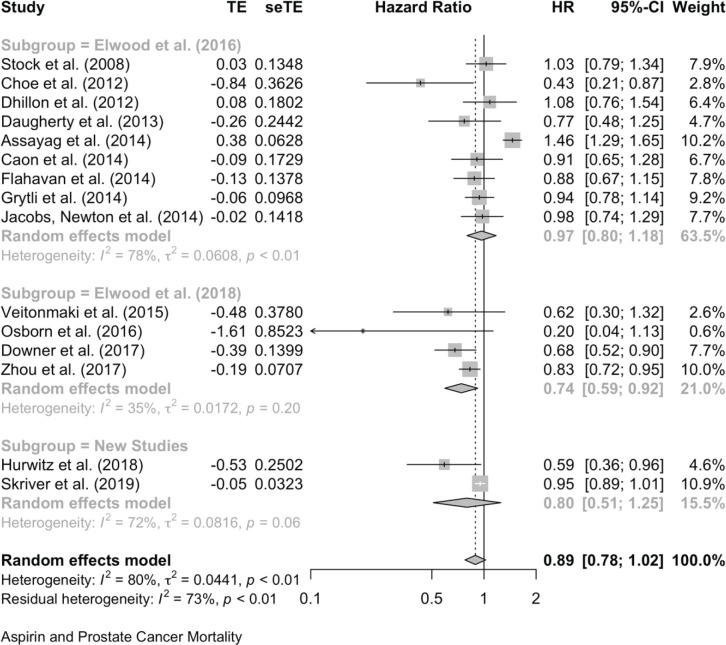
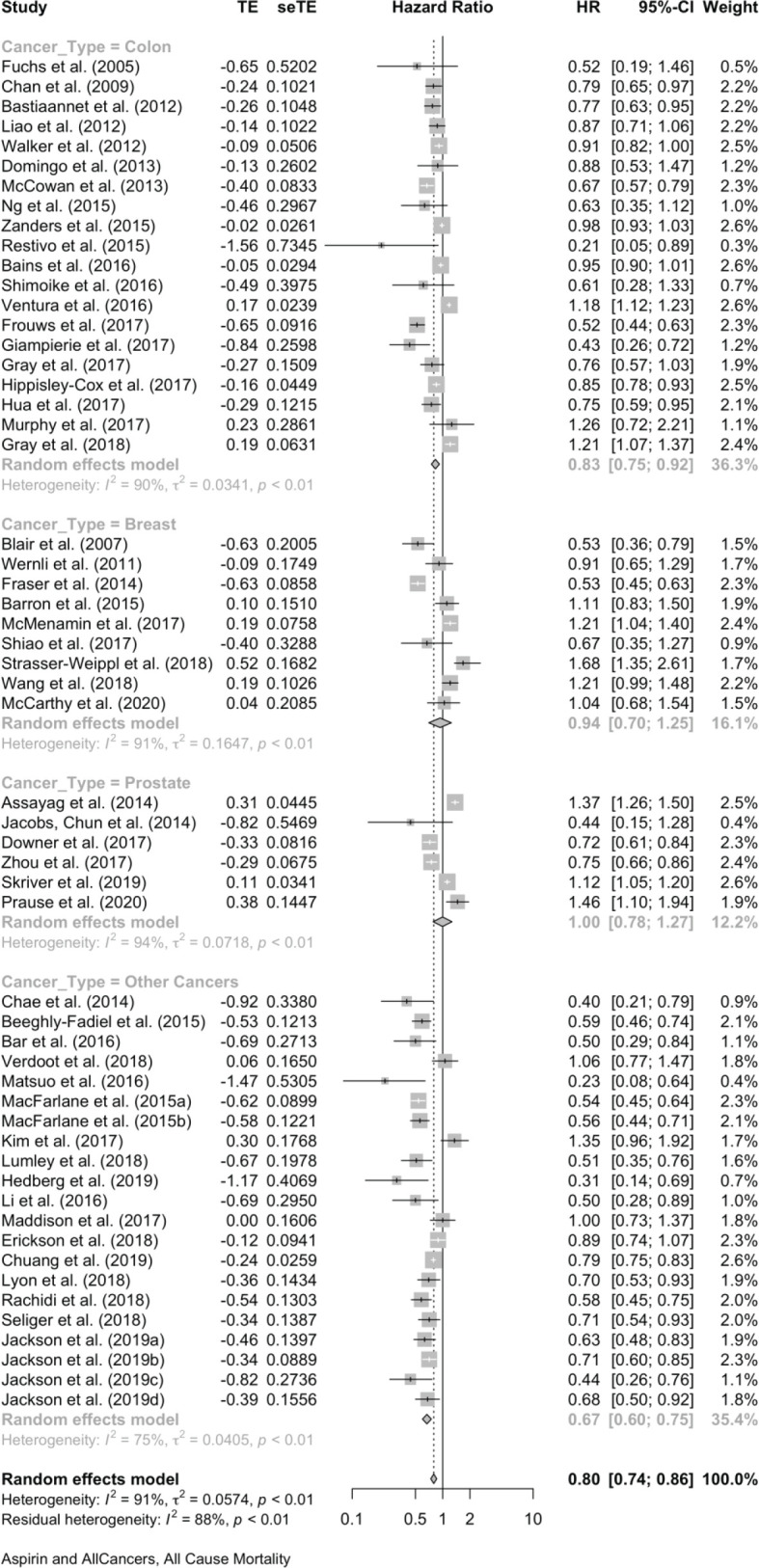
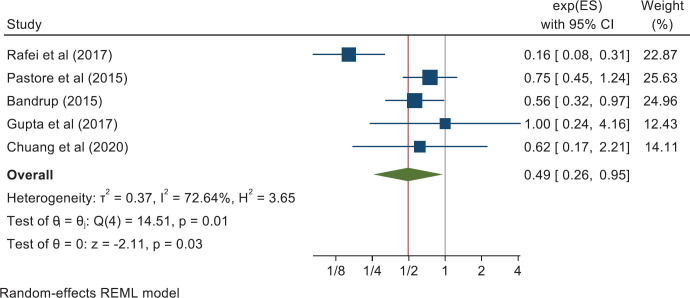
Three literature searches identified 118 published observational studies in patients with 18 different cancers. Eighty-one studies report on aspirin and cancer mortality and 63 studies report on all-cause mortality. Within a total of about a quarter of a million patients with cancer who reported taking aspirin, representing 20%-25% of the total cohort, we found aspirin to be associated with a reduction of about 20% in cancer deaths (pooled hazard ratio (HR): 0.79; 95% confidence intervals: 0.73, 0.84 in 70 reports and a pooled odds ratio (OR): 0.67; 0.45, 1.00 in 11 reports) with similar reductions in all-cause mortality (HR: 0.80; 0.74, 0.86 in 56 studies and OR: 0.57; 0.36, 0.89 in seven studies). The relative safety of aspirin taking was examined in the studies and the corresponding author of every paper was written to asking for additional information on bleeding. As expected, the frequency of bleeding increased in the patients taking aspirin, but fatal bleeding was rare and no author reported a significant excess in fatal bleeds associated with aspirin. No author mentioned cerebral bleeding in the patients they had followed.
There is a considerable body of evidence suggestive of about a 20% reduction in mortality in patients with cancer who take aspirin, and the benefit appears not to be restricted to one or a few cancers. Aspirin, therefore, appears to deserve serious consideration as an adjuvant treatment of cancer, and patients with cancer, and their carers, have a right to be informed of the available evidence.
尽管关于阿司匹林与癌症的研究论文不断积累,但对于阿司匹林是否是一种可接受且有效的癌症辅助治疗方法仍存在疑问。几项随机试验的结果尚未得出,这些试验应能为三种常见癌症(结肠癌、乳腺癌和前列腺癌)提供明确证据。然而,阿司匹林的生物学效应似乎与一般癌症以及转移扩散相关,而非仅与一种或几种癌症相关,并且已经有大量证据(主要来自观察性研究)表明阿司匹林与多种癌症患者的生存率之间存在关联。
为了检验服用阿司匹林与癌症患者生存率提高相关这一假设,我们进行了一系列系统的文献检索,以确定癌症患者的临床研究,其中一些患者在被诊断患有癌症后服用了阿司匹林。
三次文献检索共识别出118项已发表的关于18种不同癌症患者的观察性研究。81项研究报告了阿司匹林与癌症死亡率的关系,63项研究报告了全因死亡率。在总共约25万报告服用阿司匹林的癌症患者中,占总队列的20% - 25%,我们发现阿司匹林与癌症死亡减少约20%相关(合并风险比(HR):0.79;95%置信区间:70份报告中为0.73,0.84,11份报告中合并比值比(OR):0.67;0.45,1.00),全因死亡率也有类似程度的降低(56项研究中HR:0.80;0.74,0.86,7项研究中OR:0.57;0.36,0.89)。研究中对服用阿司匹林的相对安全性进行了检查,并致函每篇论文的通讯作者索要关于出血的更多信息。正如预期的那样,服用阿司匹林的患者出血频率增加,但致命性出血很少见,且没有作者报告与阿司匹林相关的致命性出血显著增加。没有作者提及他们所随访患者中的脑出血情况。
有大量证据表明,服用阿司匹林的癌症患者死亡率降低约20%,且这种益处似乎并不局限于一种或几种癌症。因此,阿司匹林似乎值得作为癌症辅助治疗方法进行认真考虑,癌症患者及其护理人员有权了解现有证据。