Zhan Li, Granade Timothy, Liu Yilin, Wei Xierong, Youngpairoj Ae, Sullivan Vickie, Johnson Jeff, Bischof John
Department of Mechanical Engineering, University of Minnesota, Minneapolis, MN USA.
Centers for Disease Control and Prevention, Atlanta, GA USA.
Microsyst Nanoeng. 2020 Jul 27;6:54. doi: 10.1038/s41378-020-0168-9. eCollection 2020.
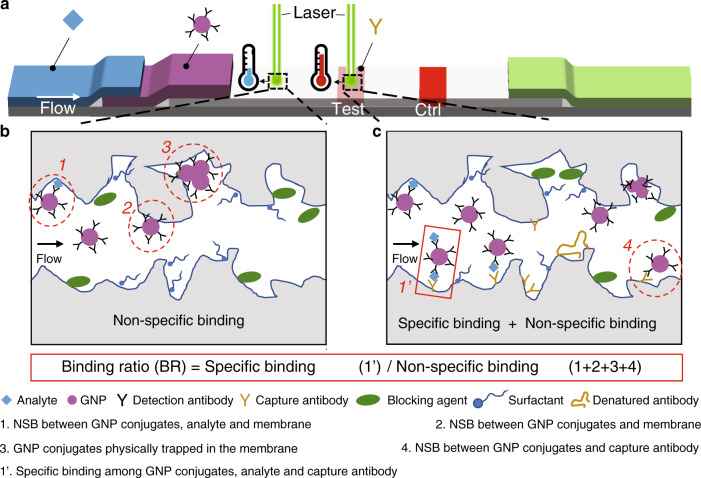
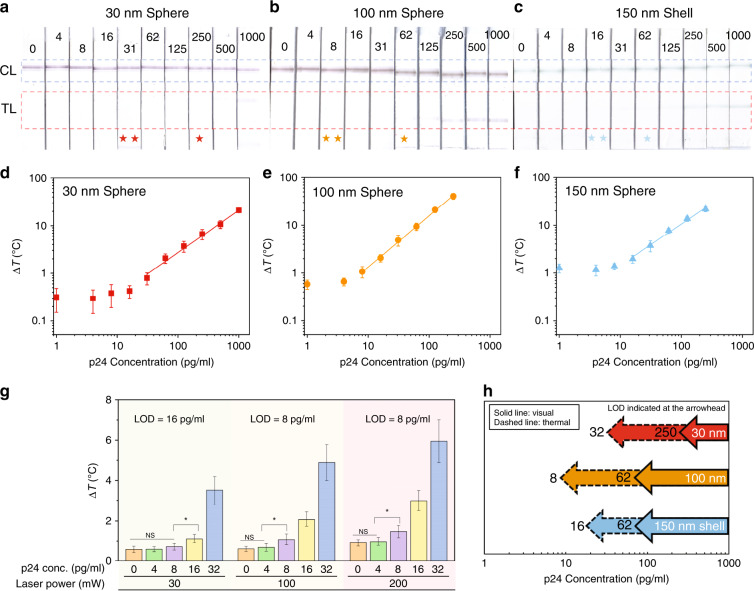
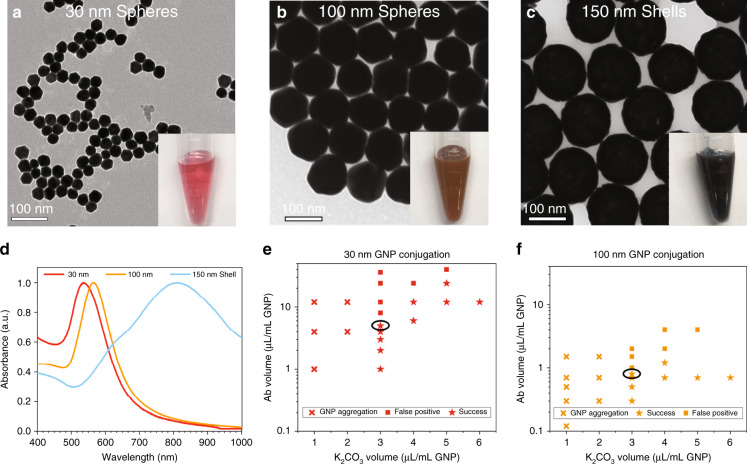
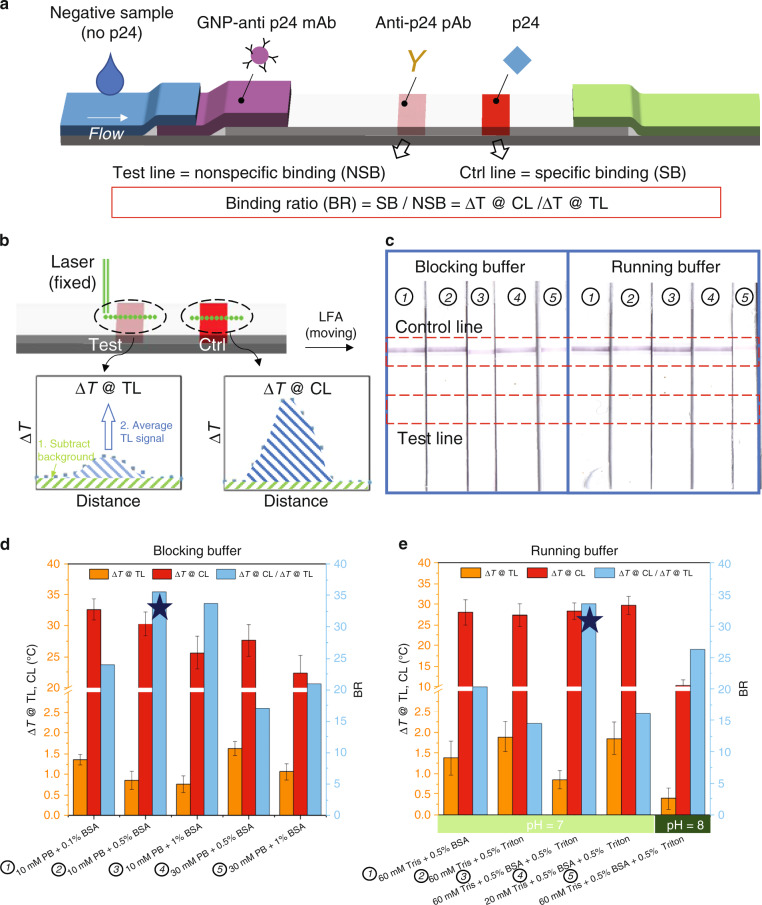
Detection of human immunodeficiency virus (HIV) p24 protein at a single pg/ml concentration in point-of-care (POC) settings is important because it can facilitate acute HIV infection diagnosis with a detection sensitivity approaching that of laboratory-based assays. However, the limit of detection (LOD) of lateral flow immunoassays (LFAs), the most prominent POC diagnostic platform, falls short of that of laboratory protein detection methods such as enzyme-linked immunosorbent assay (ELISA). Here, we report the development and optimization of a thermal contrast amplification (TCA) LFA that will allow ultrasensitive detection of 8 pg/ml p24 protein spiked into human serum at POC, approaching the LOD of a laboratory test. To achieve this aim, we pursued several innovations as follows: (a) defining a new quantitative figure of merit for LFA design based on the specific to nonspecific binding ratio (BR); (b) using different sizes and shapes of gold nanoparticles (GNPs) in the systematic optimization of TCA LFA designs; and (c) exploring new laser wavelengths and power regimes for TCA LFA designs. First, we optimized the blocking buffer for the membrane and running buffer by quantitatively measuring the BR using a TCA reader. The TCA reader interprets the thermal signal (i.e., temperature) of GNPs within the membrane when irradiated by a laser at the plasmon resonance wavelength of the particle. This process results in higher detection and quantitation of GNPs than in traditional visual detection (i.e., color intensity). Further, we investigated the effect of laser power (30, 100, 200 mW), GNP size and shape (30 and 100 nm gold spheres, 150 nm gold-silica shells), and laser wavelength (532, 800 nm). Applying these innovations to a new TCA LFA design, we demonstrated that 100 nm spheres with a 100 mW 532 nm laser provided the best performance (i.e., LOD = 8 pg/ml). This LOD is significantly better than that of the current colorimetric LFA and is in the range of the laboratory-based p24 ELISA. In summary, this TCA LFA for p24 protein shows promise for detecting acute HIV infection in POC settings.
在即时检测(POC)环境中检测浓度为单皮克/毫升的人类免疫缺陷病毒(HIV)p24蛋白非常重要,因为它有助于诊断急性HIV感染,其检测灵敏度接近基于实验室检测的方法。然而,最突出的POC诊断平台——侧向流动免疫分析(LFA)的检测限(LOD)低于酶联免疫吸附测定(ELISA)等实验室蛋白质检测方法。在此,我们报告了一种热对比度放大(TCA)LFA的开发和优化,该方法能够在POC环境中超灵敏地检测添加到人类血清中的8皮克/毫升p24蛋白,接近实验室检测的LOD。为实现这一目标,我们进行了以下几项创新:(a)基于特异性与非特异性结合率(BR)定义一种新的LFA设计定量品质因数;(b)在TCA LFA设计的系统优化中使用不同尺寸和形状的金纳米颗粒(GNP);(c)探索TCA LFA设计的新激光波长和功率范围。首先,我们通过使用TCA读数器定量测量BR来优化膜的封闭缓冲液和运行缓冲液。TCA读数器在颗粒的等离子体共振波长下用激光照射时,可解读膜内GNP的热信号(即温度)。与传统的视觉检测(即颜色强度)相比,这一过程能实现更高的GNP检测和定量。此外,我们研究了激光功率(30、100、200毫瓦)、GNP尺寸和形状(30和100纳米金球、150纳米金 - 二氧化硅壳)以及激光波长(532、800纳米)的影响。将这些创新应用于新的TCA LFA设计中,我们证明100纳米的球体与100毫瓦的532纳米激光提供了最佳性能(即LOD = 8皮克/毫升)。该LOD明显优于当前的比色LFA,且处于基于实验室的p24 ELISA范围内。总之,这种用于p24蛋白的TCA LFA在POC环境中检测急性HIV感染方面显示出前景。