Luo Anxin, Xu Yixin, Zhang Yulong, Zhang Mi, Zhang Xiaoqing, Lu Yan, Wang Fei
School of Microelectronics, Southern University of Science and Technology, 518055 Shenzhen, China.
State Key Laboratory of AMS-VLSI, Institute of Microelectronics, University of Macau (UM), 999078 Macao, China.
Microsyst Nanoeng. 2021 Feb 9;7:15. doi: 10.1038/s41378-021-00239-0. eCollection 2021.
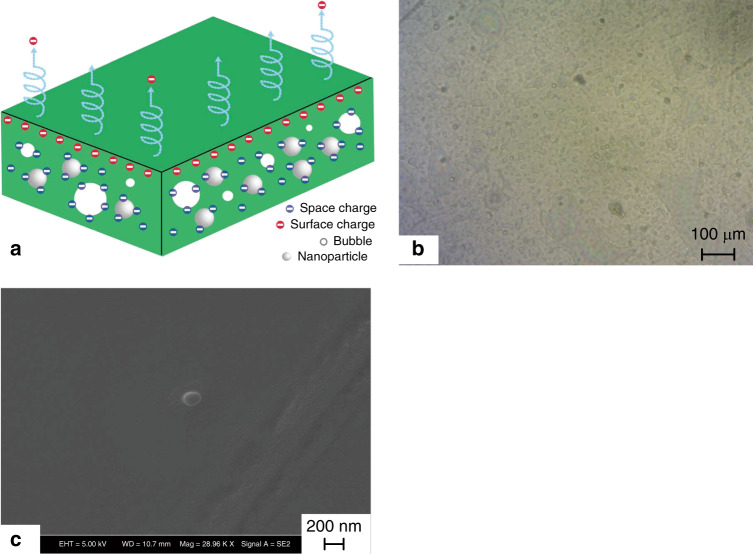
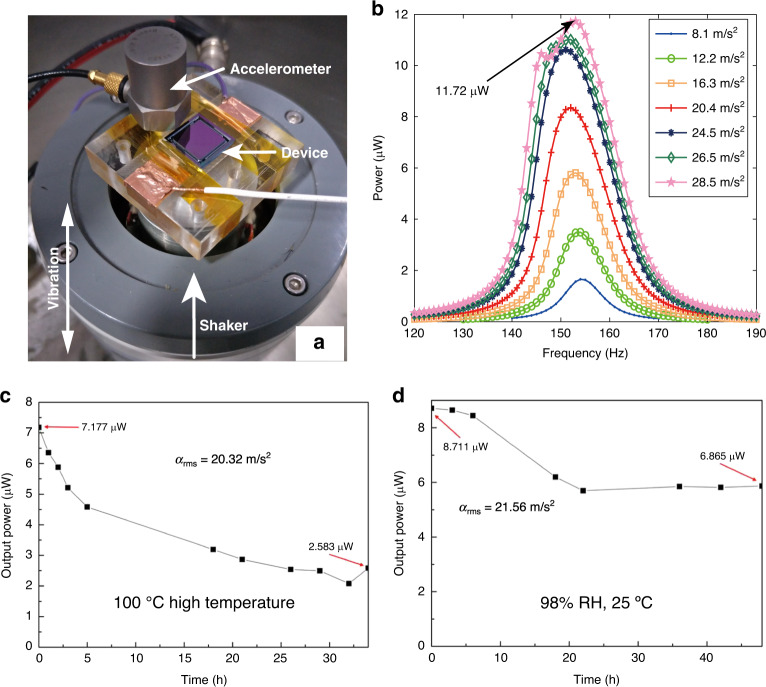
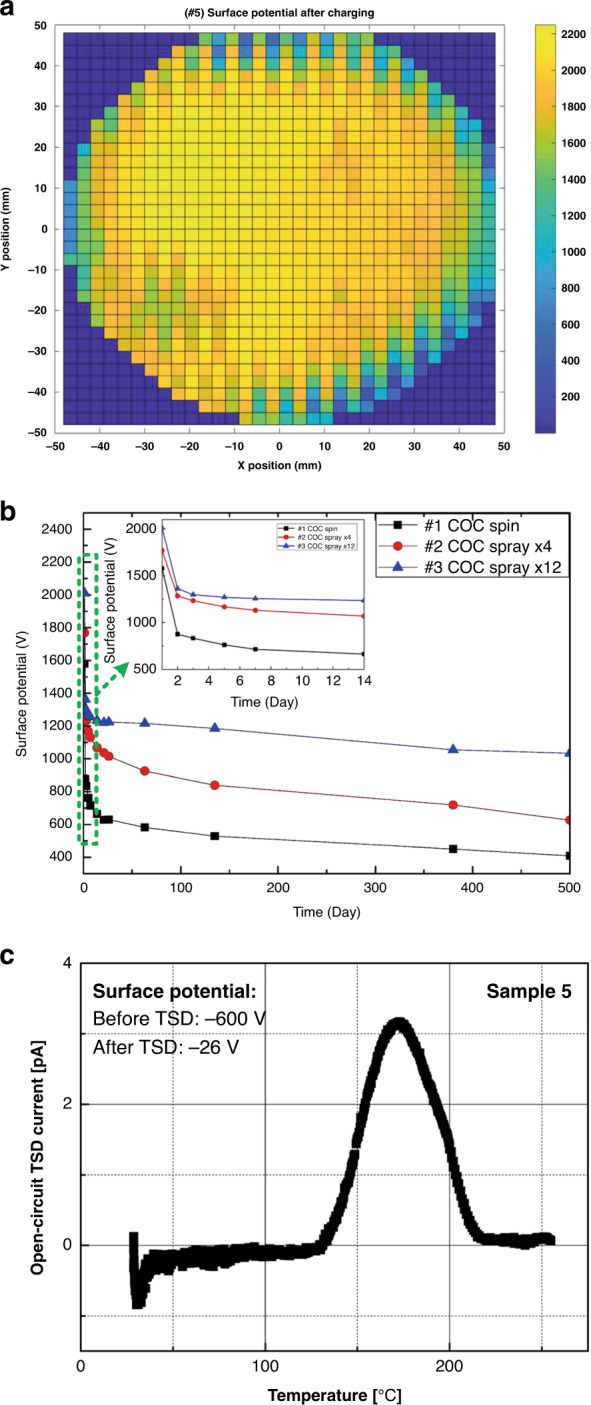
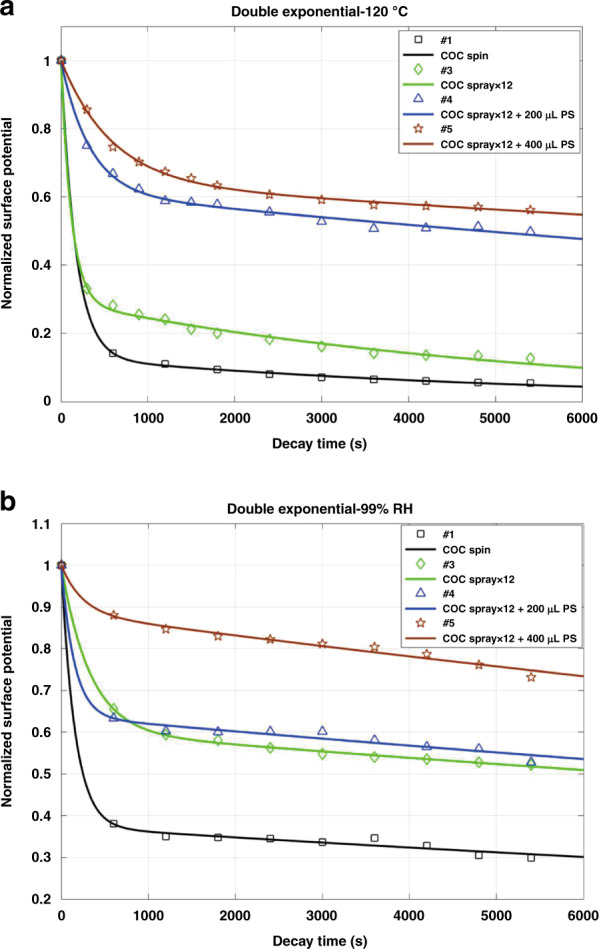
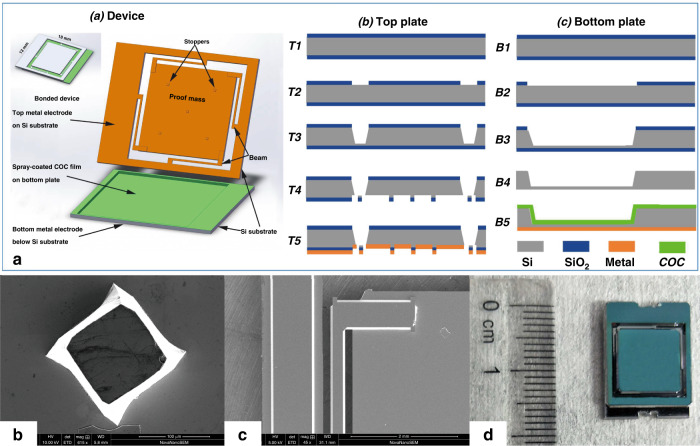
The charge stability of electret materials can directly affect the performance of electret-based devices such as electrostatic energy harvesters. In this paper, a spray-coating method is developed to deposit an electret layer with enhanced charge stability. The long-term stability of a spray-coated electret is investigated for 500 days and shows more stable performance than a spin-coated layer. A second-order linear model that includes both the surface charge and space charge is proposed to analyze the charge decay process of electrets in harsh environments at a high temperature (120 °C) and high humidity (99% RH); this model provides better accuracy than the traditional deep-trap model. To further verify the stability of the spray-coated electret, an electrostatic energy harvester is designed and fabricated with MEMS (micro-electromechanical systems) technology. The electret material can work as both the bonding interface and electret layer during fabrication. A maximum output power of 11.72 μW is harvested from a vibrating source at an acceleration of 28.5 m/s. When the energy harvester with the spray-coated electret is exposed to a harsh environment (100 °C and 98% RH), an adequate amount of power can still be harvested even after 34 h and 48 h, respectively.
驻极体材料的电荷稳定性会直接影响基于驻极体的器件性能,如静电能量收集器。本文开发了一种喷涂方法来沉积具有增强电荷稳定性的驻极体层。对喷涂驻极体的长期稳定性进行了500天的研究,结果表明其性能比旋涂层更稳定。提出了一个包含表面电荷和空间电荷的二阶线性模型,用于分析高温(120°C)和高湿度(99%相对湿度)恶劣环境下驻极体的电荷衰减过程;该模型比传统的深陷阱模型具有更高的精度。为进一步验证喷涂驻极体的稳定性,采用微机电系统(MEMS)技术设计并制作了一个静电能量收集器。驻极体材料在制作过程中既作为键合界面又作为驻极体层。在28.5 m/s²的加速度下,从振动源收集到的最大输出功率为11.72 μW。当带有喷涂驻极体的能量收集器暴露在恶劣环境(100°C和98%相对湿度)中时,即使分别经过34小时和48小时后,仍能收集到足够的功率。