Karataş Yusuf, Khan Zakir, Bilen Çağrı, Boz Aslı, Özagil Ezgi Sena Gören, Abussuutoğlu Ayşe Büşra, Rahman Hazir
Institute of Health Sciences, Faculty of Medicines, Department of Pharmacology, Cukurova University, Saricam, Adana, Turkey.
Department of Medical Education, Çukurova University, Saricam, Adana, Turkey.
Adv Integr Med. 2021 Dec;8(4):261-266. doi: 10.1016/j.aimed.2021.09.002. Epub 2021 Sep 20.
Coronavirus disease 2019 (COVID-19) caused a universal psychosocial impact, with many individuals exposed to threats preferring to try self-care interventions and non-conventional approaches such as traditional and complementary medicine (T&CM) for preventive purposes. This study was conducted to determine the use of and beliefs about T&CM among a subset of the general Turkish population during the COVID-19 outbreak.
A cross-sectional online survey was carried out among the general population (aged ≥ 18 years) of Adana, Turkey during the strict lockdown period (April 11 to April 30, 2020). The survey instrument included details about sociodemographic characteristics, general information, T&CM use and beliefs. It was distributed among eligible participants via social media channels (Instagram, WhatsApp and Facebook accounts).
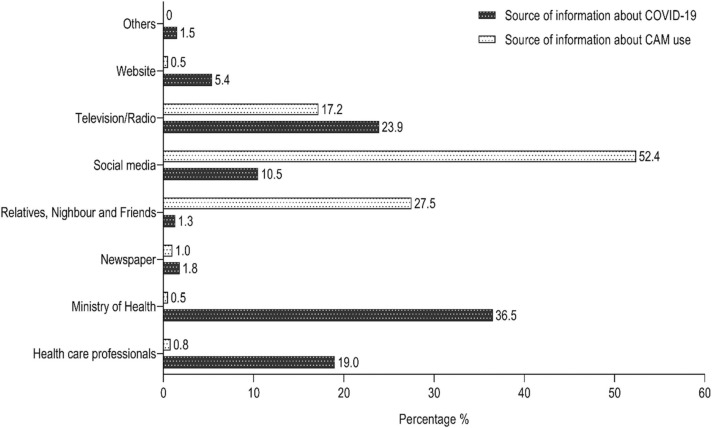
Out of a total 389 participants, 39.3% (n = 153) used T&CM and 60.7% were non-T&CM users during COVID-19. Of those using T&CM, 61 (39.8%) reported the usage of more than one form of T&CM, mostly herbal medicine (30.8%), followed by nutritional supplements/vitamins (23.8%). 33.9% (n = 52) of participants using T&CM did not report T&CM use to theirmedical physicians. A statistically significant difference was observed between T&CM users and non-T&CM users in gender, age, marital status, level of education, income, and prior use of T&CM (p < 0.05). Social media (n = 204; 52.4%) was the primary source of information for T&CM use. Overall, 33.7%, 54.8% and 39% of participants in this stduy believed that T&CM therapies are effective, have fever side-effects/safe and should be use for COVID-19, respectively.
During the outbreak of COVID-19, a significant proportion of the population reported the use of T&CM, with different beliefs about T&CM being observed. Better-structured T&CM-specific educational programs, enhanced physician-patient communication and access to reliable information are needed to ensure appropriate T&CM use during pandemics in Turkey.
2019年冠状病毒病(COVID-19)造成了普遍的社会心理影响,许多面临威胁的人更倾向于尝试自我护理干预措施以及诸如传统和补充医学(T&CM)等非常规方法来进行预防。本研究旨在确定COVID-19疫情期间土耳其普通人群中一部分人对传统和补充医学的使用情况及看法。
在严格封锁期间(2020年4月11日至4月30日),对土耳其阿达纳的普通人群(年龄≥18岁)进行了一项横断面在线调查。调查工具包括社会人口学特征、一般信息、传统和补充医学的使用情况及看法等详细信息。通过社交媒体渠道(Instagram、WhatsApp和Facebook账户)分发给符合条件的参与者。
在总共389名参与者中,39.3%(n = 153)在COVID-19期间使用了传统和补充医学,60.7%为非使用者。在使用传统和补充医学的人群中,61人(39.8%)报告使用了不止一种形式的传统和补充医学,其中大多是草药(30.8%),其次是营养补充剂/维生素(23.8%)。使用传统和补充医学的参与者中有33.9%(n = 52)未向其医生报告使用情况。在性别、年龄、婚姻状况、教育程度、收入以及之前是否使用过传统和补充医学方面,传统和补充医学使用者与非使用者之间存在统计学显著差异(p < 0.05)。社交媒体(n = 204;52.4%)是传统和补充医学使用信息的主要来源。总体而言,本研究中分别有33.7%、54.8%和39%的参与者认为传统和补充医学疗法有效、有轻微副作用/安全且应在COVID-19中使用。
在COVID-19疫情期间,相当一部分人群报告使用了传统和补充医学,且对其有不同看法。在土耳其应对疫情期间,需要更好地构建针对传统和补充医学的教育项目,加强医患沟通并提供可靠信息,以确保合理使用传统和补充医学。