Department of Social & Behavioral Sciences, School of Global Public Health, New York University, New York, NY, United States.
Ophthalmology, Department of Surgery, University of Melbourne, Melbourne, Australia.
JMIR Public Health Surveill. 2020 Oct 8;6(4):e21071. doi: 10.2196/21071.
During the COVID-19 pandemic, there is a heightened need to understand health information seeking behaviors to address disparities in knowledge and beliefs about the crisis.
This study assessed sociodemographic predictors of the use and trust of different COVID-19 information sources, as well as the association between information sources and knowledge and beliefs about the pandemic.
An online survey was conducted among US adults in two rounds during March and April 2020 using advertisement-based recruitment on social media. Participants were asked about their use of 11 different COVID-19 information sources as well as their most trusted source of information. The selection of COVID-related knowledge and belief questions was based on past empirical literature and salient concerns at the time of survey implementation.
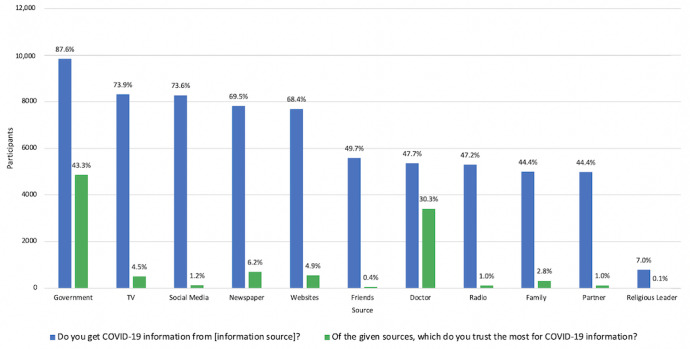
The sample consisted of 11,242 participants. When combined, traditional media sources (television, radio, podcasts, or newspapers) were the largest sources of COVID-19 information (91.2%). Among those using mainstream media sources for COVID-19 information (n=7811, 69.5%), popular outlets included CNN (24.0%), Fox News (19.3%), and other local or national networks (35.2%). The largest individual information source was government websites (87.6%). They were also the most trusted source of information (43.3%), although the odds of trusting government websites were lower among males (adjusted odds ratio [AOR] 0.58, 95% CI 0.53-0.63) and those aged 40-59 years and ≥60 years compared to those aged 18-39 years (AOR 0.83, 95% CI 0.74-0.92; AOR 0.62, 95% CI 0.54-0.71). Participants used an average of 6.1 sources (SD 2.3). Participants who were male, aged 40-59 years or ≥60 years; not working, unemployed, or retired; or Republican were likely to use fewer sources while those with children and higher educational attainment were likely to use more sources. Participants surveyed in April were markedly less likely to use (AOR 0.41, 95% CI 0.35-0.46) and trust (AOR 0.51, 95% CI 0.47-0.56) government sources. The association between information source and COVID-19 knowledge was mixed, while many COVID-19 beliefs were significantly predicted by information source; similar trends were observed with reliance on different types of mainstream media outlets.
COVID-19 information source was significantly determined by participant sociodemographic characteristics and was also associated with both knowledge and beliefs about the pandemic. Study findings can help inform COVID-19 health communication campaigns and highlight the impact of using a variety of different and trusted information sources.
在 COVID-19 大流行期间,人们需要深入了解健康信息搜索行为,以解决有关危机的知识和信念方面的差异。
本研究评估了社会人口统计学因素对不同 COVID-19 信息来源的使用和信任的预测作用,以及信息来源与对大流行的知识和信念之间的关联。
在 2020 年 3 月至 4 月期间,通过社交媒体上的基于广告的招募,在美国成年人中进行了两次在线调查。参与者被问及他们对 11 种不同 COVID-19 信息来源的使用情况以及他们最信任的信息来源。与 COVID 相关的知识和信仰问题的选择基于过去的经验文献和调查实施时的突出问题。
该样本由 11242 名参与者组成。当组合使用时,传统媒体来源(电视、广播、播客或报纸)是 COVID-19 信息的最大来源(91.2%)。在使用主流媒体来源获取 COVID-19 信息的人群中(n=7811,69.5%),受欢迎的渠道包括 CNN(24.0%)、Fox News(19.3%)和其他本地或国家网络(35.2%)。最大的个人信息来源是政府网站(87.6%)。它们也是最受信任的信息来源(43.3%),尽管男性(调整后的优势比[OR]0.58,95%置信区间[CI]0.53-0.63)和 40-59 岁以及≥60 岁的参与者比 18-39 岁的参与者更有可能不信任政府网站(调整后的优势比[OR]0.83,95%置信区间[CI]0.74-0.92;OR 0.62,95% CI 0.54-0.71)。参与者平均使用 6.1 个来源(SD 2.3)。男性、40-59 岁或≥60 岁、不工作、失业或退休、或共和党人的参与者更有可能使用较少的来源,而有孩子和受过高等教育的参与者更有可能使用更多的来源。在四月份接受调查的参与者明显不太可能使用(调整后的优势比[OR]0.41,95%置信区间[CI]0.35-0.46)和信任(调整后的优势比[OR]0.51,95%置信区间[CI]0.47-0.56)政府来源。信息来源与 COVID-19 知识之间的关联是复杂的,而许多 COVID-19 信念都与信息来源显著相关;对不同类型主流媒体渠道的依赖也观察到了类似的趋势。
COVID-19 信息来源主要由参与者的社会人口统计学特征决定,同时也与对大流行的知识和信念有关。研究结果可以帮助为 COVID-19 健康传播活动提供信息,并强调使用各种不同和受信任的信息来源的影响。