MRIGlobal, Gaithersburg, MD, United States.
EpiPointe, LLC, Cary, NC, United States.
Front Public Health. 2021 Sep 10;9:659695. doi: 10.3389/fpubh.2021.659695. eCollection 2021.
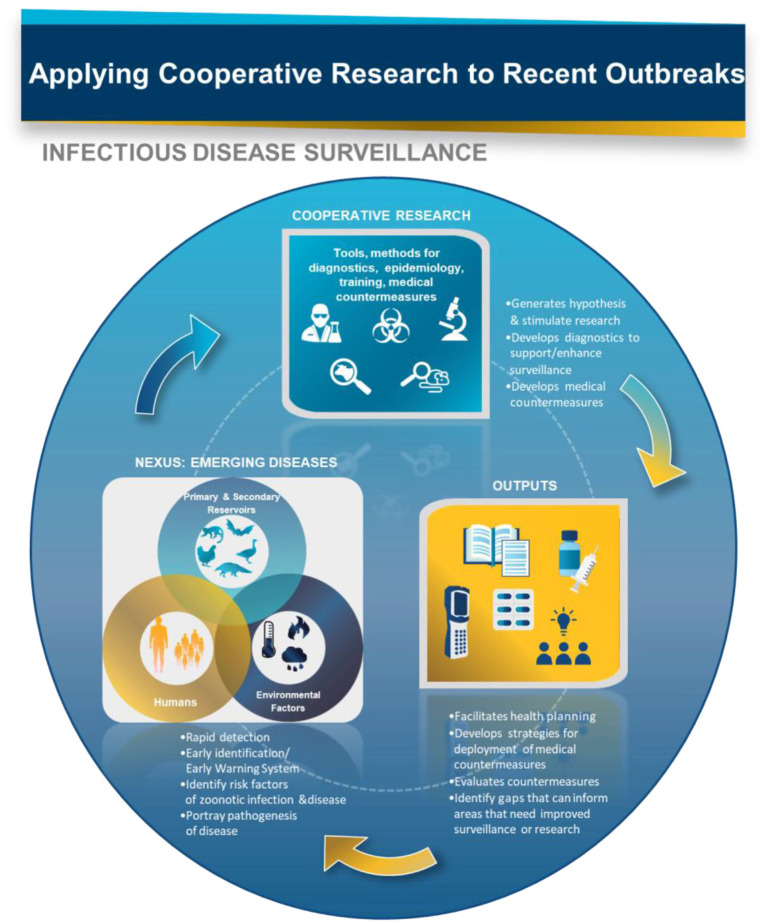
The current COVID-19 pandemic demonstrates the need for urgent and on-demand solutions to provide diagnostics, treatment and preventative measures for infectious disease outbreaks. Once solutions are developed, meeting capacities depends on the ability to mitigate technical, logistical and production issues. While it is difficult to predict the next outbreak, augmenting investments in preparedness, such as infectious disease surveillance, is far more effective than mustering last-minute response funds. Bringing research outputs into practice sooner rather than later is part of an agile approach to pivot and deliver solutions. Cooperative multi- country research programs, especially those funded by global biosecurity programs, develop capacity that can be applied to infectious disease surveillance and research that enhances detection, identification, and response to emerging and re-emerging pathogens with epidemic or pandemic potential. Moreover, these programs enhance trust building among partners, which is essential because setting expectation and commitment are required for successful research and training. Measuring research outputs, evaluating outcomes and justifying continual investments are essential but not straightforward. Lessons learned include those related to reducing biological threats and maturing capabilities for national laboratory diagnostics strategy and related health systems. Challenges, such as growing networks, promoting scientific transparency, data and material sharing, sustaining funds and developing research strategies remain to be fully resolved. Here, experiences from several programs highlight successful partnerships that provide ways forward to address the next outbreak.
当前的 COVID-19 大流行表明,需要紧急和按需的解决方案,为传染病爆发提供诊断、治疗和预防措施。一旦开发出解决方案,满足能力取决于减轻技术、后勤和生产问题的能力。虽然很难预测下一次疫情爆发,但增加对传染病监测等防范措施的投资,远比紧急筹集应对资金更为有效。尽快将研究成果付诸实践,是采取灵活方法调整和提供解决方案的一部分。合作的多国研究计划,特别是那些由全球生物安全计划资助的计划,开发了可以应用于传染病监测和研究的能力,这些研究可以提高对具有流行或大流行潜力的新发和再发病原体的检测、识别和应对能力。此外,这些计划还增强了合作伙伴之间的信任,这是至关重要的,因为成功的研究和培训需要设定期望和承诺。衡量研究成果、评估结果和证明持续投资的合理性是必不可少的,但并不简单。吸取的教训包括与减少生物威胁和成熟国家实验室诊断战略及相关卫生系统能力有关的教训。挑战,如不断扩大的网络、促进科学透明度、数据和材料共享、维持资金和制定研究战略,仍有待完全解决。这里,来自几个计划的经验突出了成功的伙伴关系,为应对下一次疫情爆发提供了途径。