Biosecurity and Public Health, Los Alamos National Laboratory, Los Alamos, NM, United States.
Front Public Health. 2021 Mar 1;9:648424. doi: 10.3389/fpubh.2021.648424. eCollection 2021.
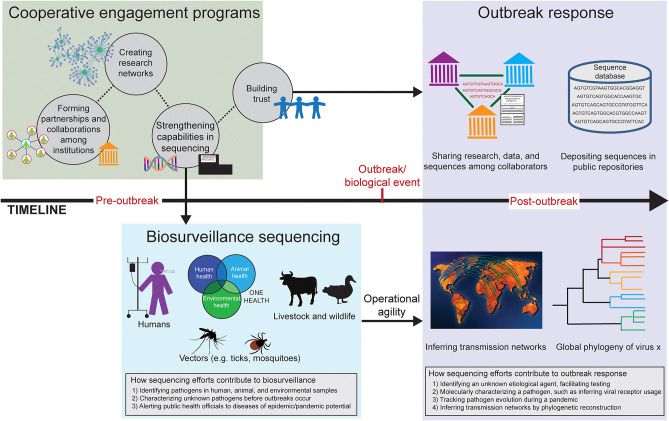
The threat of emerging and re-emerging infectious diseases continues to be a challenge to public and global health security. Cooperative biological engagement programs act to build partnerships and collaborations between scientists and health professionals to strengthen capabilities in biosurveillance. Biosurveillance is the systematic process of detecting, reporting, and responding to especially dangerous pathogens and pathogens of pandemic potential before they become outbreaks, epidemics, and pandemics. One important tool in biosurveillance is next generation sequencing. Expensive sequencing machines, reagents, and supplies make it difficult for countries to adopt this technology. Cooperative engagement programs help by providing funding for technical assistance to strengthen sequencing capabilities. Through workshops and training, countries are able to learn sequencing and bioinformatics, and implement these tools in their biosurveillance programs. Cooperative programs have an important role in building and sustaining collaborations among institutions and countries. One of the most important pieces in fostering these collaborations is trust. Trust provides the confidence that a successful collaboration will benefit all parties involved. With sequencing, this enables the sharing of pathogen samples and sequences. Obtaining global sequencing data helps to identify unknown etiological agents, track pathogen evolution and infer transmission networks throughout the duration of a pandemic. Having sequencing technology in place for biosurveillance generates the capacity to provide real-time data to understand and respond to pandemics. We highlight the need for these programs to continue to strengthen sequencing in biosurveillance. By working together to strengthen sequencing capabilities, trust can be formed, benefitting global health in the face of biological threats.
新发和再现传染病的威胁继续对公共卫生和全球卫生安全构成挑战。合作性生物参与计划旨在建立科学家和卫生专业人员之间的伙伴关系和合作,以加强生物监测能力。生物监测是在特别危险的病原体和具有大流行潜力的病原体成为暴发、流行和大流行之前,对其进行检测、报告和应对的系统过程。生物监测的一个重要工具是下一代测序。昂贵的测序仪器、试剂和耗材使得各国难以采用这项技术。合作参与计划通过提供技术援助资金来帮助加强测序能力。通过研讨会和培训,各国能够学习测序和生物信息学,并在其生物监测计划中实施这些工具。合作计划在机构和国家之间建立和维持合作方面发挥着重要作用。在促进这些合作方面,最重要的一点是信任。信任提供了一种信心,即成功的合作将使所有相关方受益。通过测序,可以共享病原体样本和序列。获得全球测序数据有助于确定未知的病因,跟踪病原体的进化,并推断大流行期间的传播网络。在生物监测中拥有测序技术可以实时提供数据,以了解和应对大流行。我们强调需要继续加强这些计划在生物监测中的测序能力。通过共同努力加强测序能力,可以建立信任,在面对生物威胁时造福全球健康。