Ruth Sara R A, Kim Min-Gu, Oda Hiroki, Wang Zhen, Khan Yasser, Chang James, Fox Paige M, Bao Zhenan
Department of Chemical Engineering, Stanford University, Stanford, CA, USA.
Division of Plastic and Reconstructive Surgery, Stanford University School of Medicine, Stanford, CA, USA.
iScience. 2021 Sep 2;24(9):103079. doi: 10.1016/j.isci.2021.103079. eCollection 2021 Sep 24.
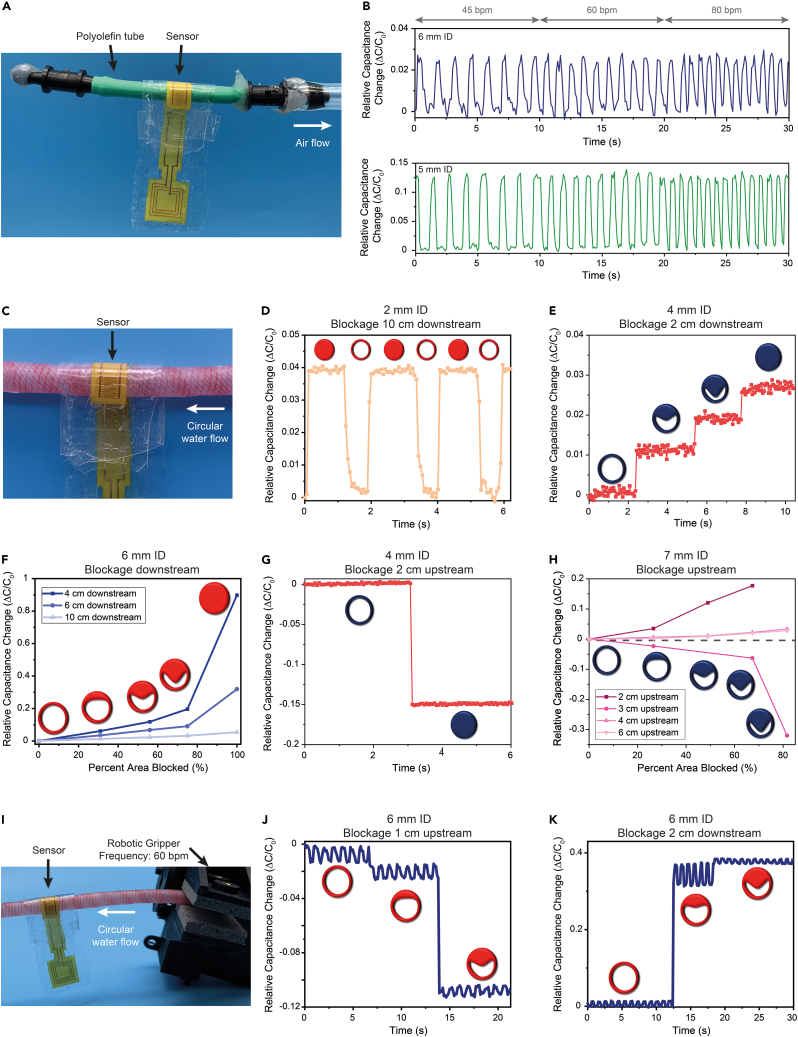
Early detection of limb ischemia, strokes, and heart attacks may be enabled via long-term monitoring of arterial health. Early stenosis, decreased blood flow, and clots are common after surgical vascular bypass or plaque removal from a diseased vessel and can lead to the above diseases. Continuous arterial monitoring for the early diagnosis of such complications is possible by implanting a sensor during surgery that is wirelessly monitored by patients after surgery. Here, we report the design of a wireless capacitive sensor wrapped around the artery during surgery for continuous post-operative monitoring of arterial health. The sensor responds to diverse artery sizes and extents of occlusion in vitro to at least 20 cm upstream and downstream of the sensor. It demonstrated strong capability to monitor progression of arterial occlusion in human cadaver and small animal models. This technology is promising for wireless monitoring of arterial health for pre-symptomatic disease detection and prevention.
通过对动脉健康状况进行长期监测,或许能够实现对肢体缺血、中风和心脏病发作的早期检测。在进行外科血管搭桥手术或从患病血管中清除斑块后,早期狭窄、血流减少和血栓形成较为常见,这些情况可能会引发上述疾病。通过在手术期间植入一种传感器,并在术后由患者进行无线监测,就能够持续监测动脉状况,以便早期诊断此类并发症。在此,我们报告一种无线电容式传感器的设计,该传感器在手术期间环绕动脉,用于术后对动脉健康状况进行持续监测。该传感器在体外对不同大小的动脉以及至少在传感器上下游20厘米范围内的闭塞程度均有响应。它在人体尸体和小动物模型中展现出强大的监测动脉闭塞进展的能力。这项技术有望用于对动脉健康状况进行无线监测,以实现症状前疾病的检测和预防。