Department of Internal Medicine, College of Medicine, 37128The Catholic University of Korea, Seoul, Republic of Korea.
The Catholic Liver Research Center, College of Medicine, 37128The Catholic University of Korea, Seoul, Republic of Korea.
Cancer Control. 2021 Jan-Dec;28:10732748211039758. doi: 10.1177/10732748211039758.
This retrospective study aimed to investigate the impact of positive hepatitis B core antibody (anti-HBc) and metabolic disorders on clinical characteristics of hepatocellular carcinoma (HCC) patients in an HBV-endemic area.
A total of 1950 consecutive patients newly diagnosed with HCC between 2002 and 2015 were included. Patient records were reviewed. We compared non-viral and non-alcoholic HCC patients with other etiological groups for HCC. In addition, we compared HCC patients with negative hepatitis B surface antigen (HBsAg) and positive anti-HBc to those with negative HBsAg and negative anti-HBc, and to those with HBV.
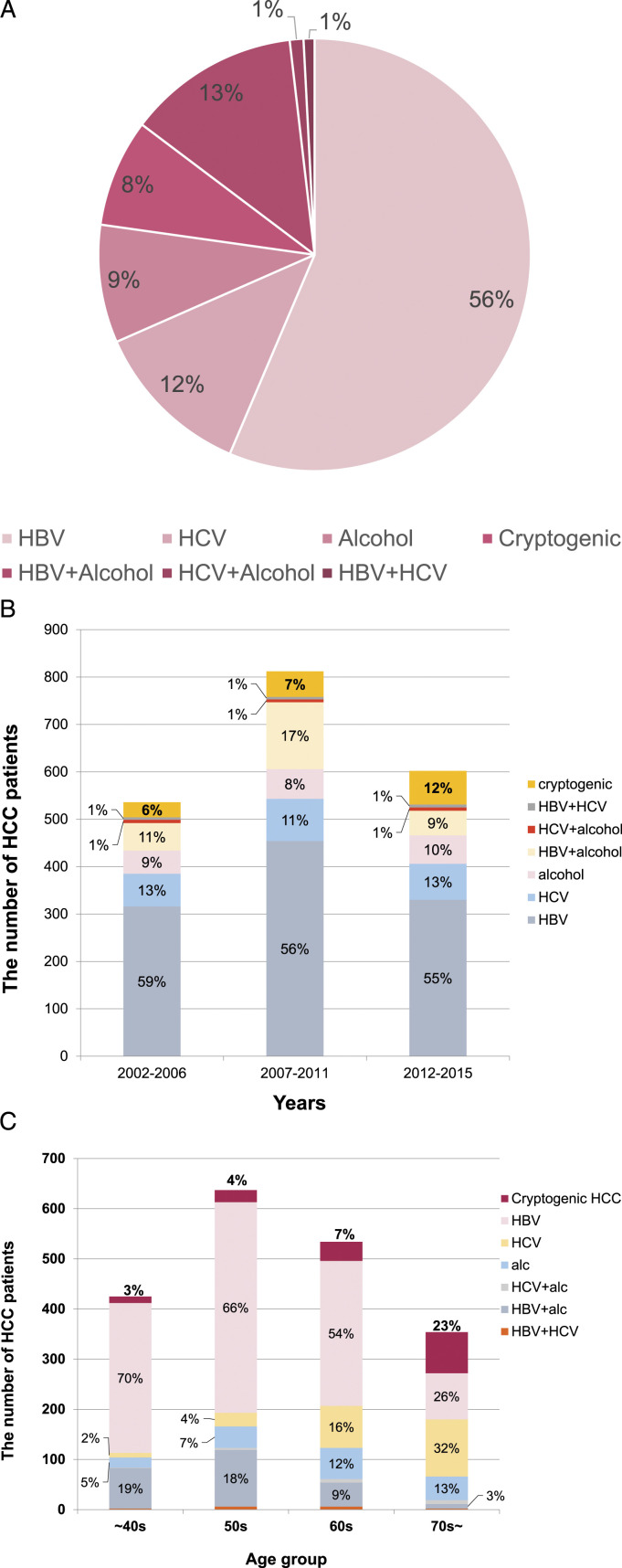
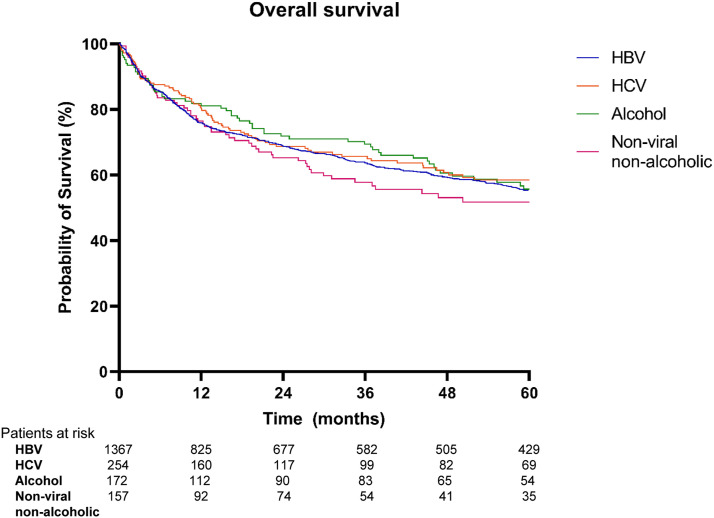
The prevalence of non-viral and non-alcoholic HCC increased from 7% in 2002-2011 to 12% in 2012-2015. The proportion of non-viral and non-alcoholic HCC gradually increased with age. Patients with non-viral and non-alcoholic HCC exhibited higher rates of metabolic disorders and preserved liver function. The rate of anti-HBc positivity was similarly high in all HCC etiological groups. The clinical features of HCC patients with negative HBsAg and positive anti-HBc were similar to those with negative HBsAg and negative anti-HBc, but significantly different from those with HBV HCC. Regarding tumor characteristics, patients in the non-viral and non-alcoholic HCC group had more advanced stages of tumors (mUICC stage III-V and BCLC stage C/D). There was no significant difference in overall survival among the patient groups. The presence of anti-HBc did not affect patient survival.
Patients with non-viral and non-alcoholic HCC had a relatively high prevalence of metabolic disorders and preserved liver function. However, they had advanced tumor stage compared to patients from other etiological groups. Anti-HBc positivity did not affect the clinical characteristics or prognosis of non-HBV HCC patients in this study.
本回顾性研究旨在探讨乙型肝炎病毒(HBV)流行地区阳性乙型肝炎核心抗体(抗-HBc)和代谢紊乱对肝细胞癌(HCC)患者临床特征的影响。
共纳入 1950 例 2002 年至 2015 年间新诊断为 HCC 的连续患者。回顾患者病历。我们将非病毒性和非酒精性 HCC 患者与其他病因组的 HCC 患者进行比较。此外,我们将 HBsAg 阴性和抗-HBc 阳性的 HCC 患者与 HBsAg 阴性和抗-HBc 阴性的 HCC 患者以及 HBV 患者进行比较。
非病毒性和非酒精性 HCC 的患病率从 2002-2011 年的 7%上升至 2012-2015 年的 12%。非病毒性和非酒精性 HCC 的比例随年龄增长而逐渐增加。非病毒性和非酒精性 HCC 患者的代谢紊乱和肝功能保留率较高。所有 HCC 病因组的抗-HBc 阳性率相似。HBsAg 阴性和抗-HBc 阳性的 HCC 患者的临床特征与 HBsAg 阴性和抗-HBc 阴性的 HCC 患者相似,但与 HBV HCC 患者明显不同。在肿瘤特征方面,非病毒性和非酒精性 HCC 组患者的肿瘤分期更晚(mUICC 分期 III-V 和 BCLC 分期 C/D)。各组患者的总生存率无显著差异。抗-HBc 的存在并不影响患者的生存。
非病毒性和非酒精性 HCC 患者代谢紊乱和肝功能保留的患病率相对较高。然而,与其他病因组的患者相比,他们的肿瘤分期更晚。在本研究中,抗-HBc 阳性并不影响非 HBV HCC 患者的临床特征或预后。