Institute of Cognitive Neuroscience, University College London, London, United Kingdom.
Nuffield Department of Clinical Neurosciences, University of Oxford, Oxford, United Kingdom.
PLoS Comput Biol. 2021 Sep 27;17(9):e1009434. doi: 10.1371/journal.pcbi.1009434. eCollection 2021 Sep.
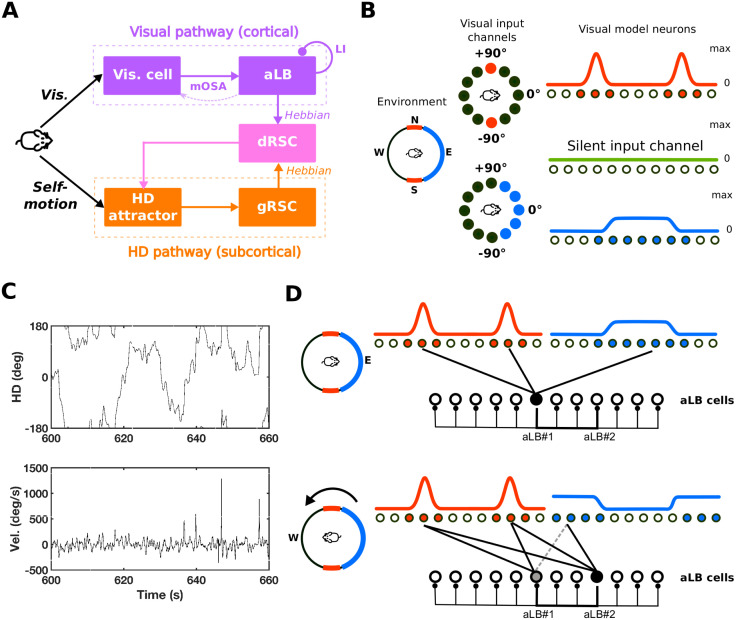
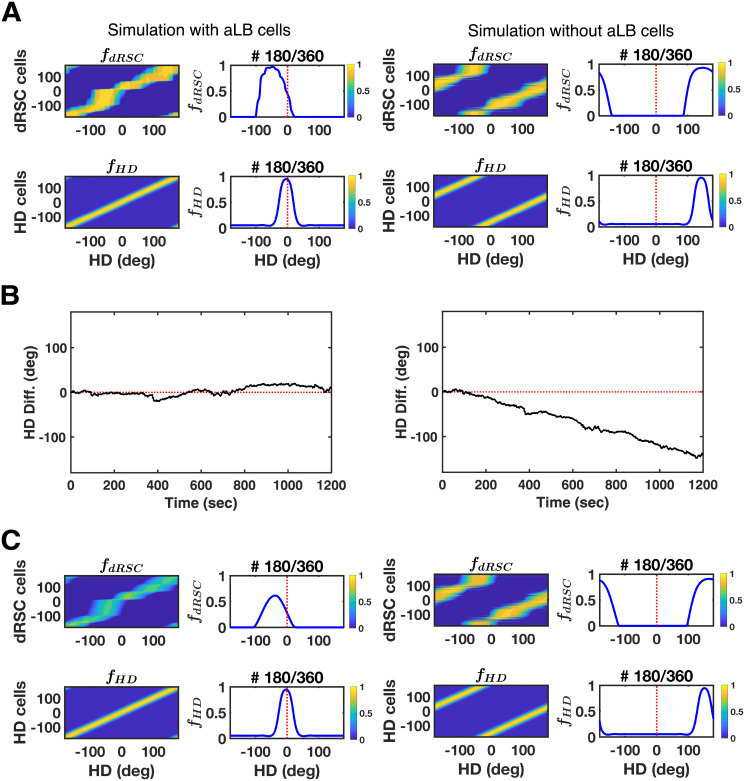
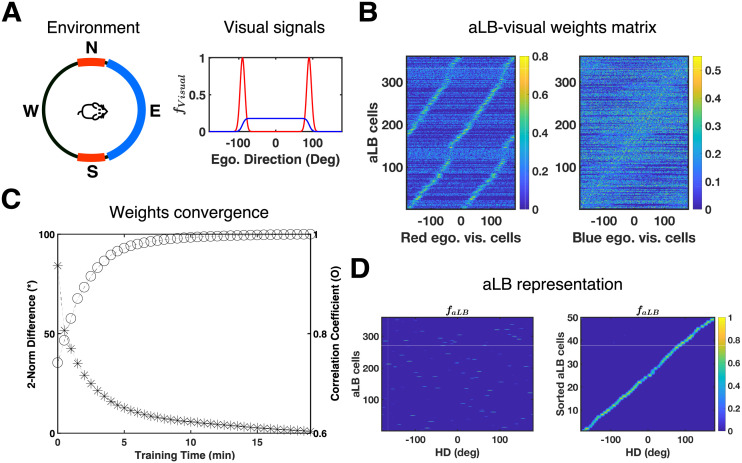
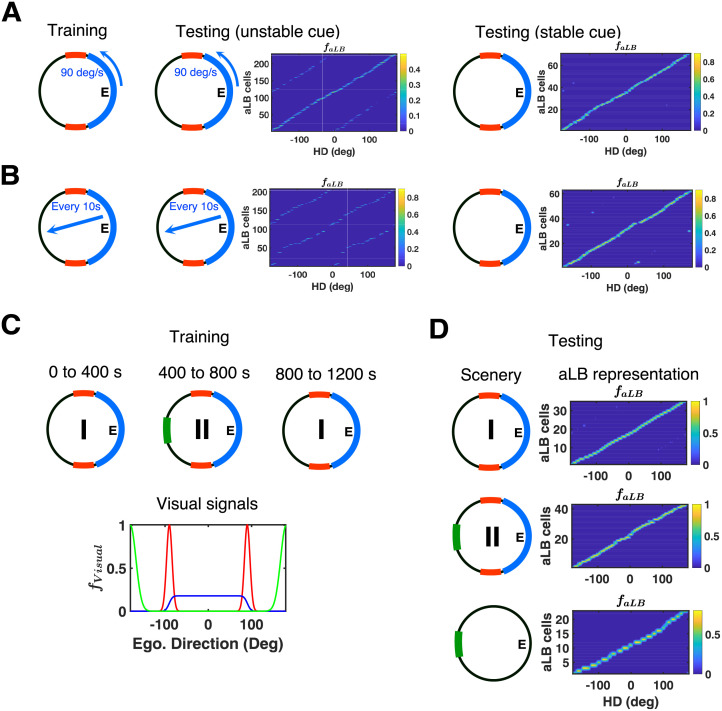
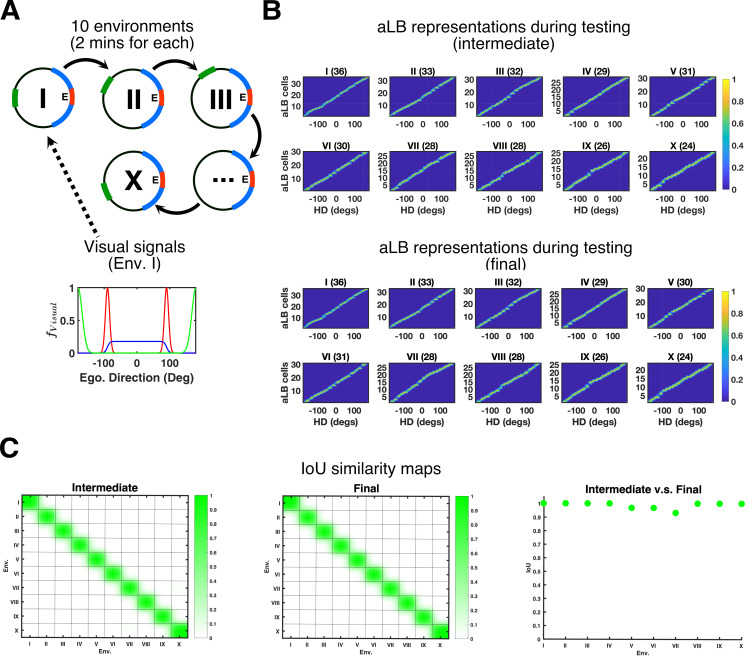
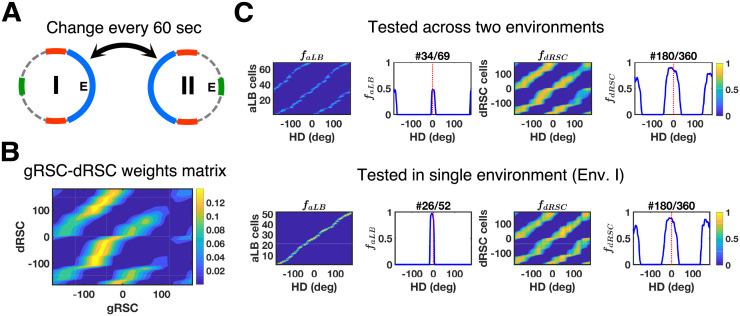
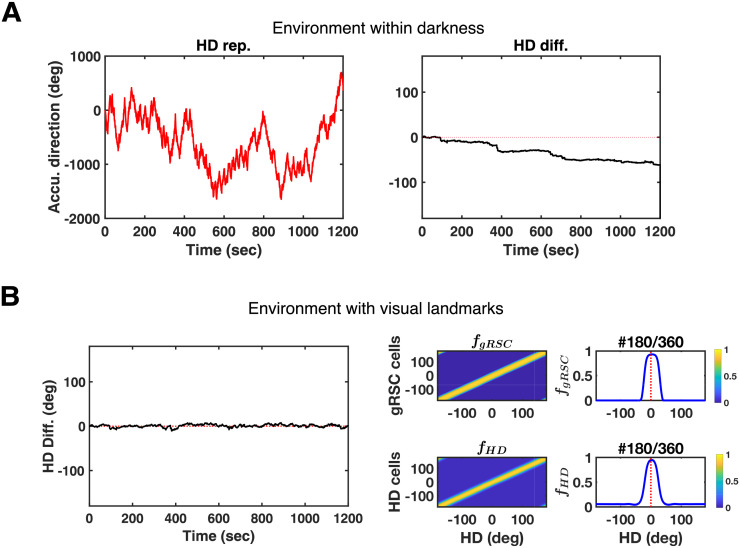
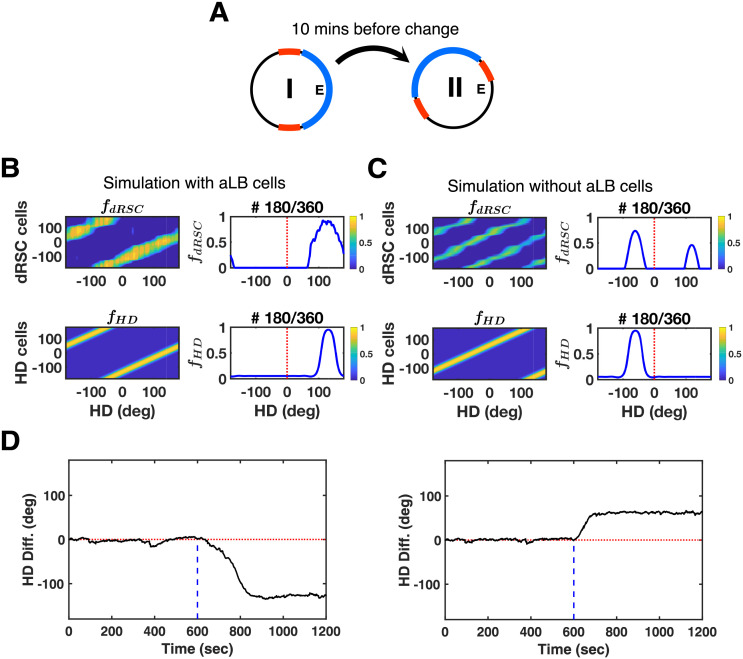
Environmental information is required to stabilize estimates of head direction (HD) based on angular path integration. However, it is unclear how this happens in real-world (visually complex) environments. We present a computational model of how visual feedback can stabilize HD information in environments that contain multiple cues of varying stability and directional specificity. We show how combinations of feature-specific visual inputs can generate a stable unimodal landmark bearing signal, even in the presence of multiple cues and ambiguous directional specificity. This signal is associated with the retrosplenial HD signal (inherited from thalamic HD cells) and conveys feedback to the subcortical HD circuitry. The model predicts neurons with a unimodal encoding of the egocentric orientation of the array of landmarks, rather than any one particular landmark. The relationship between these abstract landmark bearing neurons and head direction cells is reminiscent of the relationship between place cells and grid cells. Their unimodal encoding is formed from visual inputs via a modified version of Oja's Subspace Algorithm. The rule allows the landmark bearing signal to disconnect from directionally unstable or ephemeral cues, incorporate newly added stable cues, support orientation across many different environments (high memory capacity), and is consistent with recent empirical findings on bidirectional HD firing reported in the retrosplenial cortex. Our account of visual feedback for HD stabilization provides a novel perspective on neural mechanisms of spatial navigation within richer sensory environments, and makes experimentally testable predictions.
环境信息对于基于角度路径积分来稳定头部方向 (HD) 的估计是必需的。然而,在现实世界(视觉复杂)环境中,这种情况是如何发生的尚不清楚。我们提出了一个计算模型,用于研究视觉反馈如何在包含多种稳定性和方向特异性不同的线索的环境中稳定 HD 信息。我们展示了如何通过特定于特征的视觉输入的组合来生成稳定的单峰地标方位信号,即使存在多个线索和模糊的方向特异性。该信号与后穹窿 HD 信号(从丘脑 HD 细胞继承而来)相关联,并将反馈传递给皮质下 HD 电路。该模型预测具有地标阵列的自我中心方向的单峰编码的神经元,而不是任何一个特定的地标。这些抽象地标方位神经元与头部方向细胞之间的关系让人联想到位置细胞和网格细胞之间的关系。它们的单峰编码是通过视觉输入通过 Oja 的子空间算法的修改版本形成的。该规则允许地标方位信号与方向不稳定或短暂的线索断开连接,纳入新添加的稳定线索,支持许多不同环境中的方向(高内存容量),并与最近在后穹窿皮层中报告的双向 HD 发射的经验发现一致。我们对 HD 稳定化的视觉反馈的解释为更丰富的感官环境中的空间导航神经机制提供了新的视角,并提出了可进行实验检验的预测。