Department of Neurosurgery, Faculty of Medicine and University Hospital Düsseldorf, Heinrich-Heine University Düsseldorf, Moorenstrasse 5, D-40225 Düsseldorf, Germany.
Department of Neurosurgery, University of Helsinki and Helsinki University Hospital, 00100 Helsinki, Finland.
Cells. 2021 Sep 15;10(9):2429. doi: 10.3390/cells10092429.
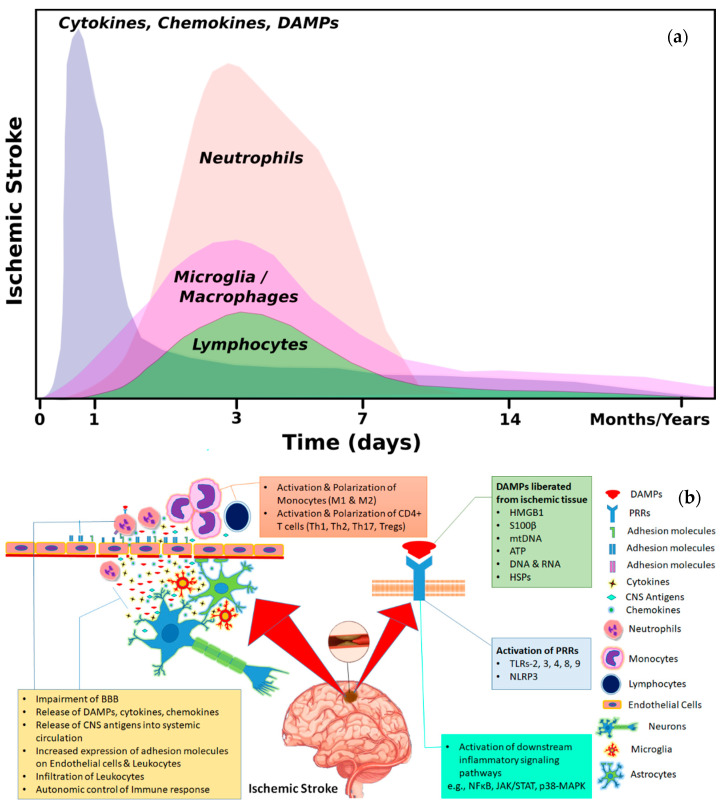
Ischemic stroke is still among the leading causes of mortality and morbidity worldwide. Despite intensive advancements in medical sciences, the clinical options to treat ischemic stroke are limited to thrombectomy and thrombolysis using tissue plasminogen activator within a narrow time window after stroke. Current state of the art knowledge reveals the critical role of local and systemic inflammation after stroke that can be triggered by interactions taking place at the brain and immune system interface. Here, we discuss different cellular and molecular mechanisms through which brain-immune interactions can take place. Moreover, we discuss the evidence how the brain influence immune system through the release of brain derived antigens, damage-associated molecular patterns (DAMPs), cytokines, chemokines, upregulated adhesion molecules, through infiltration, activation and polarization of immune cells in the CNS. Furthermore, the emerging concept of stemness-induced cellular immunity in the context of neurodevelopment and brain disease, focusing on ischemic implications, is discussed. Finally, we discuss current evidence on brain-immune system interaction through the autonomic nervous system after ischemic stroke. All of these mechanisms represent potential pharmacological targets and promising future research directions for clinically relevant discoveries.
缺血性中风仍然是全球范围内导致死亡和发病的主要原因之一。尽管医学科学取得了深入的进展,但治疗缺血性中风的临床选择仅限于在中风后狭窄的时间窗口内使用组织纤溶酶原激活物进行血栓切除术和溶栓治疗。目前的知识状态揭示了中风后局部和全身炎症的关键作用,这种炎症可以通过发生在大脑和免疫系统界面的相互作用触发。在这里,我们讨论了大脑-免疫相互作用可能发生的不同细胞和分子机制。此外,我们还讨论了大脑通过释放脑源性抗原、损伤相关分子模式 (DAMPs)、细胞因子、趋化因子、上调的粘附分子、通过免疫细胞在中枢神经系统中的浸润、激活和极化来影响免疫系统的证据。此外,还讨论了在神经发育和脑部疾病背景下,干细胞诱导的细胞免疫的新兴概念,重点讨论了缺血性影响。最后,我们讨论了中风后通过自主神经系统进行大脑-免疫系统相互作用的现有证据。所有这些机制都代表了潜在的药物靶点和有前途的未来研究方向,以实现临床相关的发现。