Department of Ophthalmology, University Medical Center, Johannes Gutenberg University Mainz, Langenbeckstrasse 1, 55131 Mainz, Germany.
Laboratory of Corneal Immunology, Transplantation and Regeneration, Schepens Eye Research Institute, Massachusetts Eye and Ear, Department of Ophthalmology, Harvard Medical School, Boston, MA 02114, USA.
Cells. 2021 Sep 16;10(9):2440. doi: 10.3390/cells10092440.
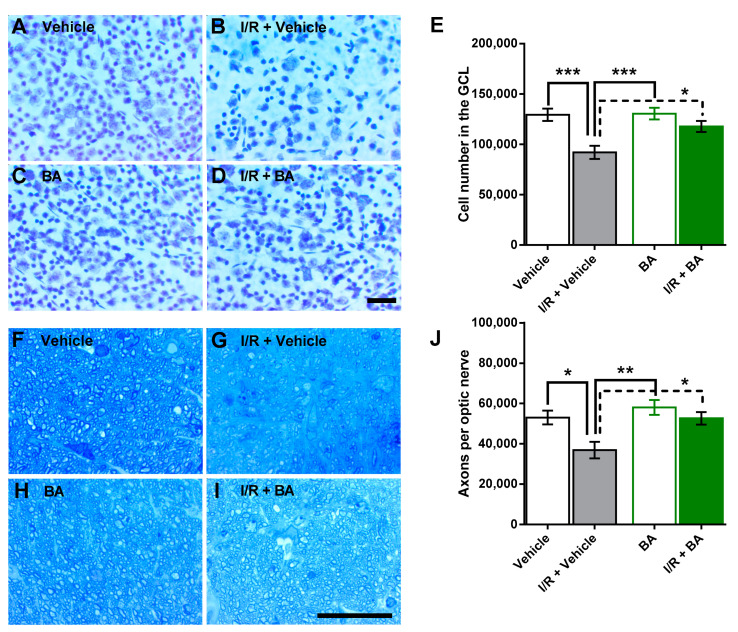
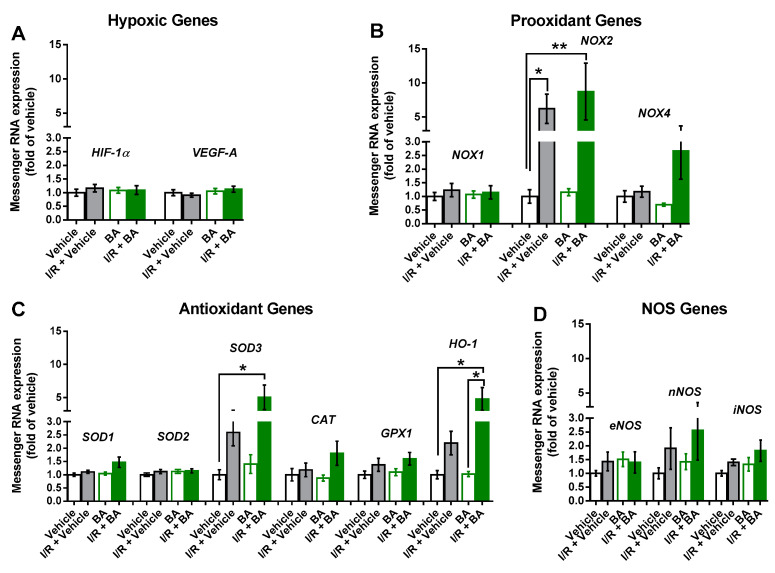
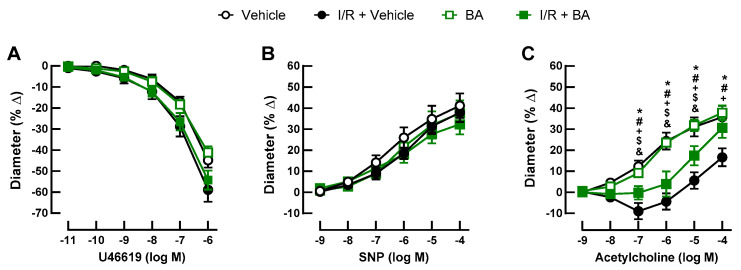
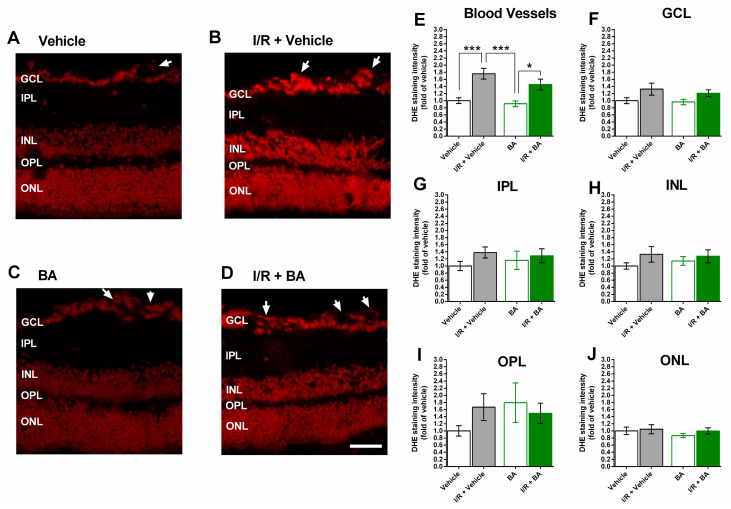
Ischemia/reperfusion (I/R) events are involved in the pathophysiology of numerous ocular diseases. The purpose of this study was to test the hypothesis that betulinic acid protects from I/R injury in the mouse retina. Ocular ischemia was induced in mice by increasing intraocular pressure (IOP) to 110 mm Hg for 45 min, while the fellow eye served as a control. One group of mice received betulinic acid (50 mg/kg/day p.o. once daily) and the other group received the vehicle solution only. Eight days after the I/R event, the animals were killed and the retinal wholemounts and optic nerve cross-sections were prepared and stained with cresyl blue or toluidine blue, respectively, to count cells in the ganglion cell layer (GCL) of the retina and axons in the optic nerve. Retinal arteriole responses were measured in isolated retinas by video microscopy. The levels of reactive oxygen species (ROS) were assessed in retinal cryosections and redox gene expression was determined in isolated retinas by quantitative PCR. I/R markedly reduced cell number in the GCL and axon number in the optic nerve of the vehicle-treated mice. In contrast, only a negligible reduction in cell and axon number was observed following I/R in the betulinic acid-treated mice. Endothelial function was markedly reduced and ROS levels were increased in retinal arterioles of vehicle-exposed eyes following I/R, whereas betulinic acid partially prevented vascular endothelial dysfunction and ROS formation. Moreover, betulinic acid boosted mRNA expression for the antioxidant enzymes SOD3 and HO-1 following I/R. Our data provide evidence that betulinic acid protects from I/R injury in the mouse retina. Improvement of vascular endothelial function and the reduction in ROS levels appear to contribute to the neuroprotective effect.
缺血/再灌注(I/R)事件涉及许多眼部疾病的病理生理学。本研究旨在检验白桦酸可防止小鼠视网膜 I/R 损伤的假说。通过将眼内压升高至 110mmHg 持续 45 分钟来诱导小鼠眼缺血,而对侧眼作为对照。一组小鼠接受白桦酸(50mg/kg/天 p.o. 每天一次),另一组仅接受载体溶液。I/R 事件发生 8 天后,处死动物,制备视网膜全层和视神经横切片,分别用 cresyl blue 或 toluidine blue 染色,以计数视网膜神经节细胞层(GCL)中的细胞和视神经中的轴突。通过视频显微镜测量分离视网膜中小动脉的反应。在视网膜冷冻切片中评估活性氧(ROS)水平,并通过定量 PCR 确定分离视网膜中的氧化还原基因表达。I/R 显著减少了载体处理小鼠 GCL 中的细胞数量和视神经中的轴突数量。相比之下,在白桦酸处理的小鼠中,I/R 后仅观察到细胞和轴突数量的微不足道减少。I/R 后,暴露于载体的眼中视网膜小动脉的内皮功能明显降低,ROS 水平升高,而白桦酸部分预防了血管内皮功能障碍和 ROS 形成。此外,白桦酸在 I/R 后增加了抗氧化酶 SOD3 和 HO-1 的 mRNA 表达。我们的数据提供了证据表明白桦酸可防止小鼠视网膜的 I/R 损伤。改善血管内皮功能和降低 ROS 水平似乎有助于神经保护作用。