Loh Doris, Reiter Russel J
Independent Researcher, Marble Falls, TX 78654, USA.
Department of Cellular and Structural Biology, UT Health Science Center, San Antonio, TX 78229, USA.
Antioxidants (Basel). 2021 Sep 17;10(9):1483. doi: 10.3390/antiox10091483.
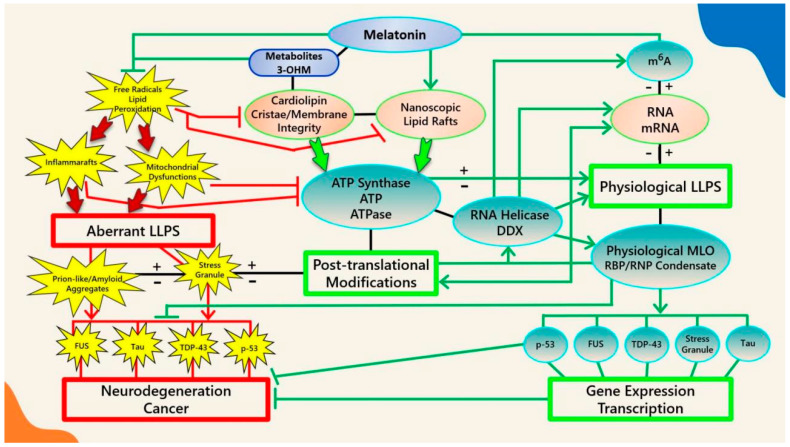
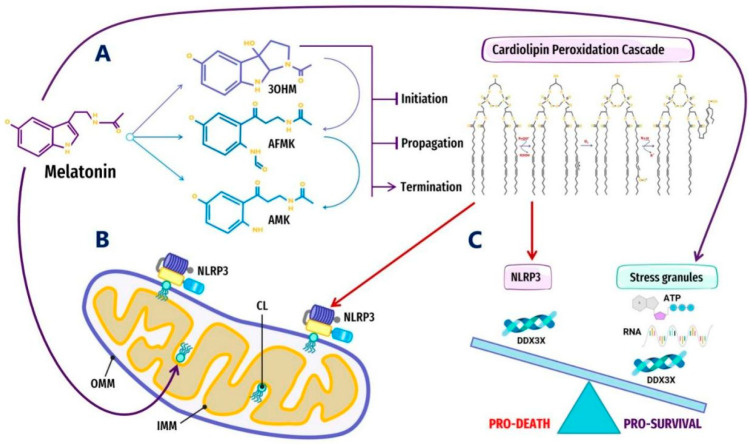
Biomolecular condensates are membraneless organelles (MLOs) that form dynamic, chemically distinct subcellular compartments organizing macromolecules such as proteins, RNA, and DNA in unicellular prokaryotic bacteria and complex eukaryotic cells. Separated from surrounding environments, MLOs in the nucleoplasm, cytoplasm, and mitochondria assemble by liquid-liquid phase separation (LLPS) into transient, non-static, liquid-like droplets that regulate essential molecular functions. LLPS is primarily controlled by post-translational modifications (PTMs) that fine-tune the balance between attractive and repulsive charge states and/or binding motifs of proteins. Aberrant phase separation due to dysregulated membrane lipid rafts and/or PTMs, as well as the absence of adequate hydrotropic small molecules such as ATP, or the presence of specific RNA proteins can cause pathological protein aggregation in neurodegenerative disorders. Melatonin may exert a dominant influence over phase separation in biomolecular condensates by optimizing membrane and MLO interdependent reactions through stabilizing lipid raft domains, reducing line tension, and maintaining negative membrane curvature and fluidity. As a potent antioxidant, melatonin protects cardiolipin and other membrane lipids from peroxidation cascades, supporting protein trafficking, signaling, ion channel activities, and ATPase functionality during condensate coacervation or dissolution. Melatonin may even control condensate LLPS through PTM and balance mRNA- and RNA-binding protein composition by regulating N-methyladenosine (mA) modifications. There is currently a lack of pharmaceuticals targeting neurodegenerative disorders via the regulation of phase separation. The potential of melatonin in the modulation of biomolecular condensate in the attenuation of aberrant condensate aggregation in neurodegenerative disorders is discussed in this review.
生物分子凝聚物是无膜细胞器(MLOs),它们在单细胞原核细菌和复杂的真核细胞中形成动态的、化学性质不同的亚细胞区室,组织蛋白质、RNA和DNA等大分子。与周围环境分离后,核质、细胞质和线粒体中的MLOs通过液-液相分离(LLPS)组装成瞬时的、非静态的、类似液体的液滴,调节基本的分子功能。LLPS主要受翻译后修饰(PTMs)控制,这些修饰可微调蛋白质的吸引和排斥电荷状态及/或结合基序之间的平衡。由于膜脂筏和/或PTM失调,以及缺乏足够的促水溶小分子如ATP,或存在特定的RNA蛋白导致异常相分离,可在神经退行性疾病中引起病理性蛋白质聚集。褪黑素可能通过稳定脂筏结构域、降低线张力、维持负膜曲率和流动性来优化膜与MLO的相互依赖反应,从而对生物分子凝聚物中的相分离产生主要影响。作为一种有效的抗氧化剂,褪黑素可保护心磷脂和其他膜脂免受过氧化级联反应的影响,在凝聚物凝聚或溶解过程中支持蛋白质运输、信号传导、离子通道活性和ATP酶功能。褪黑素甚至可能通过PTM控制凝聚物的LLPS,并通过调节N-甲基腺苷(mA)修饰来平衡mRNA和RNA结合蛋白的组成。目前缺乏通过调节相分离来靶向神经退行性疾病的药物。本文综述了褪黑素在调节生物分子凝聚物以减轻神经退行性疾病中异常凝聚物聚集方面的潜力。