Kizina Kathrin, Akkaya Yakup, Jokisch Daniel, Stolte Benjamin, Totzeck Andreas, Munoz-Rosales Juan, Thimm Andreas, Bolz Saskia, Brakemeier Svenja, Pul Refik, Aslan Derya, Hackert Jana, Kleinschnitz Christoph, Hagenacker Tim
Department of Neurology, University of Duisburg-Essen, 45147 Essen, Germany.
Brain Sci. 2021 Sep 9;11(9):1184. doi: 10.3390/brainsci11091184.
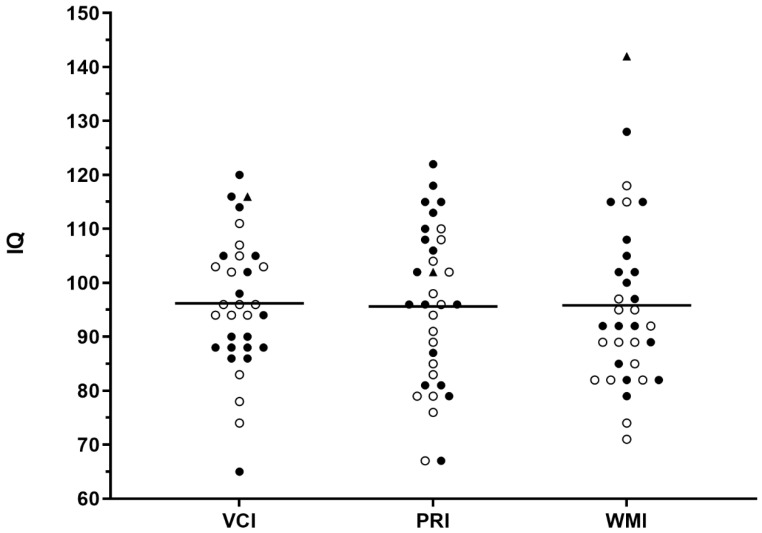
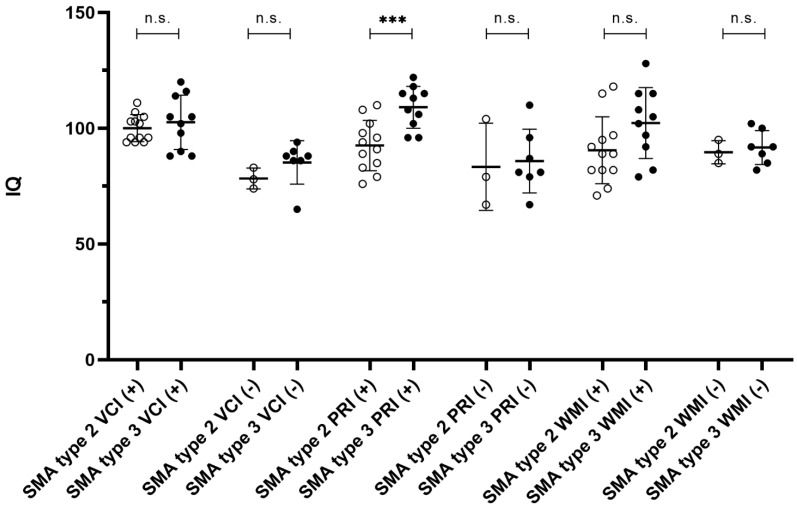
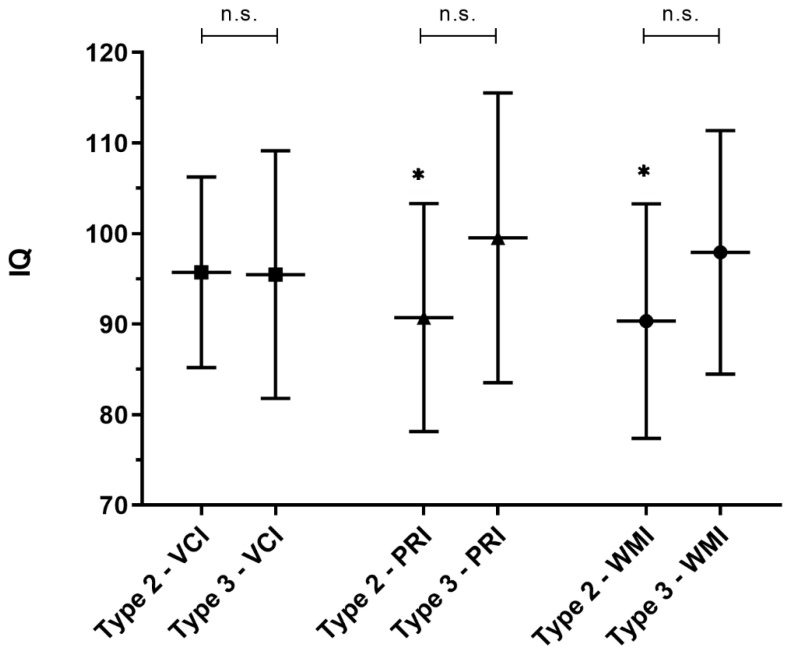
In previous studies, a below-average, average, or above-average intelligence quotient (IQ) in children with SMA was detected but, aside from a severe physical disability, the cognitive performance of adult SMA patients has not yet been evaluated. The intelligence test used in this study, the Wechsler Adult Intelligence Scale, fourth edition (WAIS-IV), was used to measure major intelligence components of adult SMA patients. The WAIS-IV determines four index scores representing verbal comprehension, perceptual reasoning, working memory, and processing speed. Due to time-dependent demands on motor function, the processing speed index score was excluded. IQ index scores of 33 adult SMA patients did not differ from IQ index scores of the normal population. In SMA type-3 patients, the index scores for verbal comprehension, perceptual reasoning, and working memory did not differ from the normal population but showed a trend of IQ scores towards lower points. Patients with SMA type 2 had lower IQ index scores for working memory (90.33 ± 12.95; = 0.012) and perceptual reasoning (90.73 ± 12.58; = 0.013) than the normal population. This study provided further evidence that SMA is a multi-systemic disease and may refute the widespread hypothesis that SMA patients might improve their cognitive skills to compensate for their physical impairment.
在先前的研究中,已检测出脊髓性肌萎缩症(SMA)患儿的智商(IQ)低于平均水平、处于平均水平或高于平均水平,但除了严重的身体残疾外,成年SMA患者的认知表现尚未得到评估。本研究中使用的智力测试,即韦氏成人智力量表第四版(WAIS-IV),用于测量成年SMA患者的主要智力组成部分。WAIS-IV确定了四个代表言语理解、知觉推理、工作记忆和处理速度的指数分数。由于对运动功能存在时间依赖性要求,处理速度指数分数被排除在外。33名成年SMA患者的智商指数分数与正常人群的智商指数分数没有差异。在3型SMA患者中,言语理解、知觉推理和工作记忆的指数分数与正常人群没有差异,但智商分数有向较低分数发展的趋势。2型SMA患者的工作记忆(90.33±12.95;P = 0.012)和知觉推理(90.73±12.58;P = 0.013)的智商指数分数低于正常人群。本研究提供了进一步的证据,证明SMA是一种多系统疾病,可能反驳了普遍存在的假设,即SMA患者可能会提高其认知技能以补偿其身体损伤。