Roy Pantu-Kumar, Qamar Ahmad-Yar, Tanga Bereket-Molla, Bang Seonggyu, Seong Gyeonghwan, Fang Xun, Kim Ghangyong, Edirisinghe Shan-Lakmal, De Zoysa Mahanama, Kang Do-Hyung, Saadeldin Islam M, Cho Jongki
College of Veterinary Medicine, Chungnam National University, Daejeon 34134, Korea.
Department of Clinical Sciences, College of Veterinary and Animal Sciences, Jhang 35200, Pakistan.
Animals (Basel). 2021 Aug 24;11(9):2483. doi: 10.3390/ani11092483.
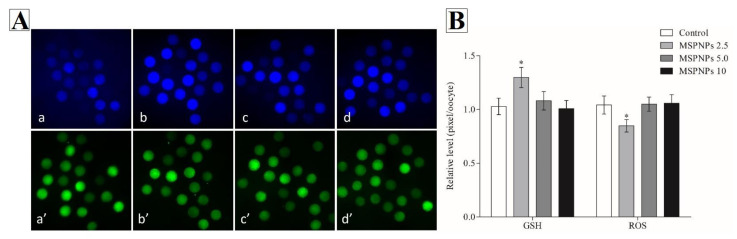
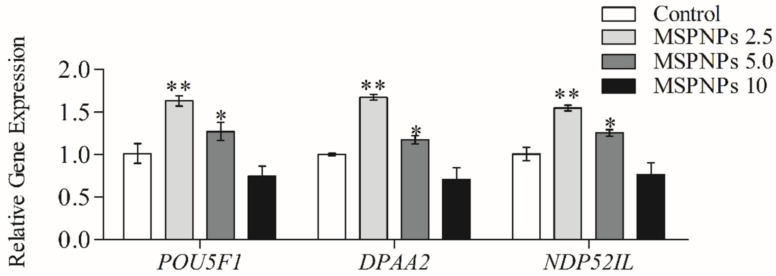
Molecular approaches have been used to determine metabolic substrates involved in the early embryonic processes to provide adequate culture conditions. To investigate the effect of modified pectin nanoparticles (MSmPNPs) on oocyte developmental competence, cumulus-oocyte complexes (COCs) retrieved from pig slaughterhouse ovaries were subjected to various concentrations of MSmPNPs (0, 2.5, 5.0, and 10 µg/mL) during in vitro maturation (IVM). In comparison to the control, MSmPNPs-5.0, and MSmPNPs-10 groups, oocytes treated with 2.5 µg/mL MSmPNPs had significantly increased glutathione (GSH) levels and lower levels of reactive oxygen species (ROS). Following parthenogenetic activation, the MSmPNPs-2.5 group had a considerably higher maturation and cleavage rates, blastocyst development, total cell number, and ratio of inner cell mass/trophectoderm (ICM:TE) cells, when compared with those in the control and all other treated groups. Furthermore, similar findings were reported for the developmental competence of somatic cell nuclear transfer (SCNT)-derived embryos. Additionally, the relative quantification of POU5F1, DPPA2, and NDP52 mRNA transcript levels were significantly higher in the MSmPNPs-2.5 group than in the control and other treated groups. Taken together, the current findings suggest that MSmPNP treatment alleviates oxidative stress and enhances the developmental competence of porcine in vitro matured oocytes after parthenogenetic activation and SCNT.
分子方法已被用于确定参与早期胚胎发育过程的代谢底物,以提供适宜的培养条件。为了研究改性果胶纳米颗粒(MSmPNPs)对卵母细胞发育能力的影响,从猪屠宰场卵巢中获取的卵丘-卵母细胞复合体(COCs)在体外成熟(IVM)过程中接受不同浓度的MSmPNPs(0、2.5、5.0和10μg/mL)处理。与对照组、MSmPNPs-5.0组和MSmPNPs-10组相比,用2.5μg/mL MSmPNPs处理的卵母细胞谷胱甘肽(GSH)水平显著升高,活性氧(ROS)水平降低。孤雌激活后,与对照组和所有其他处理组相比,MSmPNPs-2.5组的成熟率、裂解率、囊胚发育率、总细胞数以及内细胞团/滋养外胚层(ICM:TE)细胞比例显著更高。此外,对于体细胞核移植(SCNT)衍生胚胎的发育能力也有类似的发现。另外,MSmPNPs-2.5组中POU5F1、DPPA2和NDP52 mRNA转录水平的相对定量显著高于对照组和其他处理组。综上所述,目前的研究结果表明,MSmPNP处理可减轻氧化应激,并提高猪体外成熟卵母细胞在孤雌激活和SCNT后的发育能力。