Hermes Lena, Römermann Janis, Cramer Benedikt, Esselen Melanie
Institute of Food Chemistry, University of Muenster, Corrensstraße 45, 48149 Muenster, Germany.
Foods. 2021 Aug 29;10(9):2032. doi: 10.3390/foods10092032.
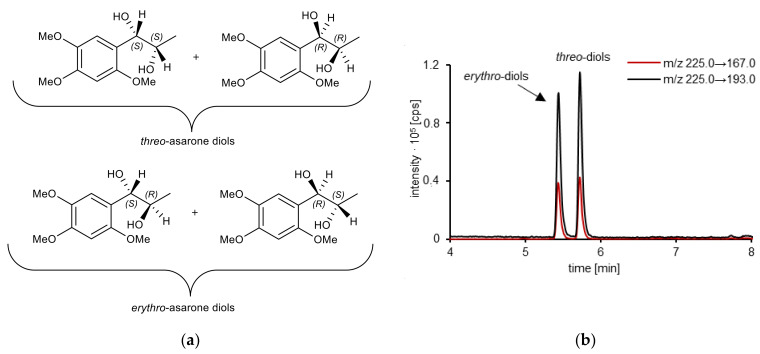
(1) Background: Metabolism data of asarone isomers, in particular phase II, in vitro and in humans is limited so far. For the first time, phase II metabolites of asarone isomers were characterized and human kinetic as well as excretion data after oral intake of asarone-containing tea infusion was determined. (2) Methods: A high pressure liquid chromatography coupled with quadrupole time-of-flight mass spectrometry (HPLC-qTOF-MS) approach was used to identify phase II metabolites using liver microsomes of different species and in human urine samples. For quantitation of the respective glucuronides, a beta-glucuronidase treatment was performed prior to analysis via high pressure liquid chromatography coupled with tandem mass spectrometry (HPLC-MS/MS). (3) Results: Ingested beta-asarone and and -asarone diols were excreted as diols and respective diol glucuronide conjugates within 24 h. An excretion rate about 42% was estimated. -Demethylation of beta-asarone was also indicated as a human metabolic pathway because a corresponding glucuronic acid conjugate was suggested. (4) Conclusions: Already reported -demethylation and epoxide-derived diols formation in phase I metabolism of beta-asarone in vitro was verified in humans and glucuronidation was characterized as main conjugation reaction. The excretion rate of 42% as and -asarone diols and respective asarone diol glucuronides suggests that epoxide formation is a key step in beta-asarone metabolism, but further, as yet unknown metabolites should also be taken into consideration.
(1) 背景:目前,细辛脑异构体的代谢数据,尤其是Ⅱ相代谢数据,在体外和人体中的研究还很有限。首次对细辛脑异构体的Ⅱ相代谢产物进行了表征,并测定了口服含细辛脑茶剂后的人体动力学及排泄数据。(2) 方法:采用高压液相色谱-四极杆飞行时间质谱联用技术(HPLC-qTOF-MS),利用不同物种的肝微粒体和人体尿液样本鉴定Ⅱ相代谢产物。为了对相应的葡糖醛酸苷进行定量,在通过高压液相色谱-串联质谱联用技术(HPLC-MS/MS)分析之前,先进行β-葡糖醛酸酶处理。(3) 结果:摄入的β-细辛脑和α-细辛脑二醇在24小时内以二醇及其相应的二醇葡糖醛酸苷缀合物形式排出。估计排泄率约为42%。β-细辛脑的去甲基化也被指出是一条人体代谢途径,因为有相应的葡糖醛酸共轭物被提出。(4) 结论:体外实验中已报道的β-细辛脑Ⅰ相代谢中的去甲基化和环氧化物衍生二醇的形成在人体中得到了验证,葡糖醛酸化被表征为主要的共轭反应。42%的α-细辛脑二醇和β-细辛脑二醇及其相应的细辛脑二醇葡糖醛酸苷的排泄率表明,环氧化物的形成是β-细辛脑代谢的关键步骤,但还应考虑其他尚未明确的代谢产物。