Andersen Barbara Vad, Chan Raymond C K, Byrne Derek Victor
Food Quality Perception and Society, Department of Food Science, Aarhus University, Agro Food Park 48, DK 8200 Aarhus, Denmark.
Sino-Danish Center for Education and Research, Beijing 100190, China.
Foods. 2021 Aug 31;10(9):2044. doi: 10.3390/foods10092044.
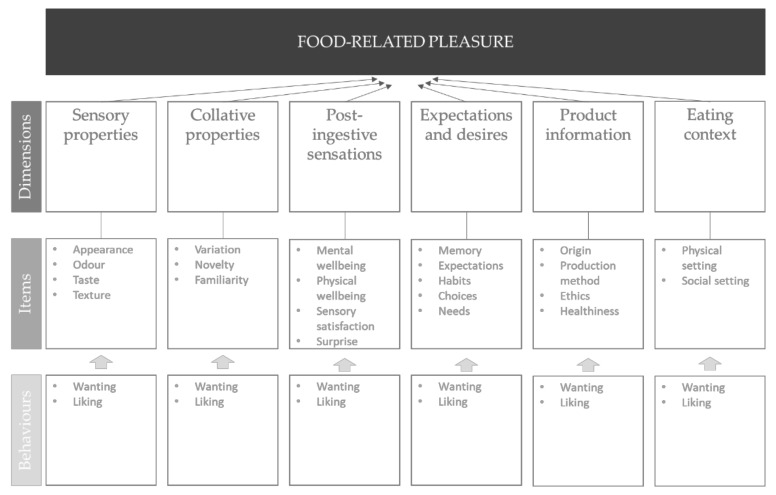
In modern times, the majority of food intake is believed to be driven by hedonic processes, rather than homeostatic ones. Various factors have been found to influence the hedonic eating experience and thereby influence eating behaviour, and each factor can be regarded a piece that contributes to parts of the total picture of the hedonic response to food. As a result, the literature on the hedonic response to food-related experiences is comprehensive, but at the same time rather fragmented; and importantly, it is not clear how individuals/segments differ in key drivers of their hedonic experience and the extent to which food pleasure is perceived. In this paper, we present a conceptual framework for the development of a scale (self-report questionnaire) to measure the qualitative and quantitative aspects of food-related pleasure, the Food Pleasure Scale. We introduce the concept of (an)hedonia and scales developed in the past for its measurement, identify the spectrum of characteristics influencing food-related pleasure and explain the relevance of developing such a scale. Based on this theoretical framework, a strategy for the development of the Food Pleasure Scale is proposed.
在现代,人们认为大多数食物摄入是由享乐过程驱动的,而非体内平衡过程。已发现多种因素会影响享乐性进食体验,进而影响进食行为,且每个因素都可被视为构成对食物享乐反应全貌的一部分。因此,关于对与食物相关体验的享乐反应的文献很全面,但同时也相当零散;重要的是,目前尚不清楚个体/群体在其享乐体验的关键驱动因素以及对食物愉悦感的感知程度方面有何差异。在本文中,我们提出了一个概念框架,用于开发一个量表(自我报告问卷)来测量与食物相关愉悦感的定性和定量方面,即食物愉悦感量表。我们介绍了快感缺失的概念以及过去为测量它而开发的量表,确定了影响与食物相关愉悦感的特征范围,并解释了开发这样一个量表的相关性。基于这一理论框架,提出了食物愉悦感量表的开发策略。