Psychology Research Laboratory, Istituto Auxologico Italiano IRCCS, 20145 Milan, Italy.
Department of Psychology, Catholic University of Milan, 20123 Milan, Italy.
Int J Environ Res Public Health. 2021 Sep 10;18(18):9558. doi: 10.3390/ijerph18189558.
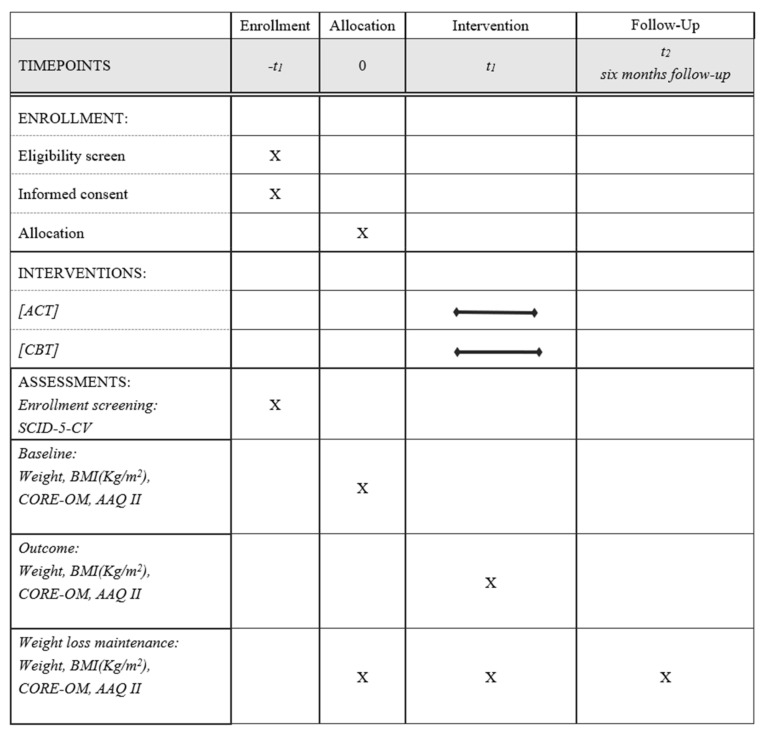
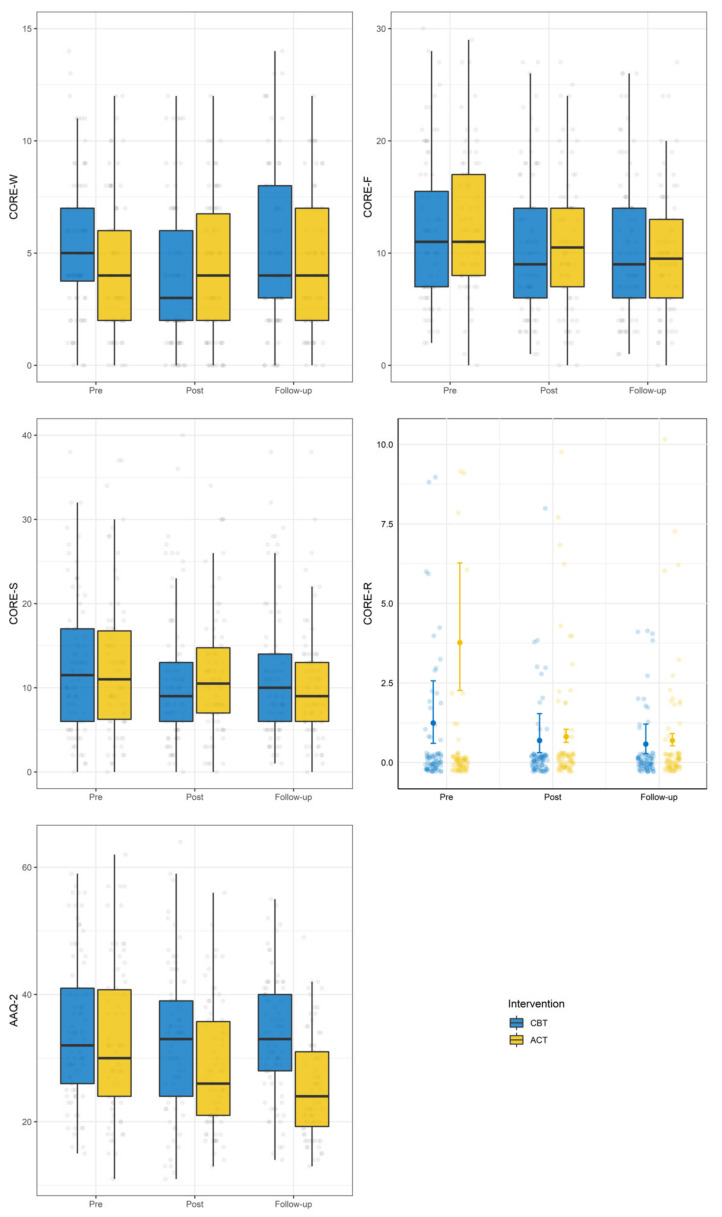
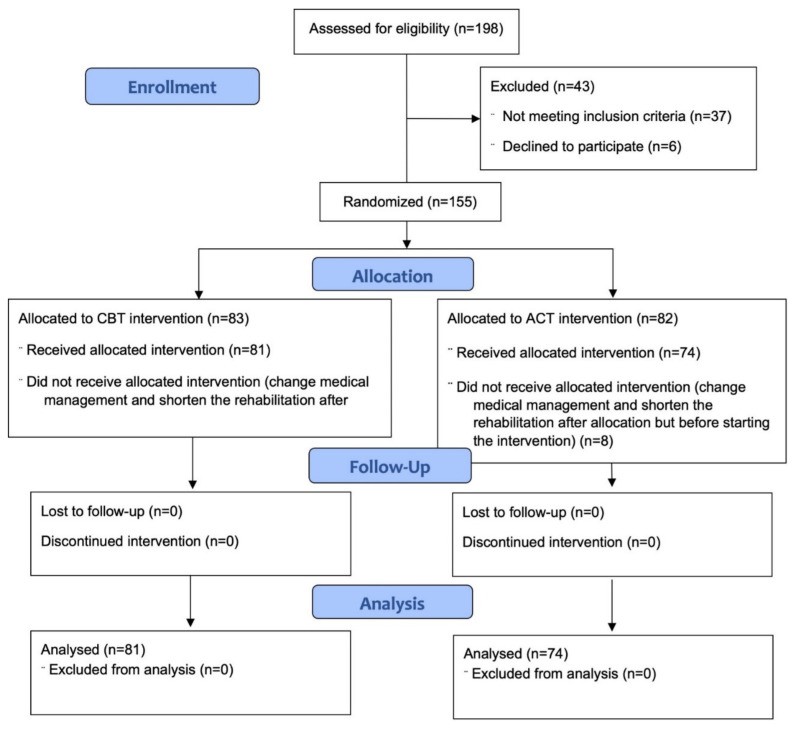
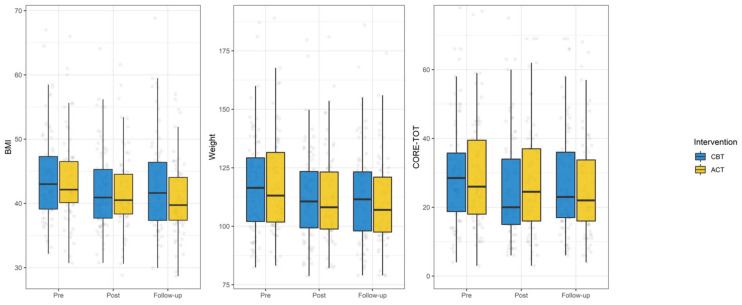
The purpose of this Individually Randomized Group Treatment Trial was to compare an Acceptance and Commitment Therapy-based (ACT) group intervention and a Cognitive Behavioral Therapy-based (CBT) group intervention for weight loss maintenance in a sample of adult patients with obesity seeking treatment for weight loss. One hundred and fifty-five adults (BMI: Kg/m = 43.8 [6.8]) attending a multidisciplinary rehabilitation program for weight loss were randomized into two conditions: ACT and CBT. Demographical, physical, and clinical data were assessed at the beginning of the program (t), at discharge (t), and at 6-month follow-up (t). The following measures were administered: The Acceptance and Action Questionnaire-II (AAQ-II) and the Clinical Outcome in Routine Evaluation-Outcome Measure (CORE-OM). Generalized linear mixed models were performed to assess differences between groups. Moderation effects for gender and Eating Disorders (ED) have been considered. From baseline to discharge, no significant differences between interventions were found, with the only exception of an improvement in the CORE-OM total score and in the CORE-OM subjective wellbeing subscale for those in the CBT condition. From discharge to follow-up, ACT group participants showed significant results in terms of weight loss maintenance, CORE-OM total score, and CORE-OM and AAQ-II wellbeing, symptoms, and psychological problems subscales. Gender moderated the effects of time and intervention on the CORE-OM subscale reporting the risk for self-harm or harm of others. The presence of an eating disorder moderated the effect of time and intervention on the CORE-OM total score, on the CORE-OM symptoms and psychological problems subscales, and on the AAQ-II. Patients who received the ACT intervention were more likely to achieve a ≥5% weight loss from baseline to follow-up and to maintain the weight loss after discharge. The ACT intervention was thus effective in maintaining weight loss over time.
本个体随机分组治疗试验旨在比较基于接受与承诺疗法(ACT)的小组干预和基于认知行为疗法(CBT)的小组干预,以比较在寻求减肥的肥胖成年患者样本中维持减肥效果。155 名成年人(BMI:公斤/米 = 43.8 [6.8])参加了多学科减肥康复计划,他们被随机分为两组:ACT 和 CBT。在计划开始时(t)、出院时(t)和 6 个月随访时(t)评估人口统计学、身体和临床数据。管理以下措施:接受和行动问卷-II(AAQ-II)和临床结果在常规评估-结果测量(CORE-OM)。广义线性混合模型用于评估组间差异。考虑了性别和饮食失调(ED)的调节作用。从基线到出院,干预组之间没有发现显著差异,唯一的例外是 CBT 组的 CORE-OM 总分和 CORE-OM 主观幸福感子量表有所改善。从出院到随访,ACT 组参与者在体重维持、CORE-OM 总分以及 CORE-OM 和 AAQ-II 幸福感、症状和心理问题子量表方面显示出显著的结果。性别调节了时间和干预对报告自我伤害或伤害他人风险的 CORE-OM 子量表的影响。饮食失调的存在调节了时间和干预对 CORE-OM 总分、CORE-OM 症状和心理问题子量表以及 AAQ-II 的影响。接受 ACT 干预的患者从基线到随访更有可能实现 ≥5%的体重减轻,并在出院后保持体重减轻。因此,ACT 干预在随着时间的推移维持体重减轻方面是有效的。