Shah Junaid Ali, Khattak Saadullah, Rauf Mohd Ahmar, Cai Yong, Jin Jingji
School of Life Sciences, Jilin University, Changchun 130012, China.
Henan International Joint Laboratory for Nuclear Protein Regulation, School of Basic Medical Sciences, Henan University, Kaifeng 475004, China.
Life (Basel). 2021 Sep 19;11(9):984. doi: 10.3390/life11090984.
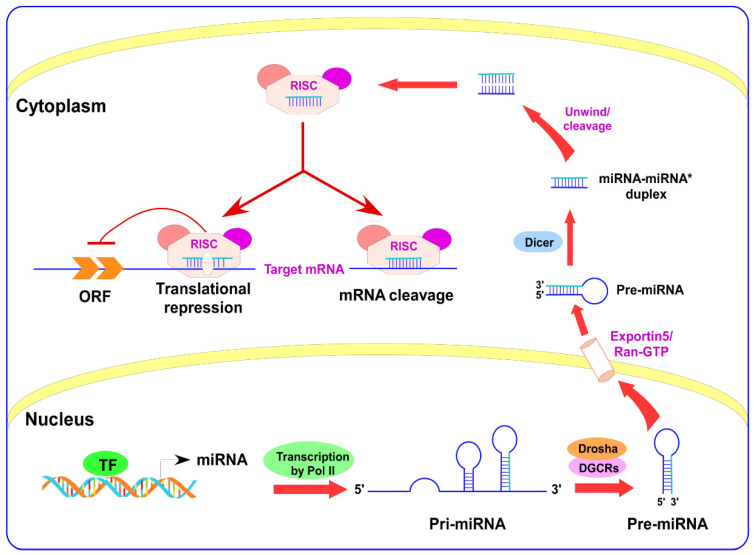
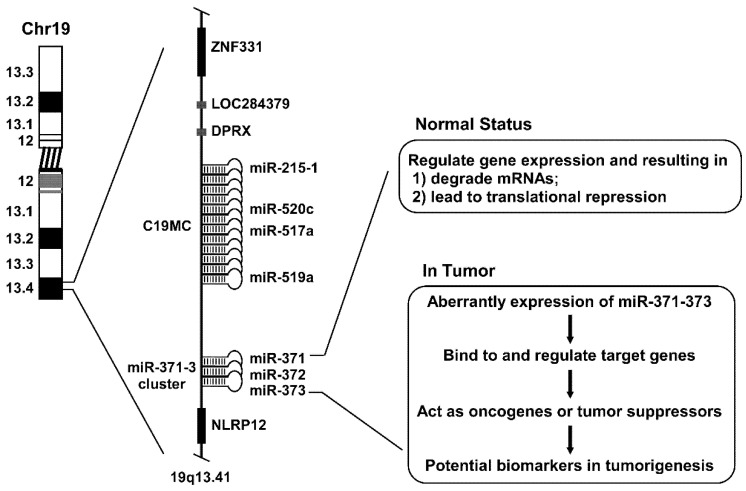
microRNAs (miRNAs) are small non-coding RNA transcripts (20-24 nucleotides) that bind to their complementary sequences in the 3'-untranslated regions (3'-UTR) of targeted genes to negatively or positively regulate their expression. miRNAs affect the expression of genes in cells, thereby contributing to several important biological processes, including tumorigenesis. Identifying the miRNA cluster as a human embryonic stem cell (hESC)-specific miRNAs initially led to the identification of miR-371, miR-372, miR-373, and miR-373*, which can ultimately be translated into mature miRNAs. Recent evidence suggests that miR-371-373 genes are abnormally expressed in various cancers and act either as oncogenes or tumor suppressors, indicating they may be suitable as molecular biomarkers for cancer diagnosis and prevention. In this article, we summarize recent studies linking miR-371-373 functions to tumorigenesis and speculate on the potential applications of miR-371-373 as biomarkers for cancer diagnosis and treatment.
微小RNA(miRNA)是一类小的非编码RNA转录本(20-24个核苷酸),它们与靶基因3'-非翻译区(3'-UTR)中的互补序列结合,以负向或正向调节其表达。miRNA影响细胞中基因的表达,从而参与包括肿瘤发生在内的多个重要生物学过程。最初将miRNA簇鉴定为人胚胎干细胞(hESC)特异性miRNA,从而导致了miR-371、miR-372、miR-373和miR-373*的鉴定,它们最终可转化为成熟的miRNA。最近的证据表明,miR-371-373基因在多种癌症中异常表达,可作为癌基因或肿瘤抑制因子发挥作用,这表明它们可能适合作为癌症诊断和预防的分子生物标志物。在本文中,我们总结了最近将miR-371-373功能与肿瘤发生联系起来的研究,并推测了miR-371-373作为癌症诊断和治疗生物标志物的潜在应用。