Saad Mabroka H, Badierah Raied, Redwan Elrashdy M, El-Fakharany Esmail M
Protein Research Department, Genetic Engineering and Biotechnology Research Institute (GEBRI), The City of Scientific Research and Technological Applications (SRTA-City), New Borg EL Arab, Alexandria 21934, Egypt.
Biological Science Department, Faculty of Science, King Abdulaziz University, Jeddah 21589, Saudi Arabia.
Pharmaceutics. 2021 Sep 4;13(9):1405. doi: 10.3390/pharmaceutics13091405.
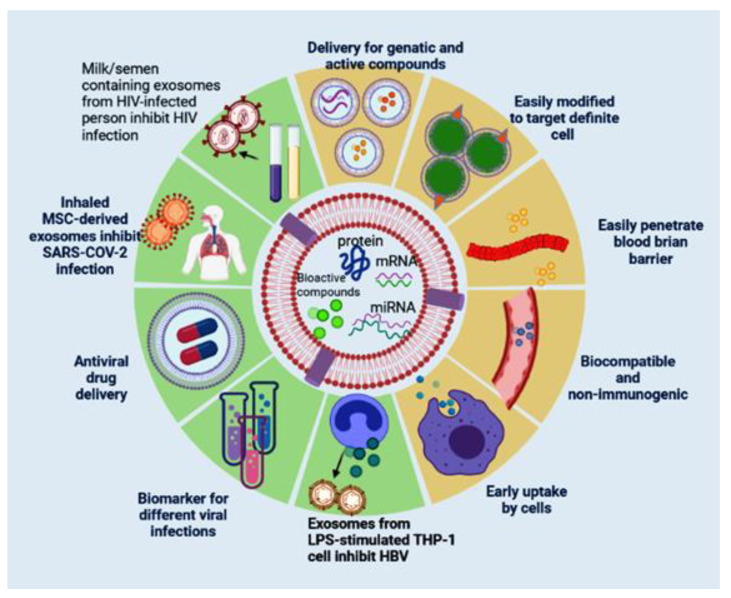
Extracellular vesicles (EVs) subtype, exosome is an extracellular nano-vesicle that sheds from cells' surface and originates as intraluminal vesicles during endocytosis. Firstly, it was thought to be a way for the cell to get rid of unwanted materials as it loaded selectively with a variety of cellular molecules, including RNAs, proteins, and lipids. However, it has been found to play a crucial role in several biological processes such as immune modulation, cellular communication, and their role as vehicles to transport biologically active molecules. The latest discoveries have revealed that many viruses export their viral elements within cellular factors using exosomes. Hijacking the exosomal pathway by viruses influences downstream processes such as viral propagation and cellular immunity and modulates the cellular microenvironment. In this manuscript, we reviewed exosomes biogenesis and their role in the immune response to viral infection. In addition, we provided a summary of how some pathogenic viruses hijacked this normal physiological process. Viral components are harbored in exosomes and the role of these exosomes in viral infection is discussed. Understanding the nature of exosomes and their role in viral infections is fundamental for future development for them to be used as a vaccine or as a non-classical therapeutic strategy to control several viral infections.
细胞外囊泡(EVs)的亚型——外泌体,是一种细胞外纳米囊泡,它从细胞表面脱落,在胞吞作用期间以内体囊泡的形式产生。最初,人们认为它是细胞清除不需要物质的一种方式,因为它会选择性地装载包括RNA、蛋白质和脂质在内的多种细胞分子。然而,现已发现它在免疫调节、细胞通讯等多种生物学过程中发挥关键作用,并且作为运输生物活性分子的载体发挥作用。最新发现表明,许多病毒利用外泌体在细胞因子内输出其病毒成分。病毒劫持外泌体途径会影响病毒传播和细胞免疫等下游过程,并调节细胞微环境。在本手稿中,我们综述了外泌体的生物发生及其在病毒感染免疫反应中的作用。此外,我们总结了一些致病病毒如何劫持这一正常生理过程。病毒成分存在于外泌体中,并讨论了这些外泌体在病毒感染中的作用。了解外泌体的性质及其在病毒感染中的作用,对于其未来作为疫苗或作为控制多种病毒感染的非经典治疗策略的发展至关重要。