Minami Misa, Otake Hiroko, Nakazawa Yosuke, Okamoto Norio, Yamamoto Naoki, Sasaki Hiroshi, Nagai Noriaki
Faculty of Pharmacy, Kindai University, 3-4-1 Kowakae, Higashi-Osaka, Osaka 577-8502, Japan.
Faculty of Pharmacy, Keio University, 1-5-30 Shibakoen, Minato-ku, Tokyo 105-8512, Japan.
Pharmaceutics. 2021 Sep 8;13(9):1425. doi: 10.3390/pharmaceutics13091425.
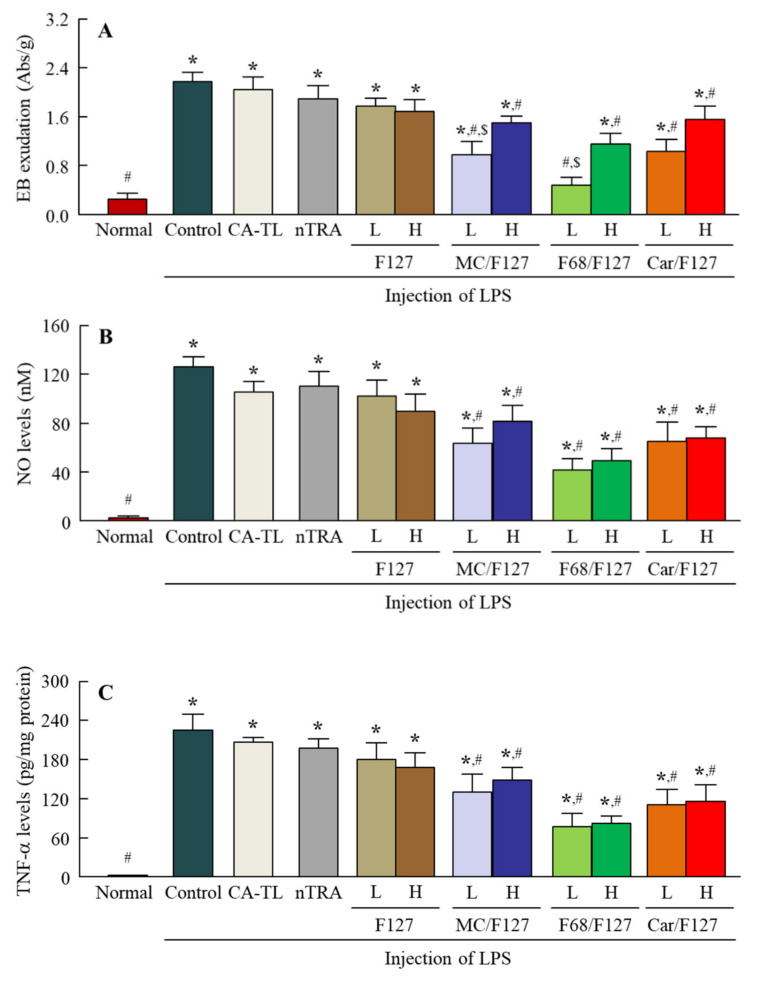
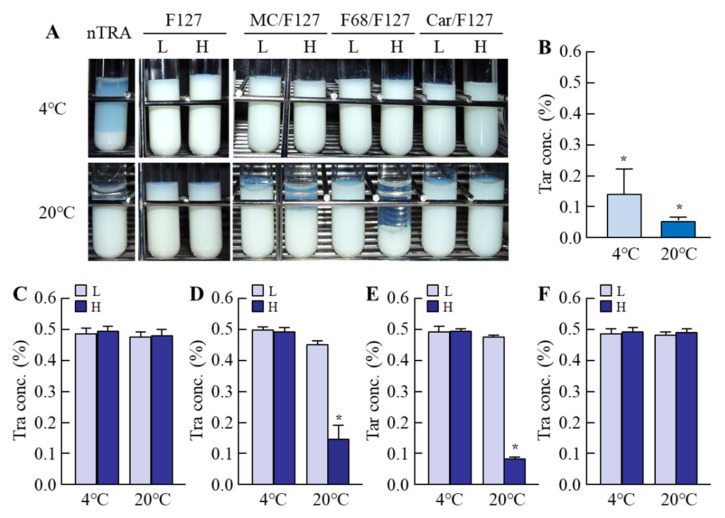
We previously designed ophthalmic formulations (nTRA) containing tranilast nanoparticles (Tra-NPs) with high uptake into ocular tissues. In this study, we used in situ gel (ISG) bases comprising combinations of pluronic F127 (F127) and methylcellulose (MC/F127), pluronic F68 (F68/F127), and Carbopol (Car/F127), and we developed in situ gels incorporating Tra-NPs (Tra-NP-incorporated ISNGs) such as nTRA-F127, nTRA-MC/F127, nTRA-F68/F127, and nTRA-Car/F127. Moreover, we demonstrated the therapeutic effect on conjunctival inflammation using lipopolysaccharide-induced rats. Each Tra-NP-incorporated ISNG was prepared by the bead mill method, the particle size was 40-190 nm, and the tranilast release and diffusion from formulation were nTRA > nTRA-F127 > nTRA-F68/F127 > nTRA-Car/F127 > nTRA-MC/F127. In the Tra-NP-incorporated ISNGs, the tranilast residence time in the lacrimal fluid, cornea, and conjunctiva was prolonged, although the was attenuated in comparison with nTRA. On the other hand, no significant difference in conjunctival inflammation between non- and nTRA-F127-instilled rats was found; however, the nTRA-F68/F127, nTRA-Car/F127, and nTRA-MC/F127 (combination-ISG) attenuated the vessel leakage, nitric oxide, and tumor necrosis factor-α expression. In particular, nTRA-F68/F127 was significant in preventing the conjunctival inflammation. In conclusion, we found that the combination-ISG base prolonged the residence time of Tra-NPs; however, Tra-NP release from the formulation was attenuated, and the was delayed longer than that in nTRA. The balance of drug residence and diffusion in lacrimal fluid may be important in providing high ocular bioavailability in formulations containing solid nanoparticles.
我们之前设计了含有曲尼司特纳米颗粒(Tra-NPs)的眼科制剂(nTRA),其可被眼部组织高效摄取。在本研究中,我们使用了由普朗尼克F127(F127)与甲基纤维素(MC/F127)、普朗尼克F68(F68/F127)以及卡波姆(Car/F127)组合而成的原位凝胶(ISG)基质,并研发了包含Tra-NPs的原位凝胶(Tra-NP包载原位凝胶,即Tra-NP-incorporated ISNGs),如nTRA-F127、nTRA-MC/F127、nTRA-F68/F127和nTRA-Car/F127。此外,我们利用脂多糖诱导的大鼠模型证明了其对结膜炎症的治疗效果。每种Tra-NP包载原位凝胶均通过珠磨法制备,粒径为40 - 190 nm,曲尼司特从制剂中的释放及扩散情况为nTRA > nTRA-F127 > nTRA-F68/F127 > nTRA-Car/F127 > nTRA-MC/F127。在Tra-NP包载原位凝胶中,曲尼司特在泪液、角膜和结膜中的停留时间得以延长,尽管与nTRA相比其[此处原文缺失部分内容]有所减弱。另一方面,未发现未滴注和滴注nTRA-F127的大鼠结膜炎症有显著差异;然而,nTRA-F68/F127、nTRA-Car/F127和nTRA-MC/F127(组合原位凝胶)减轻了血管渗漏、一氧化氮以及肿瘤坏死因子-α的表达。特别是,nTRA-F68/F127在预防结膜炎症方面效果显著。总之,我们发现组合原位凝胶基质延长了Tra-NPs的停留时间;然而,Tra-NP从制剂中的释放减弱,且[此处原文缺失部分内容]比nTRA延迟更长时间。泪液中药物停留与扩散的平衡对于含固体纳米颗粒的制剂实现高眼部生物利用度可能很重要。