Lysaght Tamra, Ballantyne Angela, Toh Hui Jin, Lau Andrew, Ong Serene, Schaefer Owen, Shiraishi Makoto, van den Boom Willem, Xafis Vicki, Tai E Shyong
Centre for Biomedical Ethics, Yong Loo Lin School of Medicine, National University of Singapore, Singapore 117597, Singapore.
Department of Primary Health Care & General Practice, University of Otago, Wellington 6021, New Zealand.
J Pers Med. 2021 Sep 16;11(9):921. doi: 10.3390/jpm11090921.
Precision medicine (PM) programs typically use broad consent. This approach requires maintenance of the social license and public trust. The ultimate success of PM programs will thus likely be contingent upon understanding public expectations about data sharing and establishing appropriate governance structures. There is a lack of data on public attitudes towards PM in Asia.
The aim of the research was to measure the priorities and preferences of Singaporeans for sharing health-related data for PM. We used adaptive choice-based conjoint analysis (ACBC) with four attributes: uses, users, data sensitivity and consent. We recruited a representative sample of = 1000 respondents for an in-person household survey.
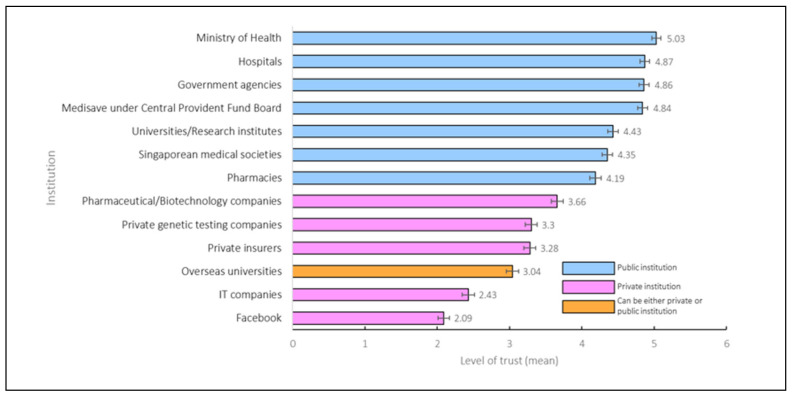
Of the 1000 respondents, 52% were female and majority were in the age range of 40-59 years (40%), followed by 21-39 years (33%) and 60 years and above (27%). A total of 64% were generally willing to share de-identified health data for IRB-approved research without re-consent for each study. Government agencies and public institutions were the most trusted users of data. The importance of the four attributes on respondents' willingness to share data were: users (39.5%), uses (28.5%), data sensitivity (19.5%), consent (12.6%). Most respondents found it acceptable for government agencies and hospitals to use de-identified data for health research with broad consent. Our sample was consistent with official government data on the target population with 52% being female and majority in the age range of 40-59 years (40%), followed by 21-39 years (33%) and 60 years and above (27%).
While a significant body of prior research focuses on preferences for consent, our conjoint analysis found consent was the least important attribute for sharing data. Our findings suggest the social license for PM data sharing in Singapore currently supports linking health and genomic data, sharing with public institutions for health research and quality improvement; but does not support sharing with private health insurers or for private commercial use.
精准医学(PM)项目通常采用广泛同意的方式。这种方法需要维护社会许可和公众信任。因此,PM项目的最终成功可能取决于了解公众对数据共享的期望并建立适当的治理结构。亚洲缺乏关于公众对PM态度的数据。
该研究的目的是衡量新加坡人在精准医学中共享健康相关数据的优先事项和偏好。我们使用基于自适应选择的联合分析(ACBC),其具有四个属性:用途、用户、数据敏感性和同意。我们招募了1000名具有代表性的受访者样本进行面对面的家庭调查。
在1000名受访者中,52%为女性,大多数年龄在40 - 59岁之间(40%),其次是21 - 39岁(33%)和60岁及以上(27%)。共有64%的人普遍愿意在未经每项研究重新同意的情况下,为经机构审查委员会批准的研究共享去标识化的健康数据。政府机构和公共机构是最受信任的数据用户。这四个属性对受访者共享数据意愿的重要性排序为:用户(39.5%)、用途(28.5%)、数据敏感性(19.5%)、同意(12.6%)。大多数受访者认为政府机构和医院在获得广泛同意的情况下使用去标识化数据进行健康研究是可以接受的。我们的样本与政府关于目标人群的官方数据一致,其中52%为女性,大多数年龄在40 - 59岁之间(40%),其次是21 - 39岁(33%)和60岁及以上(27%)。
虽然大量先前的研究集中在对同意的偏好上,但我们的联合分析发现同意是数据共享中最不重要的数据共享属性。我们的研究结果表明,新加坡目前精准医学数据共享的社会许可支持将健康和基因组数据相联系,与公共机构共享以进行健康研究和质量改进;但不支持与私人健康保险公司共享或用于私人商业用途。