Division of Pharmacy and Optometry, School of Health Sciences, Faculty of Biology, Medicine and Health, University of Manchester, Manchester Academic Health Science Centre, Manchester, UK.
Department of Public Health and Caring Sciences, Health and Medical Research, University of Uppsala, Uppsala, Sweden.
BMC Med Inform Decis Mak. 2020 Jun 16;20(1):109. doi: 10.1186/s12911-020-01139-5.
There are increasing examples of linking data on healthcare resource use and patient outcomes from different sectors of health and social care systems. Linked data are generally anonymised, meaning in most jurisdictions there are no legal restrictions to their use in research conducted by public or private organisations. Secondary use of anonymised linked data is contentious in some jurisdictions but other jurisdictions are known for their use of linked data. The publics' perceptions of the acceptability of using linked data is likely to depend on a number of factors. This study aimed to quantify the preferences of the public to understand the factors that affected views about types of linked data and its use in two jurisdictions.
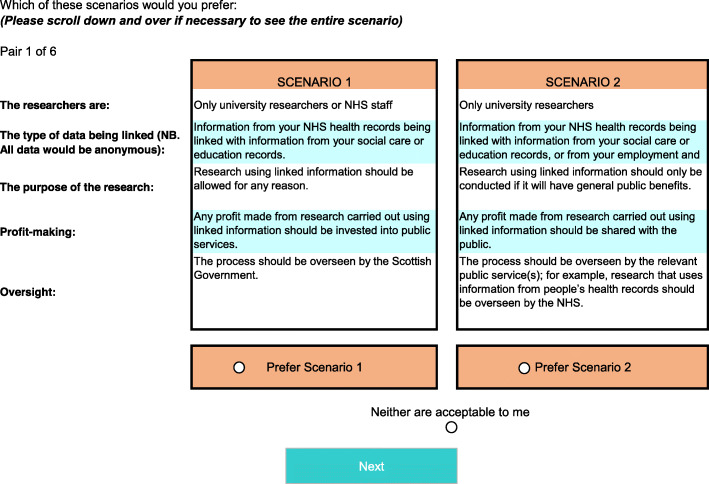
An online discrete choice experiment (DCE) previously conducted in Scotland was adapted and replicated in Sweden. The DCE was designed, comprising five attributes, to elicit the preferences from a representative sample of the public in both jurisdictions. The five attributes (number of levels) were: type of researcher using linked data (four); type of data being linked (four); purpose of the research (three); use of profit from using linked data (four); who oversees the research (four). Each DCE contained 6 choice-sets asking respondents to select their preferred option from two scenarios or state neither were acceptable. Background questions included socio-demographics. DCE data were analysed using conditional and heteroskedastic conditional logit models to create forecasts of acceptability.
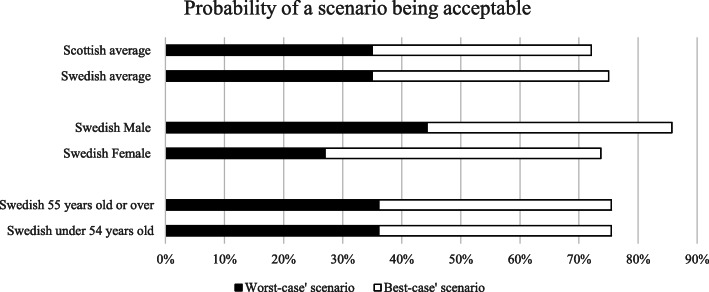
The study sample comprised members of the public living in Scotland (n = 1004) and Sweden (n = 974). All five attributes were important in driving respondents' choices. Swedish and Scottish preferences were mostly homogenous with the exception of 'who oversees the research using linked data', which had relatively less impact on the choices observed from Scotland. For a defined 'typical' linked data scenario, the probability (on average) of acceptance was 85.7% in Sweden and 82.4% in Scotland.
This study suggests that the public living in Scotland and Sweden are open to using anonymised linked data in certain scenarios for research purposes but some caution is advisable if the anonymised linked data joins health to non-health data.
越来越多的例子表明,医疗保健资源利用和患者结果的数据可以从卫生和社会保健系统的不同部门进行链接。链接数据通常是匿名的,这意味着在大多数司法管辖区,公共或私人组织进行的研究中使用链接数据没有法律限制。在一些司法管辖区,对匿名链接数据的二次使用存在争议,但其他司法管辖区则以使用链接数据而闻名。公众对使用链接数据的可接受性的看法可能取决于多个因素。本研究旨在量化公众的偏好,以了解影响对两种司法管辖区的链接数据类型及其使用的看法的因素。
对先前在苏格兰进行的在线离散选择实验(DCE)进行了改编和复制,以在瑞典进行。DCE 设计了五个属性,以从两个司法管辖区的代表性公众样本中获取偏好。五个属性(水平数量)是:使用链接数据的研究人员类型(四);链接的数据类型(四);研究目的(三);使用链接数据产生的利润(四);监督研究的人(四)。每个 DCE 包含 6 个选择集,要求受访者从两个场景中选择他们更喜欢的选项,或者声明两个都不可接受。背景问题包括社会人口统计学。使用条件和异方差条件逻辑回归模型对 DCE 数据进行分析,以创建可接受性预测。
研究样本包括居住在苏格兰(n=1004)和瑞典(n=974)的公众成员。所有五个属性对驱动受访者选择都很重要。瑞典和苏格兰的偏好大多是同质的,除了“使用链接数据监督研究的人”,这对来自苏格兰的选择观察结果的影响相对较小。对于定义的“典型”链接数据场景,接受的概率(平均)在瑞典为 85.7%,在苏格兰为 82.4%。
本研究表明,居住在苏格兰和瑞典的公众对在某些情况下出于研究目的使用匿名链接数据持开放态度,但如果匿名链接数据将健康与非健康数据结合使用,则需要谨慎。