Pathology Unit, Istituto Nazionale Tumori-Irccs-Fondazione G. Pascale, 80131 Naples, Italy.
Sarcomas and Rare Tumors Unit, Istituto Nazionale Tumori-Irccs-Fondazione G. Pascale, 80131 Naples, Italy.
Int J Mol Sci. 2021 Sep 21;22(18):10160. doi: 10.3390/ijms221810160.
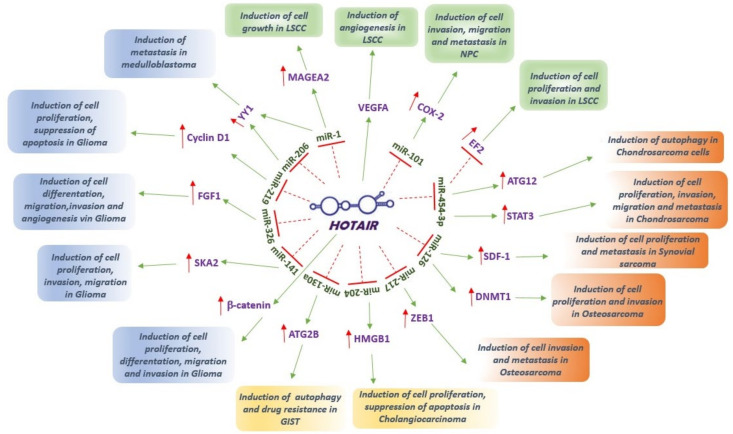
Rare cancers are identified as those with an annual incidence of fewer than 6 per 100,000 persons and includes both epithelial and stromal tumors from different anatomical areas. The advancement of analytical methods has produced an accurate molecular characterization of most human cancers, suggesting a "molecular classification" that has allowed the establishment of increasingly personalized therapeutic strategies. However, the limited availability of rare cancer samples has resulted in very few therapeutic options for these tumors, often leading to poor prognosis. Long non coding RNAs (lncRNAs) are a class of non-coding RNAs mostly involved in tumor progression and drug response. In particular, the lncRNA HOX transcript antisense RNA () represents an emergent diagnostic, prognostic and predictive biomarker in many human cancers. The aim of this review is to highlight the role of HOTAIR in rare cancers, proposing it as a new biomarker usable in the management of these tumors.
罕见癌症的定义为其年发病率低于每 10 万人 6 例,包括来自不同解剖区域的上皮和间质肿瘤。分析方法的进步对大多数人类癌症进行了准确的分子特征描述,提示了一种“分子分类”,从而为建立越来越个性化的治疗策略提供了可能。然而,由于罕见癌症样本的数量有限,这些肿瘤的治疗选择非常有限,通常导致预后不良。长链非编码 RNA(lncRNA)是一类主要参与肿瘤进展和药物反应的非编码 RNA。特别是,HOX 转录反义 RNA(HOTAIR)lncRNA 是许多人类癌症中新兴的诊断、预后和预测生物标志物。本文旨在强调 HOTAIR 在罕见癌症中的作用,提出其作为这些肿瘤管理中可用的新型生物标志物。