Centre for Applied Photonics, INESC TEC, Rua do Campo Alegre 687, 4169-007 Porto, Portugal.
Departamento de Física e Astronomia, Faculdade de Ciências da Universidade do Porto, Rua do Campo Alegre 687, 4169-007 Porto, Portugal.
Sensors (Basel). 2021 Sep 15;21(18):6181. doi: 10.3390/s21186181.
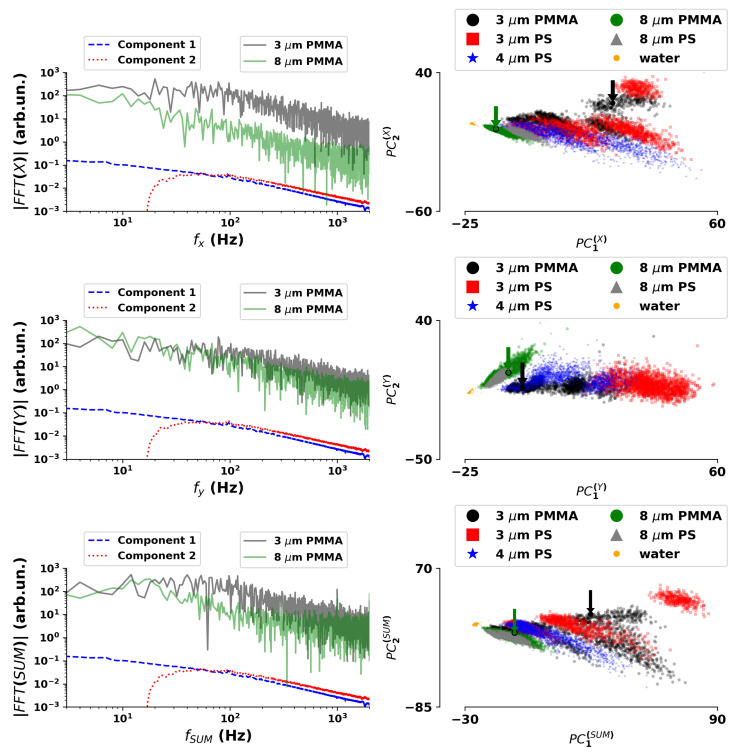
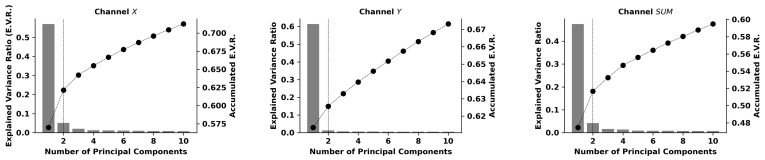
The ability to select, isolate, and manipulate micron-sized particles or small clusters has made optical tweezers one of the emergent tools for modern biotechnology. In conventional setups, the classification of the trapped specimen is usually achieved through the acquired image, the scattered signal, or additional information such as Raman spectroscopy. In this work, we propose a solution that uses the temporal data signal from the scattering process of the trapping laser, acquired with a quadrant photodetector. Our methodology rests on a pre-processing strategy that combines Fourier transform and principal component analysis to reduce the dimension of the data and perform relevant feature extraction. Testing a wide range of standard machine learning algorithms, it is shown that this methodology allows achieving accuracy performances around 90%, validating the concept of using the temporal dynamics of the scattering signal for the classification task. Achieved with 500 millisecond signals and leveraging on methods of low computational footprint, the results presented pave the way for the deployment of alternative and faster classification methodologies in optical trapping technologies.
光学镊子能够选择、隔离和操纵微米级颗粒或小团簇,使其成为现代生物技术中新兴的工具之一。在传统的设置中,捕获样本的分类通常是通过获取的图像、散射信号或拉曼光谱等附加信息来实现的。在这项工作中,我们提出了一种使用四象限光电探测器获取的捕获激光散射过程的时间数据信号的解决方案。我们的方法基于一种预处理策略,该策略结合了傅里叶变换和主成分分析,以降低数据的维度并进行相关的特征提取。通过测试广泛的标准机器学习算法,结果表明,该方法可以实现约 90%的准确率,验证了使用散射信号的时间动态进行分类任务的概念。该方法利用 500 毫秒的信号,并利用低计算量的方法,为在光学捕获技术中部署替代的、更快的分类方法铺平了道路。