Department of Health Science and Technology, Aalborg University, 9000 Aalborg, Denmark.
Centre for Chiropractic Research, New Zealand College of Chiropractic, Auckland 1060, New Zealand.
Sensors (Basel). 2021 Sep 18;21(18):6274. doi: 10.3390/s21186274.
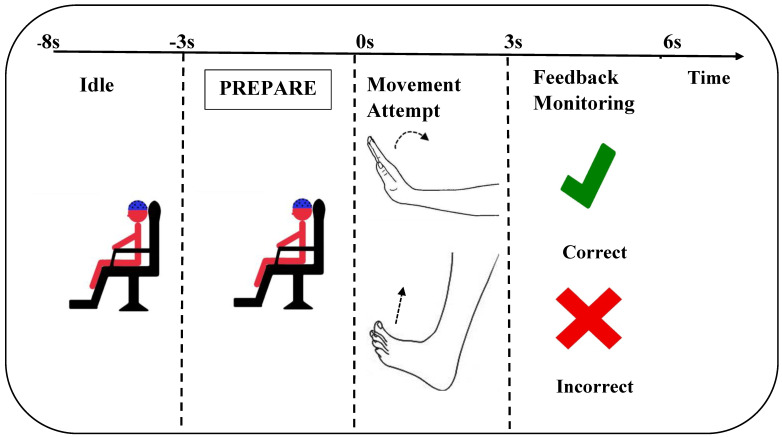
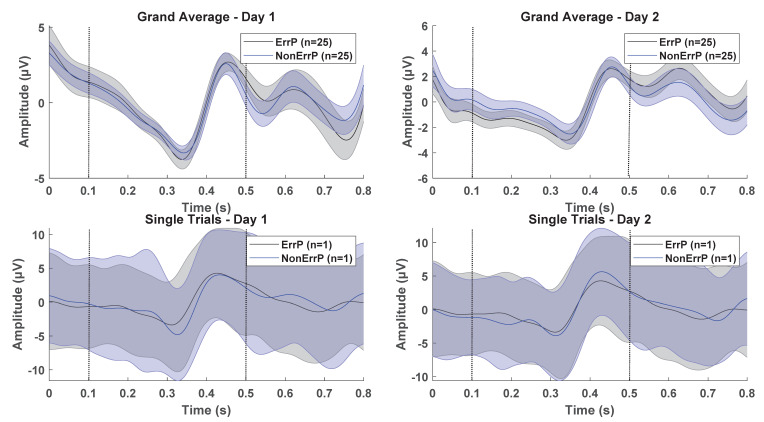
Error-related potentials (ErrPs) have been proposed as a means for improving brain-computer interface (BCI) performance by either correcting an incorrect action performed by the BCI or label data for continuous adaptation of the BCI to improve the performance. The latter approach could be relevant within stroke rehabilitation where BCI calibration time could be minimized by using a generalized classifier that is continuously being individualized throughout the rehabilitation session. This may be achieved if data are correctly labelled. Therefore, the aims of this study were: (1) classify single-trial ErrPs produced by individuals with stroke, (2) investigate test-retest reliability, and (3) compare different classifier calibration schemes with different classification methods (artificial neural network, ANN, and linear discriminant analysis, LDA) with waveform features as input for meaningful physiological interpretability. Twenty-five individuals with stroke operated a sham BCI on two separate days where they attempted to perform a movement after which they received feedback (error/correct) while continuous EEG was recorded. The EEG was divided into epochs: ErrPs and NonErrPs. The epochs were classified with a multi-layer perceptron ANN based on temporal features or the entire epoch. Additionally, the features were classified with shrinkage LDA. The features were waveforms of the ErrPs and NonErrPs from the sensorimotor cortex to improve the explainability and interpretation of the output of the classifiers. Three calibration schemes were tested: within-day, between-day, and across-participant. Using within-day calibration, 90% of the data were correctly classified with the entire epoch as input to the ANN; it decreased to 86% and 69% when using temporal features as input to ANN and LDA, respectively. There was poor test-retest reliability between the two days, and the other calibration schemes led to accuracies in the range of 63-72% with LDA performing the best. There was no association between the individuals' impairment level and classification accuracies. The results show that ErrPs can be classified in individuals with stroke, but that user- and session-specific calibration is needed for optimal ErrP decoding with this approach. The use of ErrP/NonErrP waveform features makes it possible to have a physiological meaningful interpretation of the output of the classifiers. The results may have implications for labelling data continuously in BCIs for stroke rehabilitation and thus potentially improve the BCI performance.
错误相关电位(ErrPs)已被提议作为一种通过以下两种方式来提高脑机接口(BCI)性能的方法:要么纠正由 BCI 执行的错误动作,要么对数据进行标记,以便对 BCI 进行连续自适应,从而提高性能。在中风康复中,这种方法可能具有相关性,因为通过使用在整个康复过程中不断个性化的广义分类器,可以最小化 BCI 的校准时间。如果数据得到正确标记,就可以实现这一点。因此,本研究的目的是:(1)对中风患者产生的单试次 ErrPs 进行分类,(2)研究测试-再测试的可靠性,(3)使用不同的分类方法(人工神经网络,ANN 和线性判别分析,LDA)比较不同的分类器校准方案,以及将作为输入的波形特征用于有意义的生理可解释性。25 名中风患者在两天内操作一个假 BCI,他们在尝试进行运动后收到反馈(正确/错误),同时连续记录 EEG。EEG 被分为两个时期:ErrPs 和 NonErrPs。使用多层感知器 ANN 根据时间特征或整个时期对时期进行分类。此外,使用收缩 LDA 对特征进行分类。特征是来自感觉运动皮层的 ErrPs 和 NonErrPs 的波形,以提高分类器输出的可解释性和解释性。测试了三种校准方案:日内、日间和跨参与者。使用日内校准,当将整个时期作为输入提供给 ANN 时,有 90%的数据被正确分类;当使用时间特征作为 ANN 和 LDA 的输入时,分别减少到 86%和 69%。两天之间的测试-再测试可靠性较差,其他校准方案导致的准确性在 63%-72%之间,LDA 的性能最佳。个体损伤程度与分类准确性之间没有关联。结果表明,在中风患者中可以对 ErrPs 进行分类,但这种方法需要针对用户和会话进行特定的校准,才能实现最佳的 ErrP 解码。使用 ErrP/NonErrP 波形特征可以对分类器的输出进行有生理意义的解释。这些结果可能对中风康复中的 BCI 连续标记数据具有重要意义,从而有可能提高 BCI 的性能。