Antonarelli Gabriele, Giugliano Federica, Corti Chiara, Repetto Matteo, Tarantino Paolo, Curigliano Giuseppe
Division of Early Drug Development for Innovative Therapy, European Institute of Oncology, IRCCS, 20141 Milan, Italy.
Department of Oncology and Haematology (DIPO), University of Milan, 20122 Milan, Italy.
Pharmaceuticals (Basel). 2021 Aug 31;14(9):884. doi: 10.3390/ph14090884.
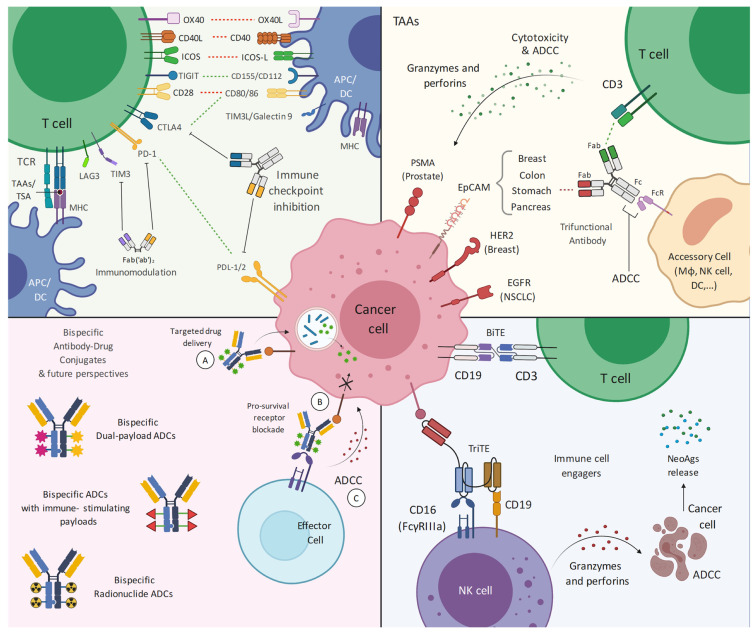
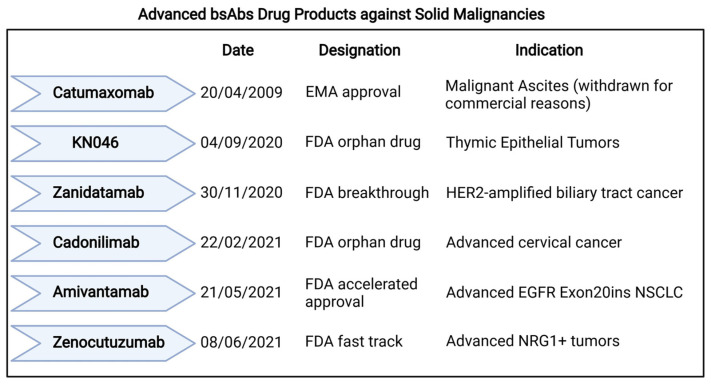
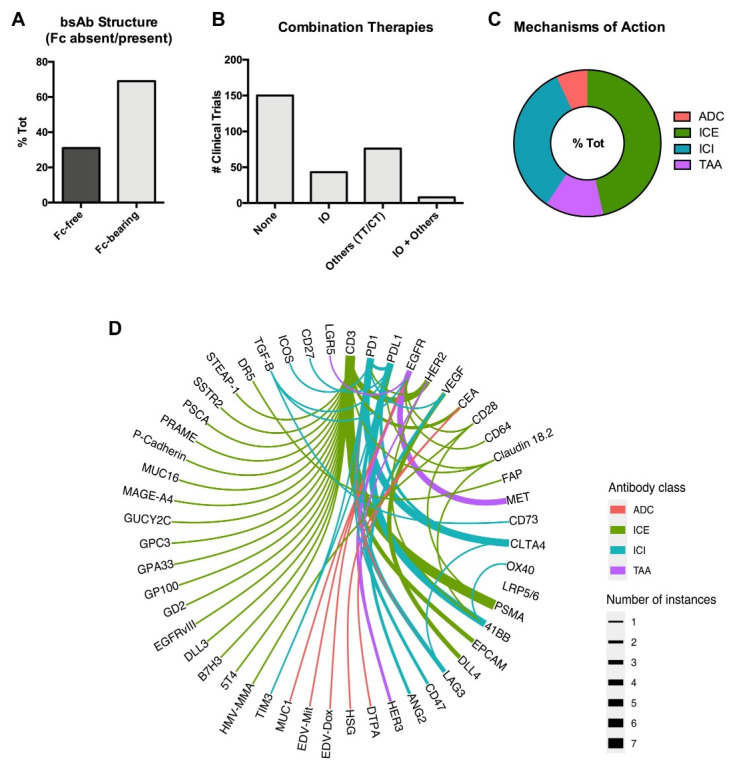
Solid tumors adopt multiple mechanisms to grow, evade immune responses, and to withstand therapeutic approaches. A major breakthrough in the armamentarium of anti-cancer agents has been the introduction of monoclonal antibodies (mAbs), able to inhibit aberrantly activated pathways and/or to unleash antigen (Ag)-specific immune responses. Nonetheless, mAb-mediated targeted pressure often fails due to escape mechanisms, mainly Ag loss/downregulation, ultimately providing therapy resistance. Hence, in order to target multiple Ag at the same time, and to facilitate cancer-immune cells interactions, bispecific antibodies (bsAbs) have been developed and are being tested in clinical trials, yielding variable safety/efficacy results based on target selection and their structure. While in hematologic cancers the bsAb blinatumomab recently reached the Food and Drug Administration (FDA)-approval for B Cell Acute Lymphoblastic Leukemia, bsAbs use in solid tumors faces considerable challenges, such as target Ag selection, biodistribution, and the presence of an immune-suppressive tumor microenvironment (TME). This review will focus on the state-of-the art, the design, and the exploitation of bsAbs against solid malignancies, delineating their mechanisms of action, major pitfalls, and future directions.
实体瘤采用多种机制来生长、逃避免疫反应并抵御治疗方法。抗癌药物库中的一项重大突破是引入了单克隆抗体(mAb),其能够抑制异常激活的信号通路和/或引发抗原(Ag)特异性免疫反应。尽管如此,mAb介导的靶向压力常常因逃逸机制而失效,主要是抗原丢失/下调,最终导致治疗抗性。因此,为了同时靶向多种抗原,并促进癌症与免疫细胞的相互作用,双特异性抗体(bsAb)已被研发出来并正在临床试验中进行测试,根据靶点选择及其结构产生了不同的安全性/疗效结果。虽然在血液系统癌症中,双特异性抗体blinatumomab最近已获得美国食品药品监督管理局(FDA)批准用于治疗B细胞急性淋巴细胞白血病,但双特异性抗体在实体瘤中的应用面临着诸多挑战,如靶点抗原选择、生物分布以及免疫抑制性肿瘤微环境(TME)的存在。本综述将聚焦于双特异性抗体针对实体恶性肿瘤的最新进展、设计及应用,阐述其作用机制、主要缺陷及未来方向。