Linssen Matthijs David, Hooghiemstra Wouter Tjerk Rudolph, Jorritsma-Smit Annelies, Allersma Derk Pieter, Dijkstra Gerard, Nagengast Wouter Bastiaan
Department of Gastroenterology and Hepatology, University of Groningen, University Medical Center Groningen, 9700 RB Groningen, The Netherlands.
Department of Clinical Pharmacy and Pharmacology, University of Groningen, University Medical Center Groningen, 9700 RB Groningen, The Netherlands.
Pharmaceuticals (Basel). 2021 Sep 13;14(9):922. doi: 10.3390/ph14090922.
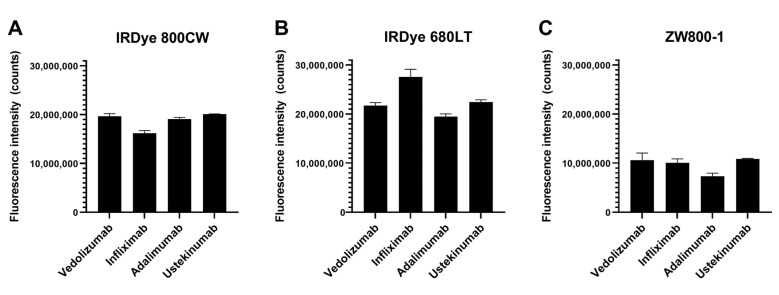
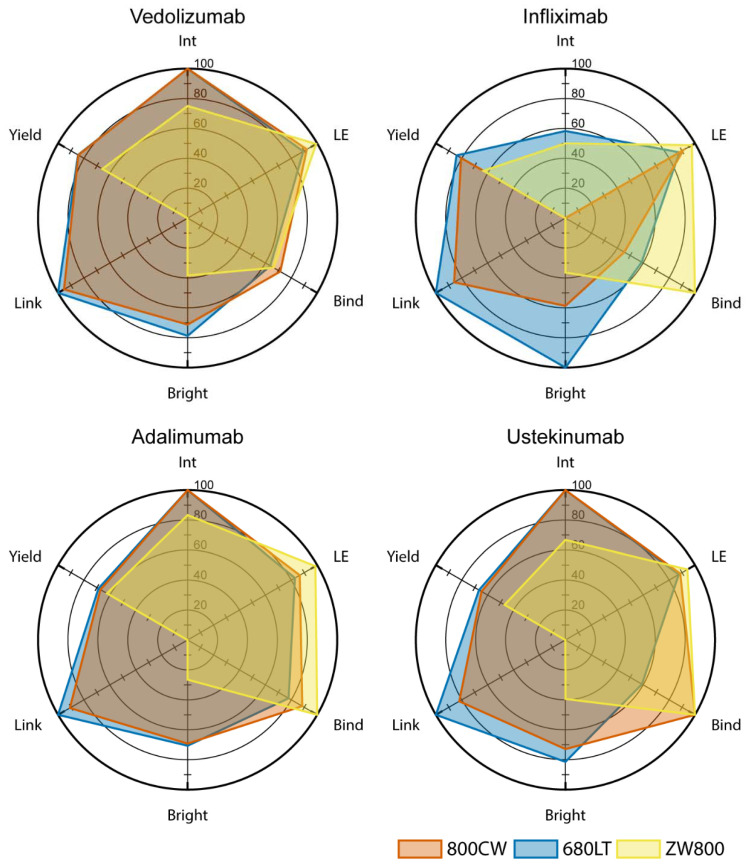
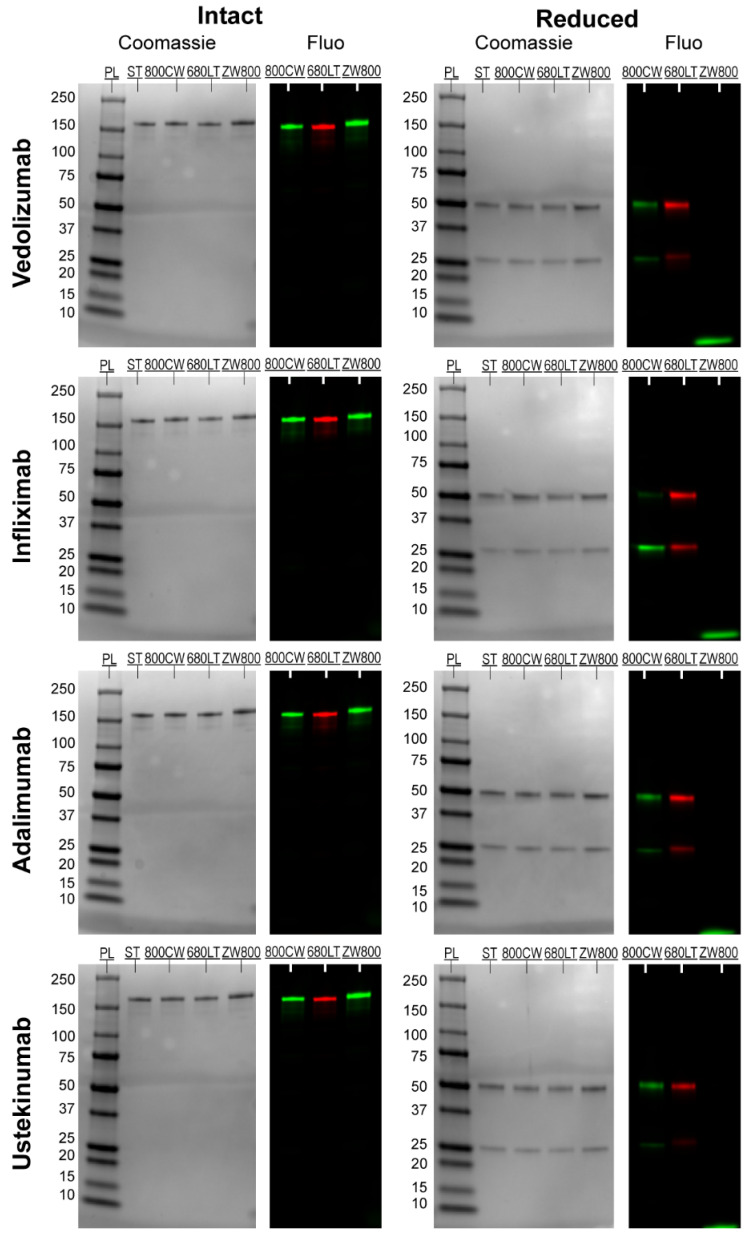
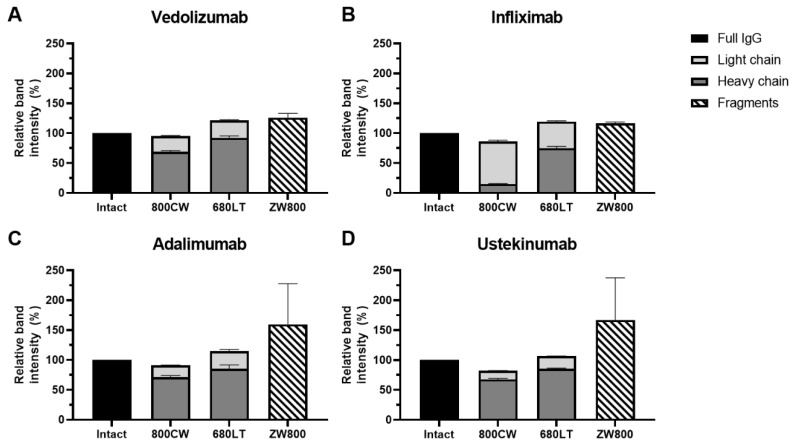
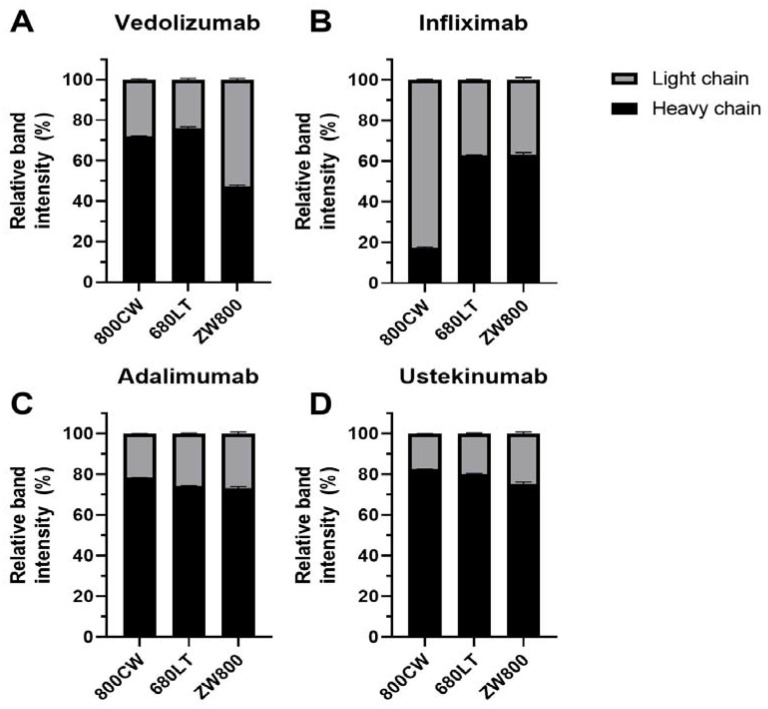
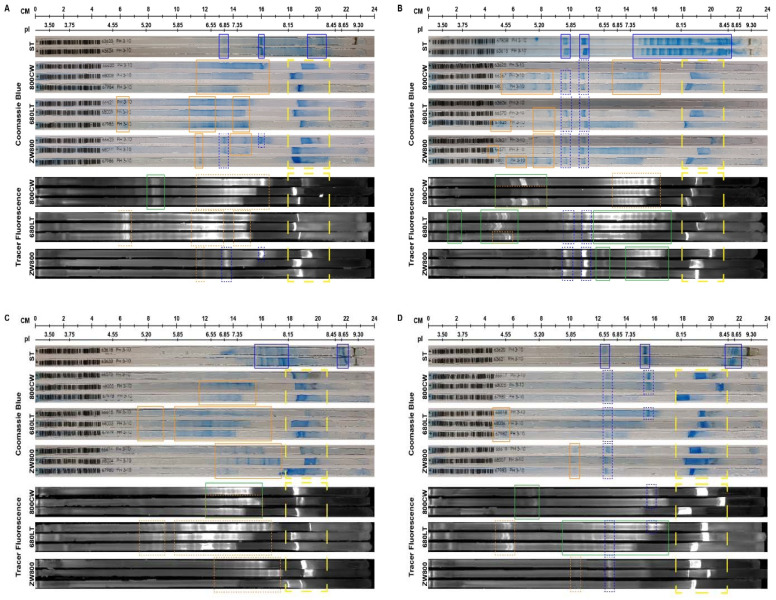
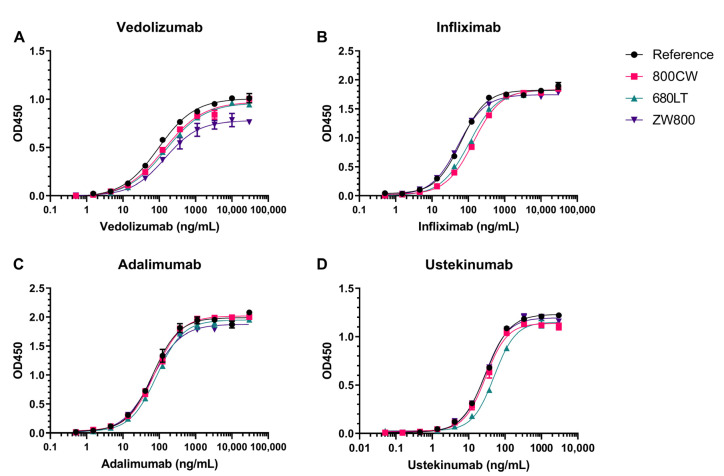
Monoclonal antibodies are an important addition to the medicinal treatment paradigm for IBD patients. While effective, these agents show a high degree of primary and secondary non-response, and methods to predict response are highly desired. Information on drug distribution at the target level is often lacking. Fluorescent endoscopic imaging using labelled antibody drugs may provide insight regarding drug distribution, target engagement and drug response, but these assessments require stable and functional fluorescently-conjugated probes. Infliximab, vedolizumab, adalimumab and ustekinumab were conjugated to IRDye 800CW, IRDye 680LT and ZW800-1. The resulting 12 tracer candidates were analysed and characterised on SE-HPLC, SDS-PAGE, iso-electric focussing (IEF) and ELISA in order to evaluate their feasibility as candidate clinical tracers for cGMP development. Major differences in the conjugation results could be seen for each conjugated drug. For Infliximab, 2 conjugates (800CW and 680LT) showed formation of aggregates, while conjugates of all drugs with ZW800-1 showed reduced fluorescent brightness, reduced purification yield and formation of fragments. All 6 of these candidates were considered unfeasible. From the remaining 6, ustekinumab-680LT showed reduced binding to IL23, and was therefore considered unfeasible. Out of 12 potential tracer candidates, 5 were considered feasible for further development: vedolizumab-800CW, vedolizumab-680LT, adalimumab-800CW, adalimumab-680LT and ustekinumab-800CW. Infliximab-680LT and ustekinumab-680LT failed to meet the standards for this panel, but may be rendered feasible if tracer production methods were further optimized.
单克隆抗体是炎性肠病(IBD)患者药物治疗模式中的一项重要补充。虽然这些药物有效,但它们表现出高度的原发性和继发性无反应性,因此非常需要预测反应的方法。目前常常缺乏关于靶点水平药物分布的信息。使用标记抗体药物的荧光内镜成像可能会提供有关药物分布、靶点结合和药物反应的见解,但这些评估需要稳定且功能正常的荧光共轭探针。英夫利昔单抗、维得利珠单抗、阿达木单抗和乌司奴单抗分别与IRDye 800CW、IRDye 680LT和ZW800-1共轭。对得到的12种示踪剂候选物进行了尺寸排阻高效液相色谱(SE-HPLC)、十二烷基硫酸钠-聚丙烯酰胺凝胶电泳(SDS-PAGE)、等电聚焦(IEF)和酶联免疫吸附测定(ELISA)分析与表征,以评估它们作为用于cGMP开发的候选临床示踪剂的可行性。每种共轭药物的共轭结果存在显著差异。对于英夫利昔单抗,2种共轭物(800CW和680LT)显示有聚集体形成,而所有药物与ZW800-1的共轭物均显示荧光亮度降低、纯化产率降低以及有片段形成。所有这6种候选物都被认为不可行。在其余6种中,乌司奴单抗-680LT显示与IL23的结合减少,因此也被认为不可行。在12种潜在的示踪剂候选物中,有5种被认为可进一步开发:维得利珠单抗-800CW、维得利珠单抗-680LT、阿达木单抗-800CW、阿达木单抗-680LT和乌司奴单抗-800CW。英夫利昔单抗-680LT和乌司奴单抗-680LT未达到该组别的标准,但如果示踪剂生产方法进一步优化,可能会变得可行。