Department of Neurosurgery, Stanford University School of Medicine, Stanford, CA, 94305, USA.
Department of Otolaryngology-Head and Neck Surgery, Stanford University School of Medicine, Stanford, CA, USA.
Sci Rep. 2021 Mar 11;11(1):5710. doi: 10.1038/s41598-021-84831-4.
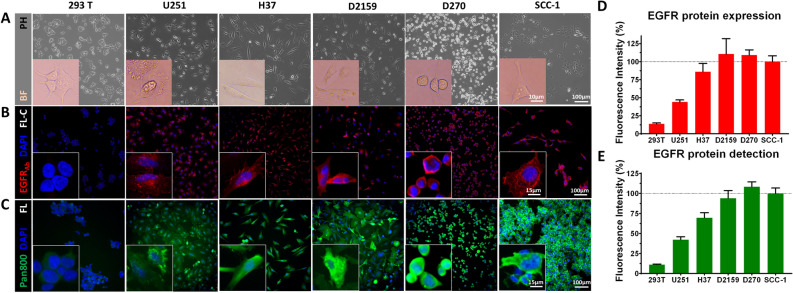
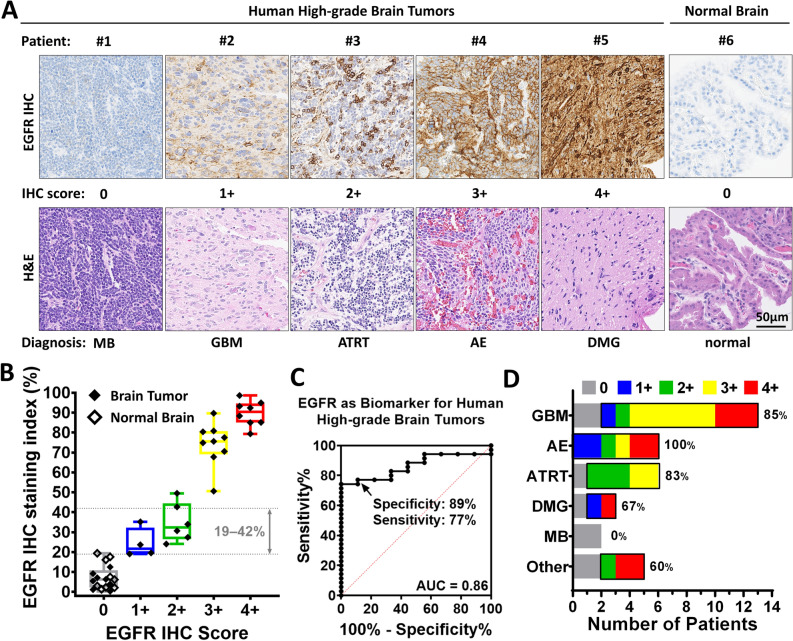
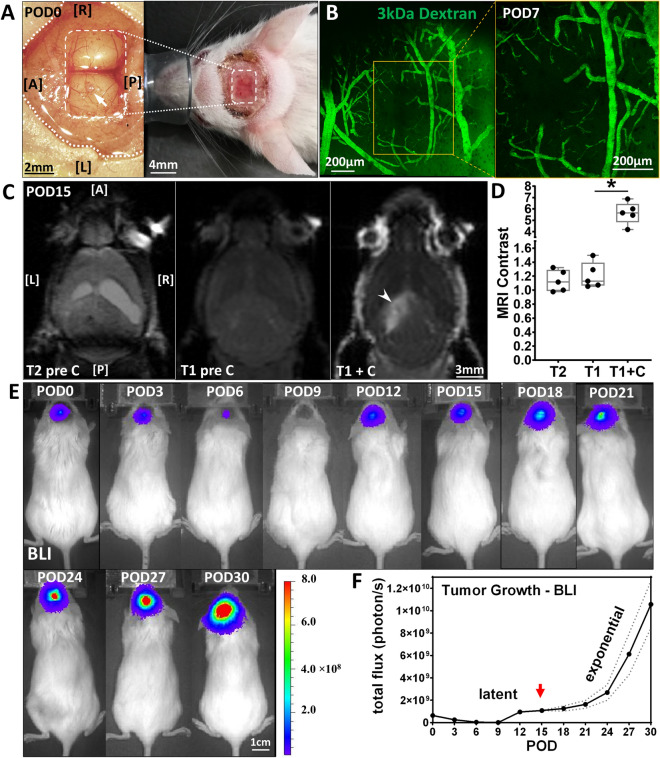
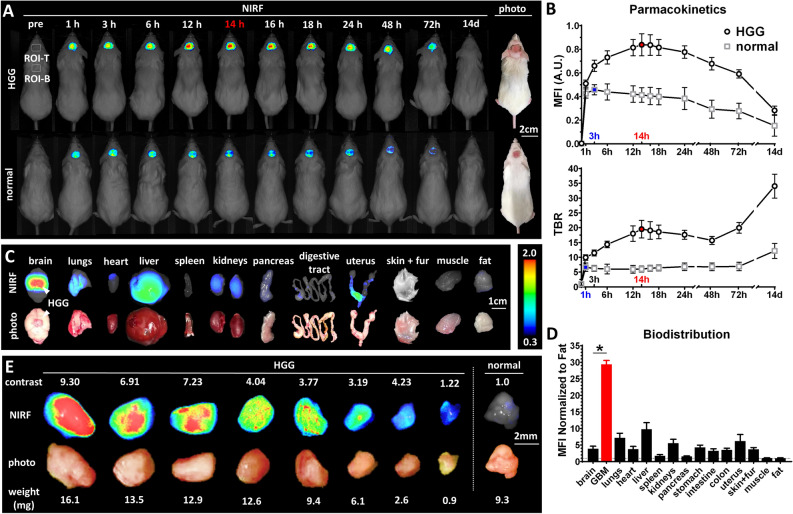
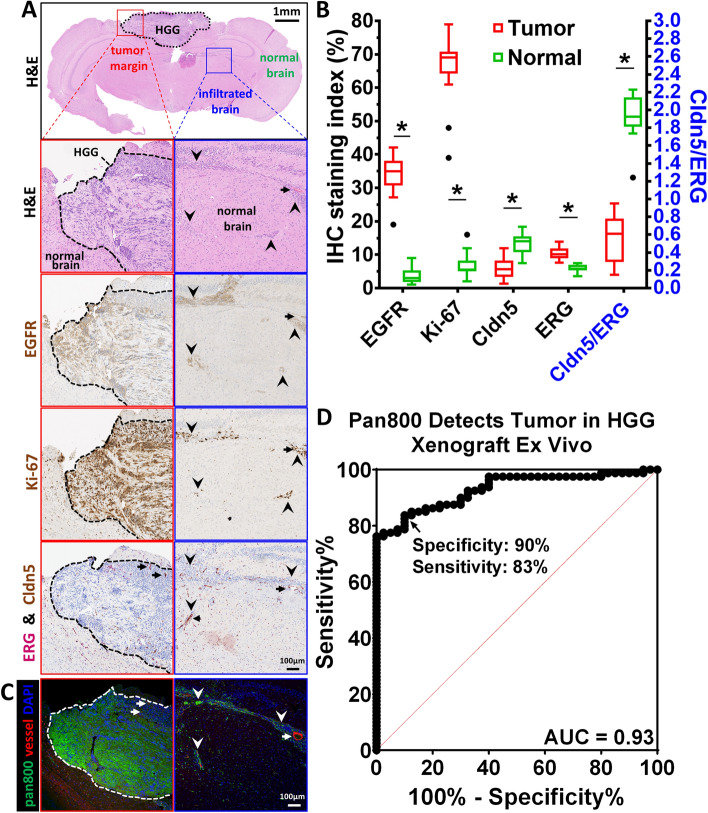
The prognosis for high-grade glioma (HGG) remains dismal and the extent of resection correlates with overall survival and progression free disease. Epidermal growth factor receptor (EGFR) is a biomarker heterogeneously expressed in HGG. We assessed the feasibility of detecting HGG using near-infrared fluorescent antibody targeting EGFR. Mice bearing orthotopic HGG xenografts with modest EGFR expression were imaged in vivo after systemic panitumumab-IRDye800 injection to assess its tumor-specific uptake macroscopically over 14 days, and microscopically ex vivo. EGFR immunohistochemical staining of 59 tumor specimens from 35 HGG patients was scored by pathologists and expression levels were compared to that of mouse xenografts. Intratumoral distribution of panitumumab-IRDye800 correlated with near-infrared fluorescence and EGFR expression. Fluorescence distinguished tumor cells with 90% specificity and 82.5% sensitivity. Target-to-background ratios peaked at 14 h post panitumumab-IRDye800 infusion, reaching 19.5 in vivo and 7.6 ex vivo, respectively. Equivalent or higher EGFR protein expression compared to the mouse xenografts was present in 77.1% HGG patients. Age, combined with IDH-wildtype cerebral tumor, was predictive of greater EGFR protein expression in human tumors. Tumor specific uptake of panitumumab-IRDye800 provided remarkable contrast and a flexible imaging window for fluorescence-guided identification of HGGs despite modest EGFR expression.
高级别神经胶质瘤(HGG)的预后仍然不容乐观,切除范围与总生存期和无进展疾病相关。表皮生长因子受体(EGFR)在 HGG 中呈异质性表达,是一种生物标志物。我们评估了使用针对 EGFR 的近红外荧光抗体检测 HGG 的可行性。在系统注射帕尼单抗-IR-Dye800 后,对载有 EGFR 表达适度的原位 HGG 异种移植瘤的小鼠进行体内成像,以在 14 天内宏观评估其肿瘤特异性摄取,以及体外评估。对 35 名 HGG 患者的 59 个肿瘤标本进行 EGFR 免疫组织化学染色,由病理学家评分,并与小鼠异种移植瘤的表达水平进行比较。帕尼单抗-IR-Dye800 的肿瘤内分布与近红外荧光和 EGFR 表达相关。荧光以 90%的特异性和 82.5%的灵敏度区分肿瘤细胞。在帕尼单抗-IR-Dye800 输注后 14 小时达到峰值,体内和体外的靶背比分别达到 19.5 和 7.6。与小鼠异种移植瘤相比,77.1%的 HGG 患者具有相当或更高的 EGFR 蛋白表达。年龄与 IDH-野生型脑肿瘤结合是人类肿瘤中 EGFR 蛋白表达增加的预测因素。尽管 EGFR 表达适度,但帕尼单抗-IR-Dye800 的肿瘤特异性摄取提供了显著的对比,并为荧光引导 HGG 的识别提供了灵活的成像窗口。