Hargreaves Alexander, Brady Caolann, Mellors Jack, Tipton Tom, Carroll Miles W, Longet Stephanie
Nuffield Department of Medicine, Wellcome Centre for Human Genetics, University of Oxford, Oxford OX3 7BN, UK.
Faculty of Health and Medical Sciences, University of Surrey, Guildford GU2 7XH, UK.
Pathogens. 2021 Sep 16;10(9):1201. doi: 10.3390/pathogens10091201.
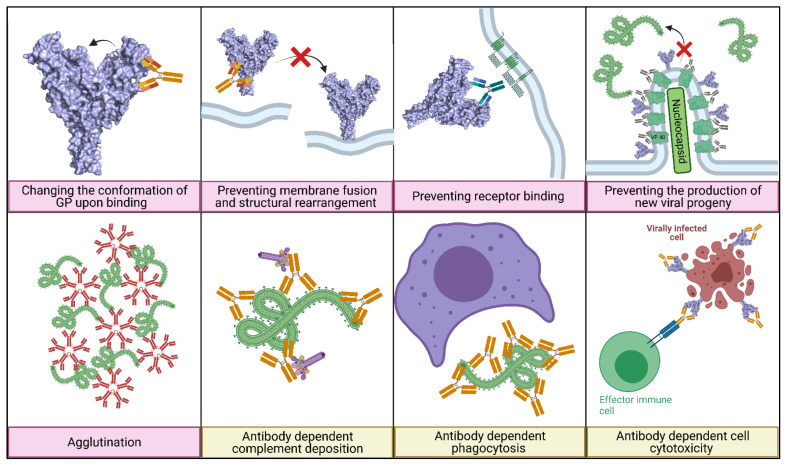
Filoviruses, especially Ebola virus, cause sporadic outbreaks of viral haemorrhagic fever with very high case fatality rates in Africa. The 2013-2016 Ebola epidemic in West Africa provided large survivor cohorts spurring a large number of human studies which showed that specific neutralising antibodies played a key role in protection following a natural Ebola virus infection, as part of the overall humoral response and in conjunction with the cellular adaptive response. This review will discuss the studies in survivors and animal models which described protective neutralising antibody response. Their mechanisms of action will be detailed. Furthermore, the importance of neutralising antibodies in antibody-based therapeutics and in vaccine-induced responses will be explained, as well as the strategies to avoid immune escape from neutralising antibodies. Understanding the neutralising antibody response in the context of filoviruses is crucial to furthering our understanding of virus structure and function, in addition to improving current vaccines & antibody-based therapeutics.
丝状病毒,尤其是埃博拉病毒,在非洲引发散发性病毒性出血热疫情,病死率极高。2013 - 2016年西非埃博拉疫情产生了大量幸存者群体,促使开展了大量人体研究,这些研究表明,作为整体体液反应的一部分,并与细胞适应性反应协同作用,特定的中和抗体在自然感染埃博拉病毒后的保护过程中发挥了关键作用。本综述将讨论在幸存者和动物模型中描述保护性中和抗体反应的研究。将详细阐述其作用机制。此外,还将解释中和抗体在基于抗体的治疗方法以及疫苗诱导反应中的重要性,以及避免病毒从中和抗体中产生免疫逃逸的策略。除了改进当前的疫苗和基于抗体的治疗方法外,了解丝状病毒背景下的中和抗体反应对于深化我们对病毒结构和功能的理解至关重要。