Shin Tae Hwan, Nithiyanandam Saraswathy, Lee Da Yeon, Kwon Do Hyeon, Hwang Ji Su, Kim Seok Gi, Jang Yong Eun, Basith Shaherin, Park Sungsu, Mo Jung-Soon, Lee Gwang
Department of Physiology, Ajou University School of Medicine, Suwon 16499, Korea.
Department of Molecular Science and Technology, Ajou University, Suwon 16499, Korea.
Nanomaterials (Basel). 2021 Sep 13;11(9):2385. doi: 10.3390/nano11092385.
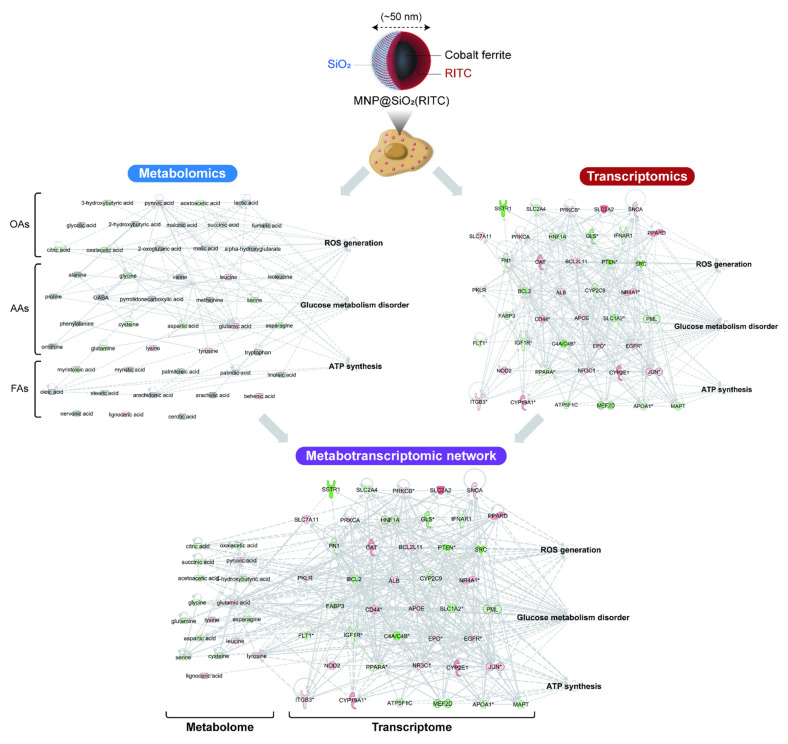
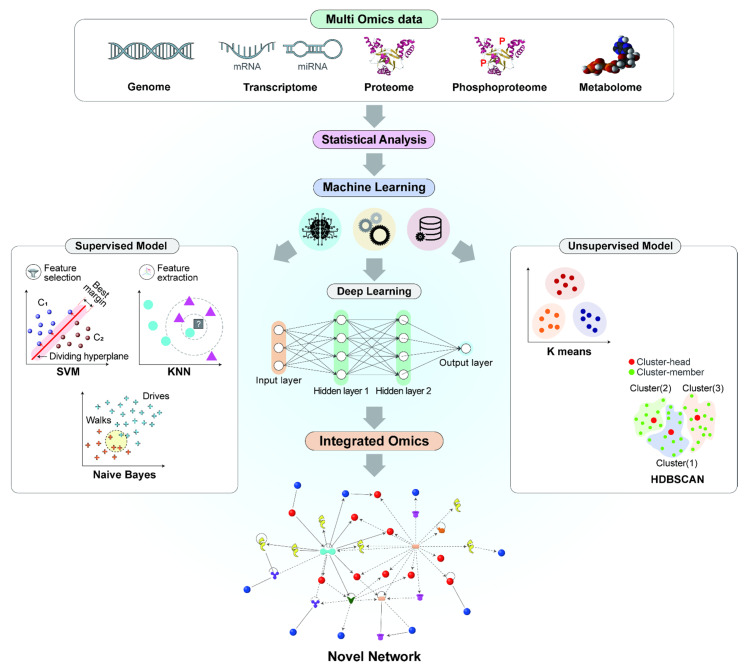
Nanoparticles (NPs) in biomedical applications have benefits owing to their small size. However, their intricate and sensitive nature makes an evaluation of the adverse effects of NPs on health necessary and challenging. Since there are limitations to conventional toxicological methods and omics analyses provide a more comprehensive molecular profiling of multifactorial biological systems, omics approaches are necessary to evaluate nanotoxicity. Compared to a single omics layer, integrated omics across multiple omics layers provides more sensitive and comprehensive details on NP-induced toxicity based on network integration analysis. As multi-omics data are heterogeneous and massive, computational methods such as machine learning (ML) have been applied for investigating correlation among each omics. This integration of omics and ML approaches will be helpful for analyzing nanotoxicity. To that end, mechanobiology has been applied for evaluating the biophysical changes in NPs by measuring the traction force and rigidity sensing in NP-treated cells using a sub-elastomeric pillar. Therefore, integrated omics approaches are suitable for elucidating mechanobiological effects exerted by NPs. These technologies will be valuable for expanding the safety evaluations of NPs. Here, we review the integration of omics, ML, and mechanobiology for evaluating nanotoxicity.
纳米颗粒(NPs)在生物医学应用中因其尺寸小而具有诸多优势。然而,其复杂且敏感的特性使得评估纳米颗粒对健康的不良影响既必要又具有挑战性。由于传统毒理学方法存在局限性,而组学分析能够对多因素生物系统进行更全面的分子剖析,因此采用组学方法来评估纳米毒性是必要的。与单一的组学层面相比,跨多个组学层面的整合组学基于网络整合分析,能提供关于纳米颗粒诱导毒性更敏感、更全面的细节。由于多组学数据具有异质性且海量,机器学习(ML)等计算方法已被用于研究各omics之间的相关性。组学与机器学习方法的这种整合将有助于分析纳米毒性。为此,力学生物学已被应用于通过使用亚弹性支柱测量纳米颗粒处理细胞中的牵引力和刚性感知来评估纳米颗粒的生物物理变化。因此,整合组学方法适用于阐明纳米颗粒所施加的力学生物学效应。这些技术对于扩展纳米颗粒的安全性评估将具有重要价值。在此,我们综述了用于评估纳米毒性的组学、机器学习和力学生物学的整合。