Awashra Mohammad, Młynarz Piotr
Department of Chemistry and Materials Science, School of Chemical Engineering, Aalto University 02150 Espoo Finland
Department of Biochemistry, Molecular Biology and Biotechnology, Faculty of Chemistry, Wroclaw University of Science and Technology Wroclaw Poland
Nanoscale Adv. 2023 Jan 30;5(10):2674-2723. doi: 10.1039/d2na00534d. eCollection 2023 May 16.
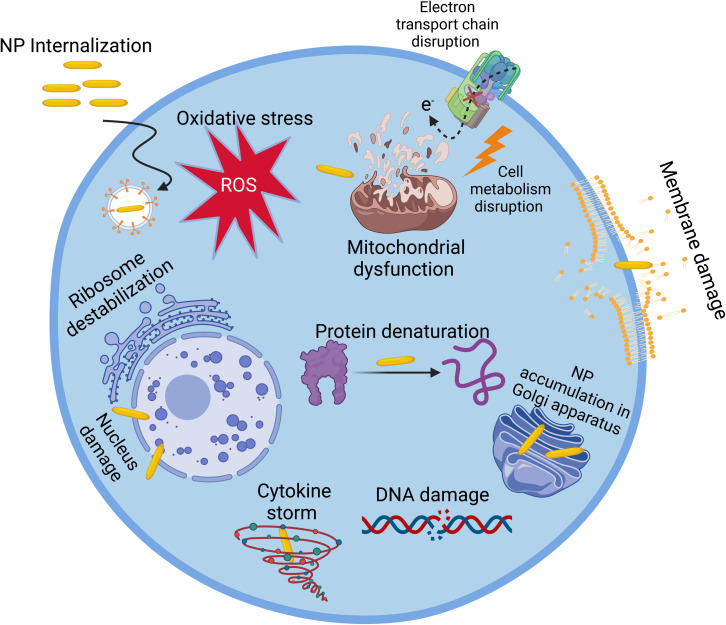
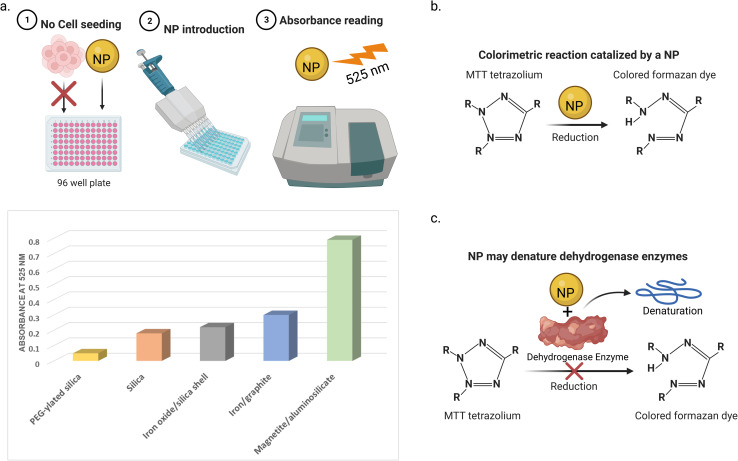
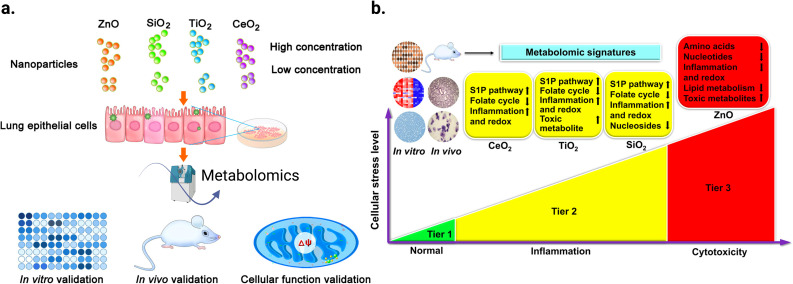
Nowadays, nanomaterials (NMs) are widely present in daily life due to their significant benefits, as demonstrated by their application in many fields such as biomedicine, engineering, food, cosmetics, sensing, and energy. However, the increasing production of NMs multiplies the chances of their release into the surrounding environment, making human exposure to NMs inevitable. Currently, nanotoxicology is a crucial field, which focuses on studying the toxicity of NMs. The toxicity or effects of nanoparticles (NPs) on the environment and humans can be preliminary assessed using cell models. However, the conventional cytotoxicity assays, such as the MTT assay, have some drawbacks including the possibility of interference with the studied NPs. Therefore, it is necessary to employ more advanced techniques that provide high throughput analysis and avoid interferences. In this case, metabolomics is one of the most powerful bioanalytical strategies to assess the toxicity of different materials. By measuring the metabolic change upon the introduction of a stimulus, this technique can reveal the molecular information of the toxicity induced by NPs. This provides the opportunity to design novel and efficient nanodrugs and minimizes the risks of NPs used in industry and other fields. Initially, this review summarizes the ways that NPs and cells interact and the NP parameters that play a role in this interaction, and then the assessment of these interactions using conventional assays and the challenges encountered are discussed. Subsequently, in the main part, we introduce the recent studies employing metabolomics for the assessment of these interactions .
如今,纳米材料因其显著的优势而广泛存在于日常生活中,这在其于生物医学、工程、食品、化妆品、传感和能源等诸多领域的应用中得到了体现。然而,纳米材料产量的不断增加使其释放到周围环境中的可能性成倍增加,导致人类不可避免地接触到纳米材料。目前,纳米毒理学是一个关键领域,专注于研究纳米材料的毒性。纳米颗粒对环境和人类的毒性或影响可以使用细胞模型进行初步评估。然而,传统的细胞毒性测定方法,如MTT测定法,存在一些缺点,包括可能干扰所研究的纳米颗粒。因此,有必要采用更先进的技术,以提供高通量分析并避免干扰。在这种情况下,代谢组学是评估不同材料毒性最强大的生物分析策略之一。通过测量引入刺激后代谢的变化,该技术可以揭示纳米颗粒诱导毒性的分子信息。这为设计新型高效的纳米药物提供了机会,并最大限度地降低了工业和其他领域使用纳米颗粒的风险。首先,本综述总结了纳米颗粒与细胞相互作用的方式以及在这种相互作用中起作用的纳米颗粒参数,然后讨论了使用传统测定法对这些相互作用的评估以及所遇到的挑战。随后,在主要部分,我们介绍了最近使用代谢组学评估这些相互作用的研究。