Almessiere Munirah A, Güner Sadik, Slimani Yassine, Hassan Mohammed, Baykal Abdulhadi, Gondal Mohammed Ashraf, Baig Umair, Trukhanov Sergei V, Trukhanov Alex V
Department of Physics, College of Science Imam Abdulrahman Bin Faisal University, P.O. Box 1982, Dammam 31441, Saudi Arabia.
Department of Biophysics, Institute for Research and Medical Consultation (IRMC), Imam Abdulrahman Bin Faisal University, P.O. Box 1982, Dammam 31441, Saudi Arabia.
Nanomaterials (Basel). 2021 Sep 21;11(9):2461. doi: 10.3390/nano11092461.
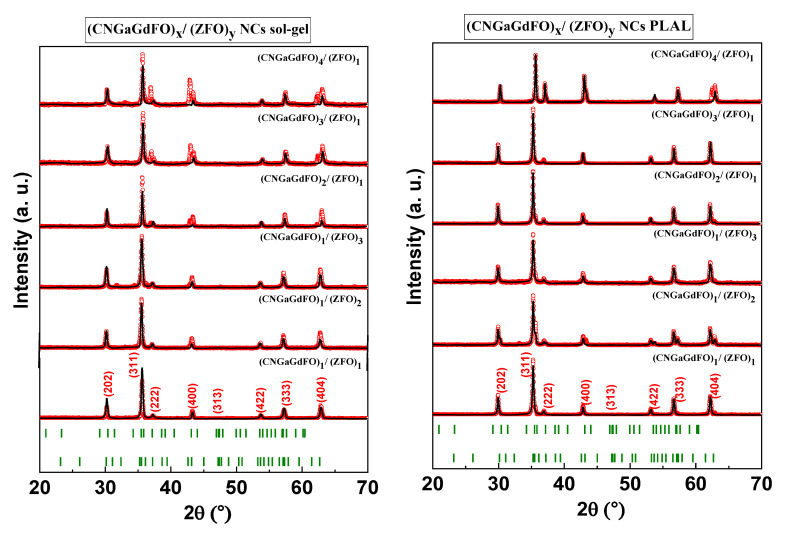
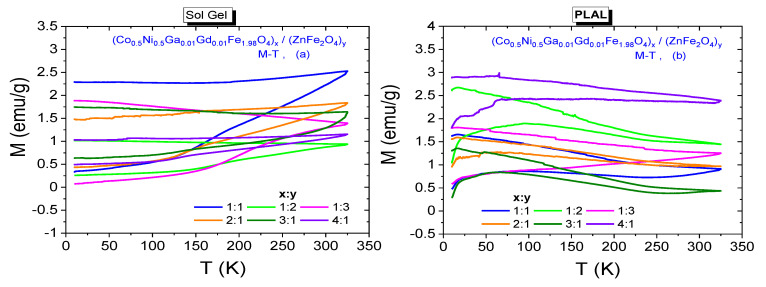
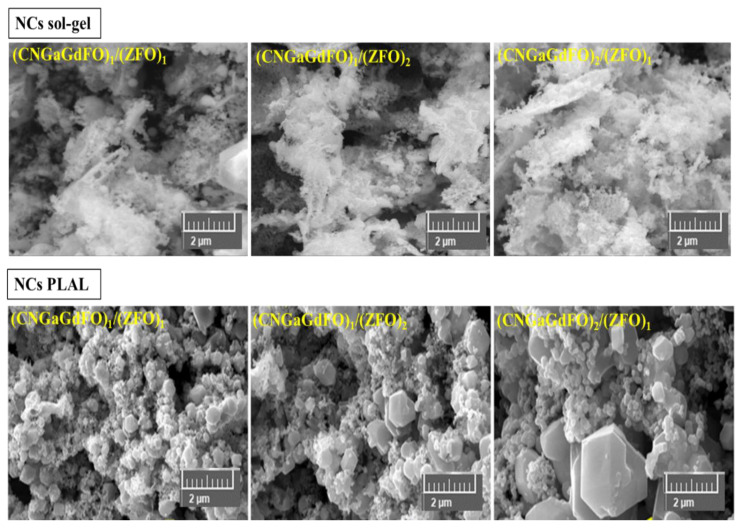
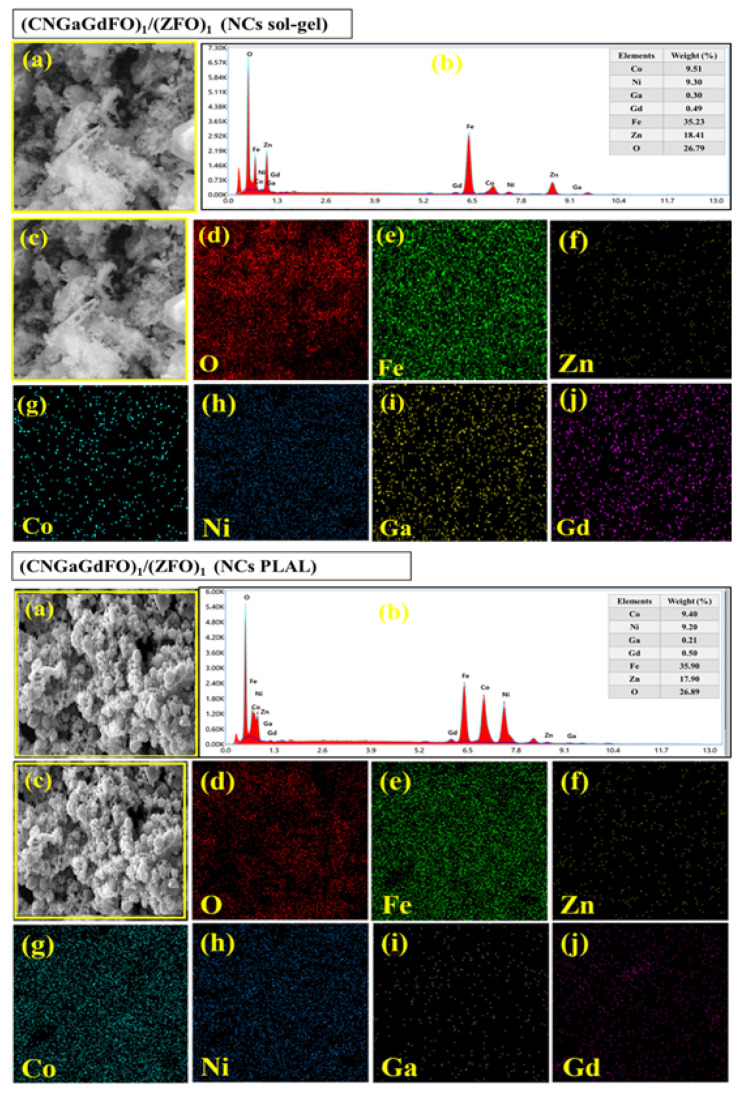
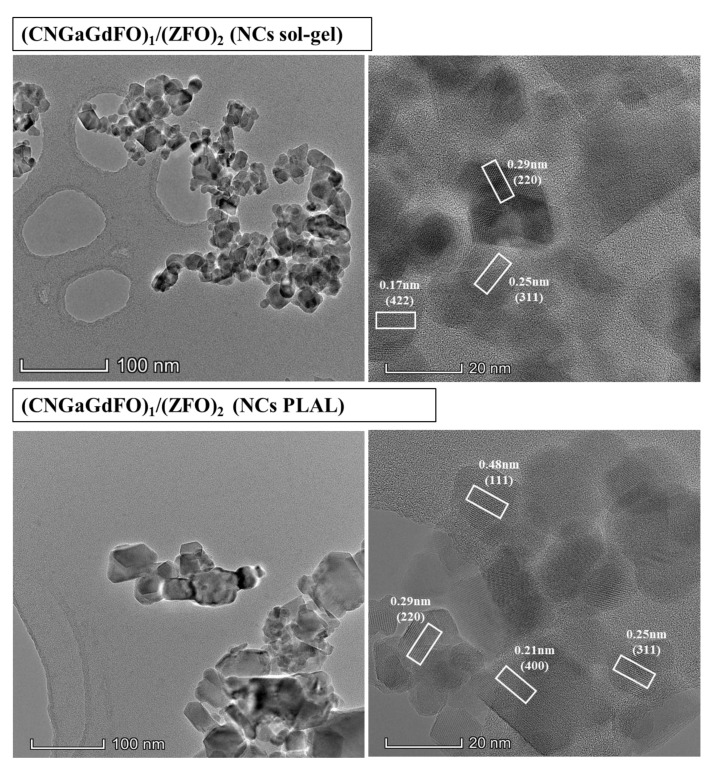
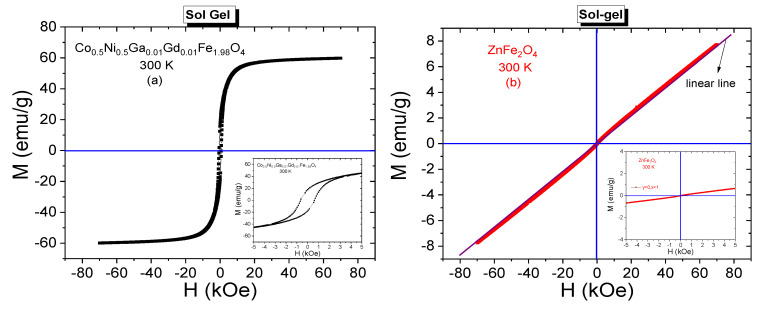
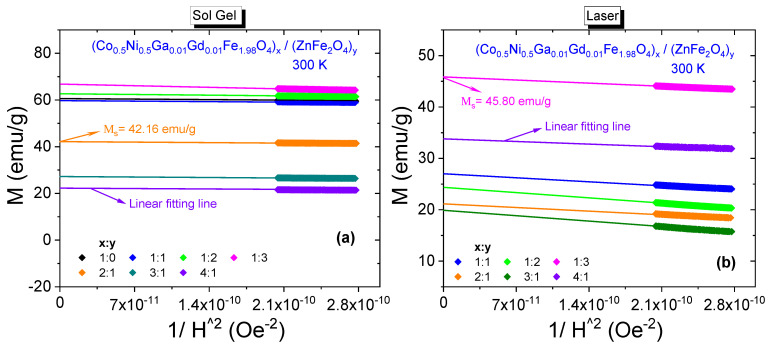
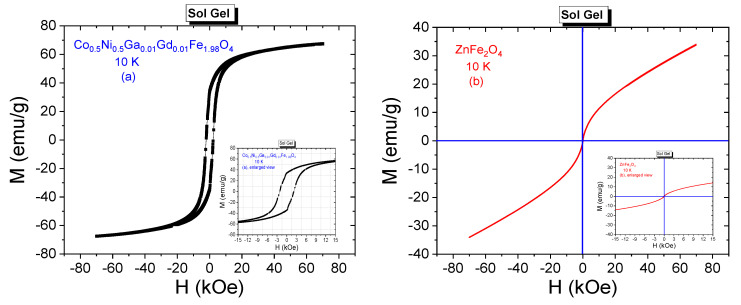
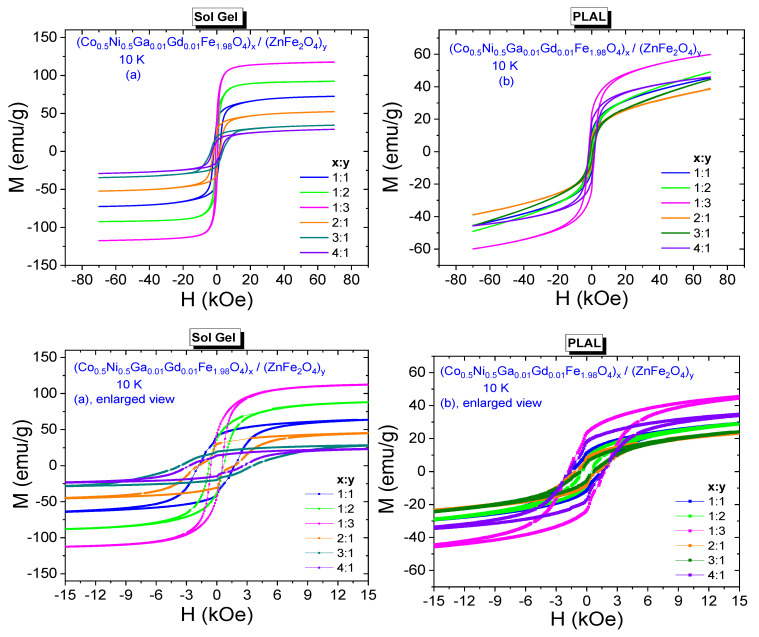
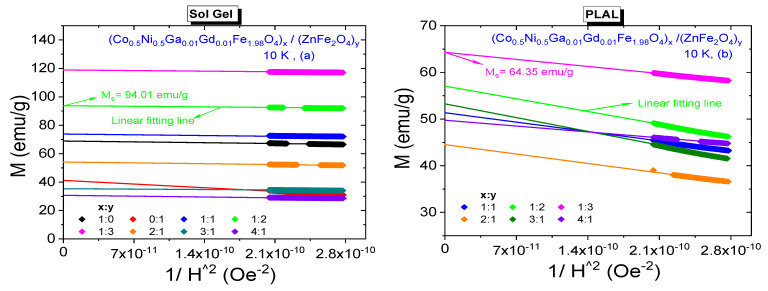
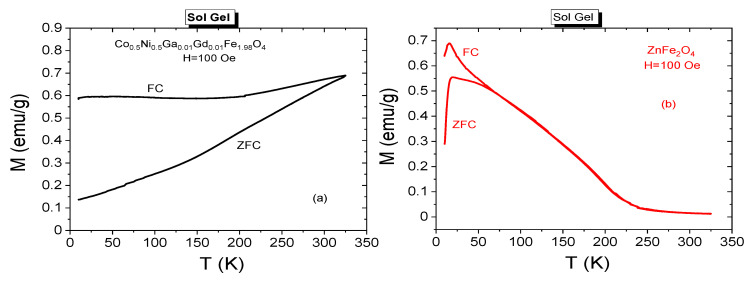
In this study, the samples of the ZnFeO (ZFO) spinel ferrites nanoparticles (SFNPs), CoNiGaGdFeO (CNGaGdFO) SFNPs and (CoNiGaGdFeO)/(ZnFeO) (: = 1:1, 1:2, 1:3, 2:1, 3:1 and 4:1) (CNGaGdFO)/(ZFO) spinel ferrite nanocomposites (NC) have been synthesized by both sol-gel and Green pulsed laser ablation in liquid (PLAL) approaches. All products were characterized by X-ray powder diffraction (XRD), scanning and transmission electron microscopies (SEM and TEM), elemental mappings and energy dispersive X-ray spectroscopy (EDX). It was objected to tune the magnetic properties of a soft spinel ferrite material with a softer one by mixing them with different fractions. Some key findings are as follows. M-H investigations revealed the exhibition of ferrimagnetic phases for all synthesized samples (except ZnFeO) that were synthesized by sol-gel or PLAL methods at both 300 K and 10 K. ZnFeO ferrite NPs exhibits almost paramagnetic feature at 300 K and glass-like phase at very low temperatures below 19.23 K. At RT analyses, maximum saturation magnetization () of 66.53 emu/g belongs to nanocomposite samples that was synthesized by sol-gel method and ratio of 1:3. At 10 K analyses, , = 118.71 emu/g belongs to same nanocomposite samples with ratio of 1:3. Maximum coercivities are 625 Oe belonging to CNGaGdFO and 3564 Oe belonging to NC sample that was obtained by sol-gel route having the 3:1 ratio. Squareness ratio (SQRs = /) of NC sample (sol-gel, 4:1 ratio) is 0.371 as maximum and other samples have much lower values until a minimum of 0.121 (laser, 3:1) assign the multi-domain wall structure for all samples at 300 K. At 10 K data, just CNGaGdFO has 0.495 SQR value assigning single domain nature. The maximum values of effective crystal anisotropy constant () are 5.92 × 10 Erg/g and 2.4 × 10 Erg/g belonging to CNGaGdFO at 300 K and 10 K, respectively. Further, this sample has an internal anisotropy field of 1953 Oe as largest at 300 K. At 10 K another sample (sol-gel, 3:1 ratio) has H of 11138 Oe which can also be classified as a soft magnetic material similar to other samples. Briefly, most magnetic parameters of NCs that were synthesized by sol-gel route are stronger than magnetic parameters of the NCs that were synthesized by PLAL at both temperatures. Some NC samples were observed to have stronger magnetic data as compared to magnetic parameters of CoNiGaGdFeO NPs at 10 K.
在本研究中,采用溶胶 - 凝胶法和液相绿色脉冲激光烧蚀(PLAL)法合成了ZnFeO(ZFO)尖晶石铁氧体纳米颗粒(SFNPs)、CoNiGaGdFeO(CNGaGdFO)SFNPs以及(CoNiGaGdFeO)/(ZnFeO)(:= 1:1、1:2、1:3、2:1、3:1和4:1)(CNGaGdFO)/(ZFO)尖晶石铁氧体纳米复合材料(NC)。所有产物均通过X射线粉末衍射(XRD)、扫描和透射电子显微镜(SEM和TEM)、元素映射以及能量色散X射线光谱(EDX)进行表征。目的是通过将软尖晶石铁氧体材料与不同比例的另一种软材料混合来调节其磁性能。一些关键发现如下。M - H研究表明,通过溶胶 - 凝胶法或PLAL法在300 K和10 K下合成的所有样品(除ZnFeO外)均呈现亚铁磁相。ZnFeO铁氧体纳米颗粒在300 K时表现出几乎顺磁特性,在低于19.23 K的极低温度下表现出类玻璃相。在室温分析中,溶胶 - 凝胶法合成的比例为1:3的纳米复合材料样品的最大饱和磁化强度()为66.53 emu/g。在10 K分析中,比例为1:3的同一纳米复合材料样品的,= 118.71 emu/g。最大矫顽力分别为属于CNGaGdFO的625 Oe和属于溶胶 - 凝胶法制备的比例为3:1的NC样品的3564 Oe。NC样品(溶胶 - 凝胶法,4:1比例)的方形度比(SQRs = /)最大为0.371,其他样品的值要低得多,最低为0.121(激光法,3:1),这表明所有样品在300 K时具有多畴壁结构。在10 K数据中,只有CNGaGdFO的SQR值为0.495,表明其为单畴性质。有效晶体各向异性常数()的最大值分别为300 K时属于CNGaGdFO的5.92×10 Erg/g和10 K时的2.4×10 Erg/g。此外,该样品在300 K时的内禀各向异性场最大为1953 Oe。在10 K时,另一个样品(溶胶 - 凝胶法,3:1比例)的H为11138 Oe,与其他样品一样也可归类为软磁材料。简而言之,在两个温度下,溶胶 - 凝胶法合成的NCs的大多数磁参数都比PLAL法合成的NCs的磁参数强。在10 K时,观察到一些NC样品的磁数据比CoNiGaGdFeO NPs的磁参数更强。