
扩展保护动机理论以解释台湾大学生接种新冠疫苗的意愿
Expanding Protection Motivation Theory to Explain Willingness of COVID-19 Vaccination Uptake among Taiwanese University Students.
作者信息
Huang Po-Ching, Hung Ching-Hsia, Kuo Yi-Jie, Chen Yu-Pin, Ahorsu Daniel Kwasi, Yen Cheng-Fang, Lin Chung-Ying, Griffiths Mark D, Pakpour Amir H
机构信息
Institute of Allied Health Sciences, College of Medicine, National Cheng Kung University, Tainan 701401, Taiwan.
Department of Physical Therapy, College of Medicine, National Cheng Kung University, Tainan 701401, Taiwan.
出版信息
Vaccines (Basel). 2021 Sep 19;9(9):1046. doi: 10.3390/vaccines9091046.
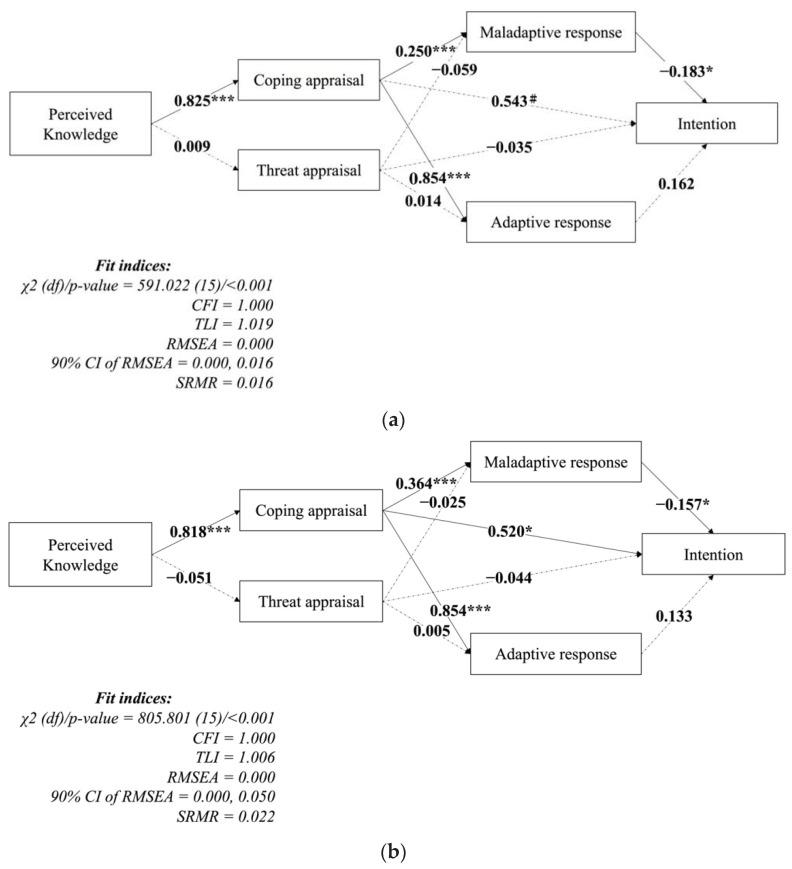
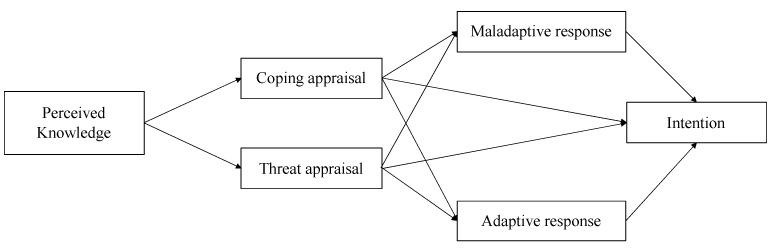
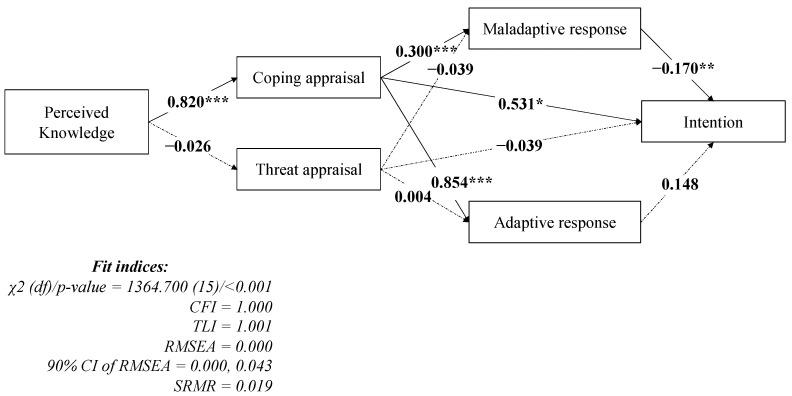
Vaccination appears to be one of the effective strategies to control the COVID-19 pandemic. However, the challenge of vaccine hesitancy may lower the uptake rate and affect overall vaccine efficacy. Being a low-risk group in terms of serious consequences of infection, university students may possess low motivation to get vaccinated. Therefore, an expanded Protection Motivation Theory (PMT) incorporating perceived knowledge, adaptive response, and maladaptive response was proposed to investigate the COVID-19 vaccination intention among Taiwanese university students. University students ( = 924; 575 males; mean age = 25.29 years) completed an online survey during January to February 2021. The proposed expanded PMT model was examined using structural equation modeling (SEM). The results showed that perceived knowledge was significantly associated with coping appraisal (standardized coefficient (β) = 0.820; < 0.001), and coping appraisal was significantly associated with adaptive response (β = 0.852; < 0.001), maladaptive response (β = 0.300; < 0.001) and intention (β = 0.533; = 0.009). Moreover, maladaptive response (β = -0.173; = 0.001) but not adaptive response (β = 0.148; = 0.482) was significantly and negatively associated with intention. The present study's results demonstrated a positive path between perceived knowledge, coping appraisal, and intention among university students. Therefore, improving knowledge among this population may increase the intention to uptake the vaccine.
接种疫苗似乎是控制新冠疫情的有效策略之一。然而,疫苗犹豫这一挑战可能会降低接种率并影响整体疫苗效果。大学生作为感染严重后果方面的低风险群体,接种疫苗的积极性可能较低。因此,提出了一个扩展的保护动机理论(PMT),该理论纳入了感知知识、适应性反应和适应不良反应,以调查台湾大学生的新冠疫苗接种意愿。大学生(n = 924;575名男性;平均年龄 = 25.29岁)于2021年1月至2月期间完成了一项在线调查。使用结构方程模型(SEM)对提出的扩展PMT模型进行了检验。结果表明,感知知识与应对评估显著相关(标准化系数(β) = 0.820;p < 0.001),应对评估与适应性反应(β = 0.852;p < 0.001)、适应不良反应(β = 0.300;p < 0.001)和意愿(β = 0.533;p = 0.009)显著相关。此外,适应不良反应(β = -0.173;p = 0.001)而非适应性反应(β = 0.148;p = 0.482)与意愿显著负相关。本研究结果表明了大学生在感知知识、应对评估和意愿之间存在积极的路径。因此,提高这一群体的知识水平可能会增加接种疫苗的意愿。
 Zotero 插件