Key Laboratory of Environmental Medicine Engineering, Ministry of Education School of Public Health Southeast University Nanjing, PR China.
Department of Epidemiology and Health Statistics, School of Public Health, Southeast University Nanjing, PR China.
Hum Vaccin Immunother. 2022 Dec 31;18(1):2026136. doi: 10.1080/21645515.2022.2026136. Epub 2022 Feb 1.
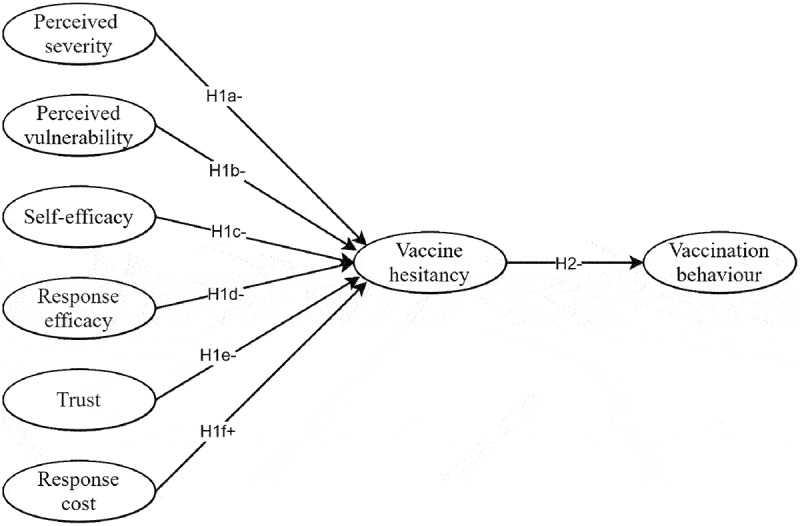
Vaccine hesitancy was listed as one of the top 10 issues threatening global health in 2019. The objectives of this study were to (a) use an extended protection motivation theory (PMT) with an added trust component to identify predictors of vaccine hesitancy and (b) explore the predictive ability of vaccine hesitancy on vaccination behavior.
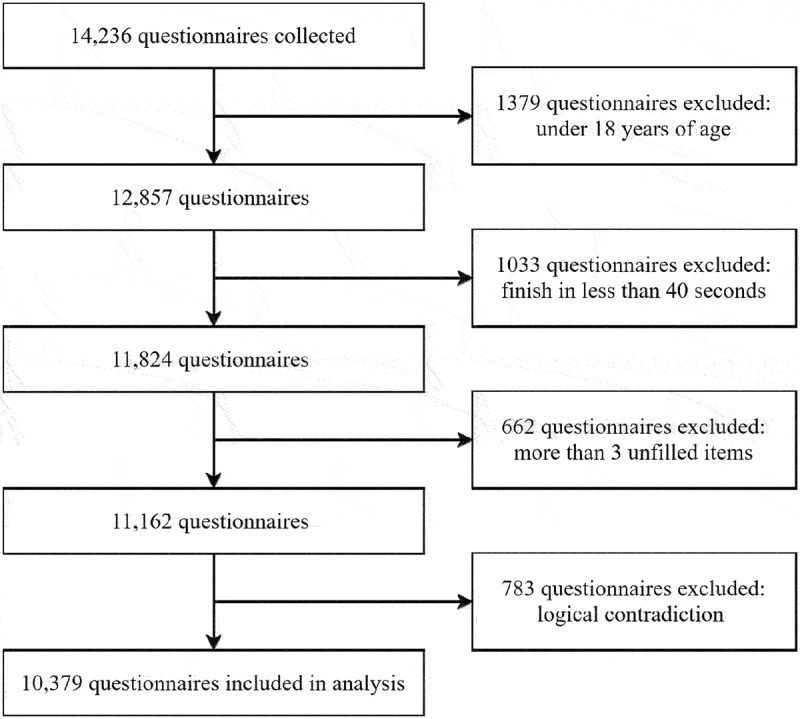
We conducted an online questionnaire from February 9 to April 9, 2021, in China. The target population was Chinese residents aged 18 and over. A total of 14,236 responses were received. Structural equation modeling was used to test the extended PMT model hypotheses.
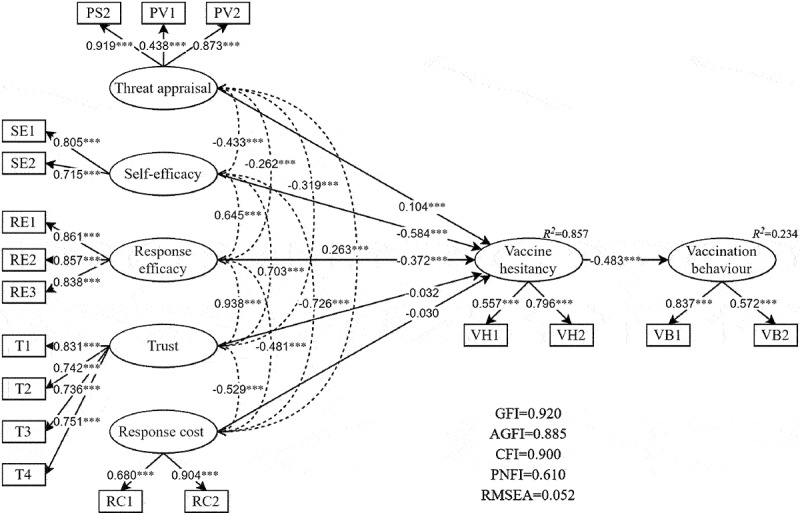
A total of 10,379 participants were finally included in this study, of whom 52.0% showed hesitancy toward vaccination. 2854 (27.5%) participants reported that they got flu shots in the past year, and 2561 (24.7%) participants were vaccinated against COVID-19. 2857 (27.5%) participants engaged in healthcare occupation. The model explained 85.7% variance of vaccine hesitancy. Self-efficacy was the strongest predictor, negatively associated with vaccine hesitancy (= -0.584; < .001). Response efficacy had a negative effect on vaccine hesitancy (= -0.372; < .001), while threat appraisal showed a positive effect (= 0.104; < .001). Compared with non-health workers, health workers showed more vaccine hesitancy, and response efficacy was the strongest predictor (= -0.560; < .001). Vaccine hesitancy had a negative effect on vaccination behavior (= -0.483; < .001), and the model explained 23.4% variance of vaccination behavior.
This study demonstrates that the extended PMT model is efficient in explaining vaccine hesitancy. However, the predictive ability of vaccine hesitancy on vaccination behavior is limited.
疫苗犹豫被列为 2019 年威胁全球健康的十大问题之一。本研究的目的是(a)使用扩展的保护动机理论(PMT)并加入信任因素来确定疫苗犹豫的预测因素,以及(b)探讨疫苗犹豫对疫苗接种行为的预测能力。
我们于 2021 年 2 月 9 日至 4 月 9 日在中国进行了一项在线问卷调查。目标人群为年龄在 18 岁及以上的中国居民。共收到 14236 份回复。结构方程模型用于检验扩展 PMT 模型假设。
最终共有 10379 名参与者纳入本研究,其中 52.0%的人对疫苗接种犹豫不决。2854 名(27.5%)参与者报告在过去一年中接种了流感疫苗,2561 名(24.7%)参与者接种了 COVID-19 疫苗。2857 名(27.5%)参与者从事医疗保健职业。该模型解释了 85.7%的疫苗犹豫方差。自我效能感是最强的预测因素,与疫苗犹豫呈负相关(= -0.584;<.001)。结果效价对疫苗犹豫有负向影响(= -0.372;<.001),而威胁评估则表现出正向影响(= 0.104;<.001)。与非卫生工作者相比,卫生工作者表现出更高的疫苗犹豫,而结果效价是最强的预测因素(= -0.560;<.001)。疫苗犹豫对疫苗接种行为有负向影响(= -0.483;<.001),该模型解释了 23.4%的疫苗接种行为方差。
本研究表明,扩展的 PMT 模型在解释疫苗犹豫方面是有效的。然而,疫苗犹豫对疫苗接种行为的预测能力有限。