Division of Population Health, Health Services Research and Primary Care, Faculty of Biology, Medicine and Health, University of Manchester, Manchester Academic Health Science Centre (MAHSC), Oxford Road, Manchester, M139PL, UK.
Clinical Research Unit of Nanoro, (IRSS-URCN), B.P.218, Ouagadougou, 11, Burkina Faso.
BMC Public Health. 2021 Sep 27;21(1):1764. doi: 10.1186/s12889-021-11819-0.
Adolescents are considered at high risk of developing iron deficiency. Studies in children indicate that the prevalence of iron deficiency increased with malaria transmission, suggesting malaria seasonally may drive iron deficiency. This paper examines monthly seasonal infection patterns of malaria, abnormal vaginal flora, chorioamnionitis, antibiotic and antimalarial prescriptions, in relation to changes in iron biomarkers and nutritional indices in adolescents living in a rural area of Burkina Faso, in order to assess the requirement for seasonal infection control and nutrition interventions.
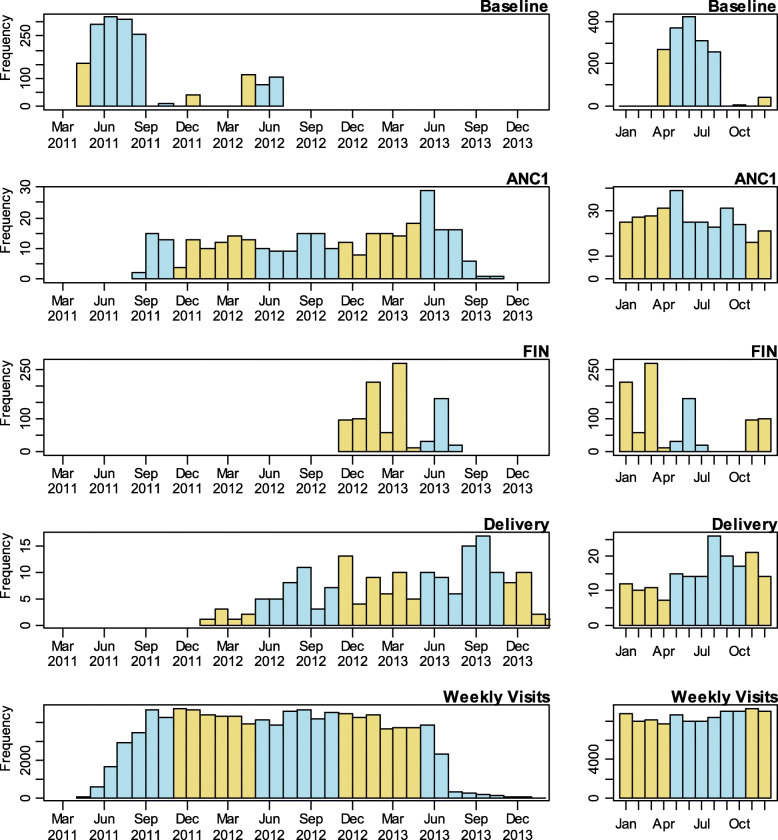
Data collected between April 2011 and January 2014 were available for an observational seasonal analysis, comprising scheduled visits for 1949 non-pregnant adolescents (≤19 years), (315 of whom subsequently became pregnant), enrolled in a randomised trial of periconceptional iron supplementation. Data from trial arms were combined. Body Iron Stores (BIS) were calculated using an internal regression for ferritin to allow for inflammation. At recruitment 11% had low BIS (< 0 mg/kg). Continuous outcomes were fitted to a mixed-effects linear model with month, age and pregnancy status as fixed effect covariates and woman as a random effect. Dichotomous infection outcomes were fitted with analogous logistic regression models.
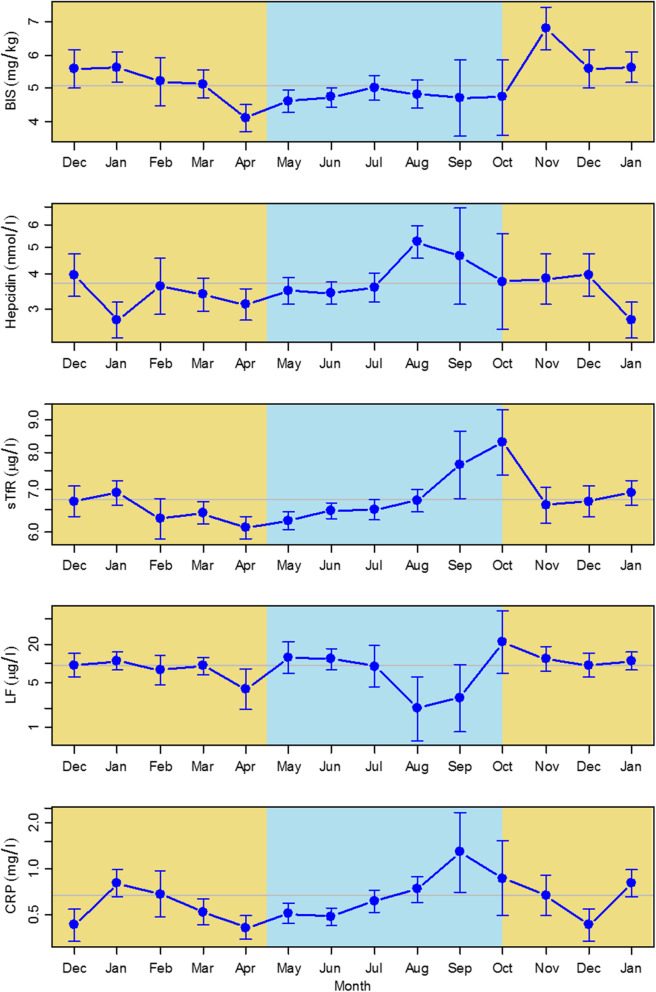
Seasonal variation in malaria parasitaemia prevalence ranged between 18 and 70% in non-pregnant adolescents (P < 0.001), peaking at 81% in those who became pregnant. Seasonal variation occurred in antibiotic prescription rates (0.7-1.8 prescriptions/100 weekly visits, P < 0.001) and chorioamnionitis prevalence (range 15-68%, P = 0.026). Mucosal vaginal lactoferrin concentration was lower at the end of the wet season (range 2-22 μg/ml, P < 0.016), when chorioamnionitis was least frequent. BIS fluctuated annually by up to 53.2% per year around the mean BIS (5.1 mg/kg, range 4.1-6.8 mg/kg), with low BIS (< 0 mg/kg) of 8.7% in the dry and 9.8% in the wet seasons (P = 0.36). Median serum transferrin receptor increased during the wet season (P < 0.001). Higher hepcidin concentration in the wet season corresponded with rising malaria prevalence and use of prescriptions, but with no change in BIS. Mean Body Mass Index and Mid-Upper-Arm-Circumference values peaked mid-dry season (both P < 0.001).
Our analysis supports preventive treatment of malaria among adolescents 15-19 years to decrease their disease burden, especially asymptomatic malaria. As BIS were adequate in most adolescents despite seasonal malaria, a requirement for programmatic iron supplementation was not substantiated.
青少年被认为处于缺铁的高风险之中。儿童研究表明,缺铁的患病率随着疟疾传播而增加,这表明疟疾可能季节性地导致缺铁。本文研究了布基纳法索农村地区青少年的每月季节性感染模式、异常阴道菌群、绒毛膜羊膜炎、抗生素和抗疟药物处方,以及与铁生物标志物和营养指数变化的关系,以评估季节性感染控制和营养干预的需求。
2011 年 4 月至 2014 年 1 月期间收集的数据可用于观察性季节性分析,包括对 1949 名非孕妇青少年(≤19 岁)进行的定期访问(其中 315 名随后怀孕),他们参加了一项围孕期铁补充剂的随机试验。试验臂的数据合并在一起。采用内部铁蛋白回归计算体铁储存量(BIS),以允许炎症。招募时,11%的青少年(BIS<0 毫克/公斤)有低 BIS。连续结局采用混合效应线性模型拟合,以月份、年龄和妊娠状态为固定效应协变量,以女性为随机效应。二分类感染结局采用类似的逻辑回归模型拟合。
非孕妇青少年中疟疾寄生虫血症患病率的季节性变化范围为 18%至 70%(P<0.001),在怀孕的青少年中患病率最高,达到 81%。抗生素处方率(0.7-1.8 份/100 周就诊,P<0.001)和绒毛膜羊膜炎患病率(15-68%,P=0.026)也存在季节性变化。在湿季末,阴道黏膜乳铁蛋白浓度较低(2-22 微克/毫升,P<0.016),此时绒毛膜羊膜炎最不常见。BIS 每年波动幅度可达平均 BIS(5.1 毫克/公斤,范围 4.1-6.8 毫克/公斤)的 53.2%,干季的低 BIS(<0 毫克/公斤)为 8.7%,湿季为 9.8%(P=0.36)。血清转铁蛋白受体在湿季升高(P<0.001)。湿季较高的铁调素浓度与疟疾流行率和处方使用的上升相对应,但 BIS 没有变化。平均体重指数和中臂围在干季中期达到峰值(均 P<0.001)。
我们的分析支持对 15-19 岁青少年进行预防性治疗疟疾,以减轻他们的疾病负担,特别是无症状疟疾。尽管大多数青少年的 BIS 在季节性疟疾期间都充足,但并未证实需要进行方案性铁补充。