Department for Infectious Diseases, Parasitology, University Hospital Heidelberg, Im Neuenheimer Feld 324, Heidelberg 69120, Germany.
Malar J. 2013 Jan 22;12:27. doi: 10.1186/1475-2875-12-27.
Malaria transmission was reported to have declined in some East African countries. However, a comparable trend has not been confirmed for West Africa. This study aims to assess the dynamics of parasite prevalence and malaria species distribution over time in an area of highly seasonal transmission in Burkina Faso. The aim was also to compare frequency of asymptomatic parasitaemia between wet and dry season by parasite density status and age group.
During the years 2009-2012, six cross-sectional studies were performed in the rural village Bourasso in the Nouna Health District in north-west Burkina Faso. In subsequent rainy and dry seasons blood samples were collected to assess the parasite prevalence, species, density and clinical parameters. In total, 1,767 children and adults were examined and compared to a baseline collected in 2000.
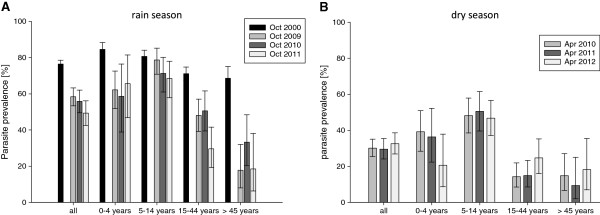
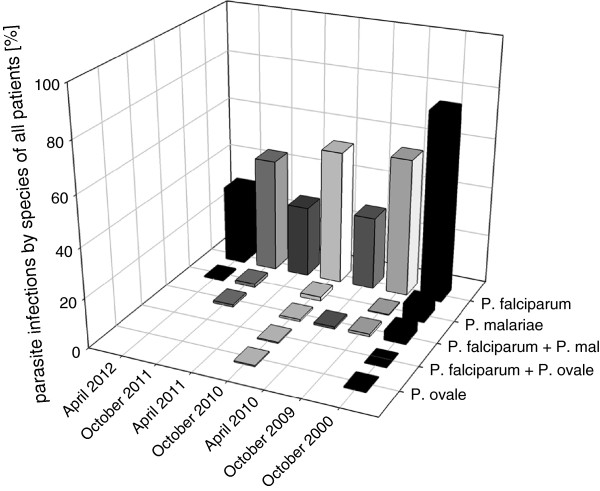
The microscopical parasite prevalence (mainly P. falciparum) measured over the rainy seasons decreased significantly from 78.9% (2000) to 58.4%, 55.9% and 49.3%, respectively (2009-2011; p <0.001). The frequency of Plasmodium malariae infections (mono- and co-infections) decreased parallel to the overall parasite prevalence from 13.4% in 2000 to 2.1%, 4.1% and 4.7% in 2009-2011 (p <0.001). Comparing parasite-positive subjects from the rainy season versus dry season, the risk of fever was significantly reduced in the dry season adjusting for parasite density (grouped) and age group.
The results of this study suggest a decline of malaria transmission over the rainy seasons between 2000 and 2009-2011 in the region of Nouna, Burkina Faso. The decreased transmission intensity was associated with lower prevalence of P. malariae infections (both mono-infections and co-infections). Asymptomatic parasitaemia was more frequent in the dry season even adjusting for parasite density and age group in a multivariate regression. Possible reasons for this observation include the existence of less pathogenic Plasmodium falciparum genotypes prevailing in the dry season, or the effect of a reduced incidence density during the dry season.
据报道,东非一些国家的疟疾传播有所下降。然而,在西非尚未证实这一趋势。本研究旨在评估布基纳法索一个高度季节性传播地区寄生虫流行率和疟疾种类分布随时间的变化情况。本研究还旨在通过寄生虫密度和年龄组比较干湿两季无症状寄生虫血症的频率。
2009-2012 年期间,在布基纳法索西北部努纳区 Bourasso 农村进行了六项横断面研究。随后在雨季和旱季采集血样,以评估寄生虫流行率、种类、密度和临床参数。共检查了 1767 名儿童和成年人,并与 2000 年基线进行了比较。
在雨季,显微镜下寄生虫(主要是恶性疟原虫)流行率从 2000 年的 78.9%显著下降至 2009-2011 年的 58.4%、55.9%和 49.3%(p<0.001)。疟原虫感染(单一和混合感染)的频率与寄生虫总流行率平行下降,从 2000 年的 13.4%降至 2009-2011 年的 2.1%、4.1%和 4.7%(p<0.001)。比较雨季和旱季寄生虫阳性者,调整寄生虫密度(分组)和年龄组后,旱季发热风险显著降低。
本研究结果表明,2000 年至 2009-2011 年期间,布基纳法索努纳地区雨季疟疾传播有所下降。这种传播强度的降低与疟原虫感染(包括单一感染和混合感染)的流行率降低有关。即使在多元回归中调整寄生虫密度和年龄组,旱季无症状寄生虫血症也更为常见。这种观察结果的可能原因包括在旱季流行更具致病性的恶性疟原虫基因型,或在旱季发病率降低的影响。